"...on Sunday afternoons we had to study The Westminster Shorter Catechism for an hour and then recite before we could walk the hills with him while he unwound between services. But he never asked us more than the first question in the catechism, 'What is the chief end of man?' And we answered together so one of us could carry on if the other forgot, 'Man's chief end is to glorify God, and to enjoy Him forever.' This always seemed to satisfy him, as indeed such a beautiful answer should have..."
In our recent paper, https://t.co/TULfZsW8ZN, @maxisi, @farrwill, and I looked to see if we can see hints of memory in the whole population of gravitational wave signals observed by the LIGO-Virgo-KAGRA detectors using a fancy technique known as "hierarchical inference". 6/13
In which I make the case that Miller Lite is the anecdote to the decadence of a professional class that constantly chases novel gustatory experiences and has come to confuse this empty, hedonistic quest with being cultured.
https://t.co/Q3cFfTQxvD
Tell me about a polytropic star
Muse, tell me how its equation was solved,
How pressure varied as density’s power,
And how it wrecked the life of students, poor fools
Today in "Will explains things to people who have a vested interest in not understanding them," let's talk about INSPRE-HEP. 1/
https://t.co/PDJHAMDX4C
Every research group should have:
—a DPS (the one who maximises publication output)
—a healer (the grant whisperer and diplomat)
—a tank (the one who deals with administration and bureaucracy)
Endorse. Recently I had it inform me that in some parts of a paper I used w and other parts \omega for the same quantity... These are the things my eyes will never catch 😅
So let's talk about this paper. For those not in the field, this is a "white paper," which is a planning document intended to convey a community position on future research priorities, in this case a satellite mission to look for gravitational waves from inflation. These are used e.g. by grant agencies to decide broad funding priorities. It is in part a literature review, so in that role it has a very broad reference list. It is intended to reflect community consensus, and is produced as a product of broad-based discussion, in this case a working group as part of a larger design study. As such, they tend to be widely cited.
It was WRITTEN by just two people: Dan Baumann @DD_Baumann and Mark Jackson. You can tell this because they are listed first, out of alphabetical order, and have emails listed as corresponding authors. The rest of the author list, appearing in alphabetical order, are "endorsers": people from the larger community who were not involved in preparation of the manuscript, but who agreed to be listed as an indication that they support the priorities outlined in the white paper. I am on there, as are many of my colleagues. Yes, I read the paper before I signed on. Given that this was 2008, and LLM slop did not exist, I did not check every reference. If you dig through my publication list, I am on several such white papers. I have no reason to believe that any cointain academic misconduct of any kind.
This is an excellent white paper, and the reference list is quite a comprehensive look at the state of the field at the time; Dan and Mark did a great job on it. The work is a fine example of science done well. It's rigorous, thorough, and deep.
In 2026, would I approach such a manuscript the same way I did in 2008? Almost certainly not. The "authors as endorsers" model for white papers has always been problematic, precisely because it blurs the two roles. But has long been an established practice that for the most part does its intended job well enough. I think with the rise of LLM-generated content, we will probably have to re-think a lot of established practices like this; in the case of white papers, it would be easy to delineate more clearly between author and endorser. It's already implicit, and well-undsertood by the intended audience of the document. People outside the field, however, might miss the distinction.
https://t.co/bjGP6HTZWU
Finished my 10th and final board meeting at @QuantaMagazine. (It’s time to step down and give someone else a turn…) So amazed by how far they’ve come and all they’ve achieved over that decade (and humbled to have played some tiny role). Can’t wait to see what they do next!
When will an oblong matter cloud of arbitrary shape collapse to form a black hole? The only answer known in the early 1900s was when the cloud was perfectly spherical. In 1972, Kip Thorne conjectured an answer for general shape, called the Hoop conjecture. 1/n
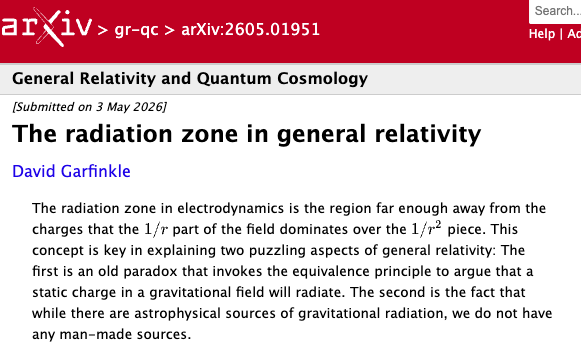
"Why doesn't a charge sitting still on the surface of Earth radiate" has many good answers but this paper is my new favorite.
If the earth was big enough that the radiation zone of the charge was within the "approximately flat" local region, the earth would be a black hole 😎
New toddler activity unlocked though: watching me send an email followed by space pictures (have to be real space pictures though: plots of \chi_eff distributions don’t cut it, nor do schematics of coordinate systems for compact binary systems).
Also, in LCDM cosmology, we are at the center of a big sphere, where the edge of the sphere is the Big Bang. Objects moving with respect to the reference frame at rest relative to this sphere slow to a stop with time.
@WKCosmo I imagine you have watched this clip that circulates from time to time, but if not, I recommend it for whomever you are subtweeting (and you, and everyone!): https://t.co/qDCWuJRDJT
For all three people in the SLC area that follow me, I'll be giving a talk about my work on NASA's Kepler mission at the Clark Planetarium at the end of the summer.
https://t.co/OJxedEm7sA
After much blood, sweat, and tears, our review on Love numbers is now online!
We aimed to be both pedagogical and comprehensive, to make this a resource for researchers in any subfield at any level. Comments are very much welcome.
https://t.co/YtmzVGCQoF
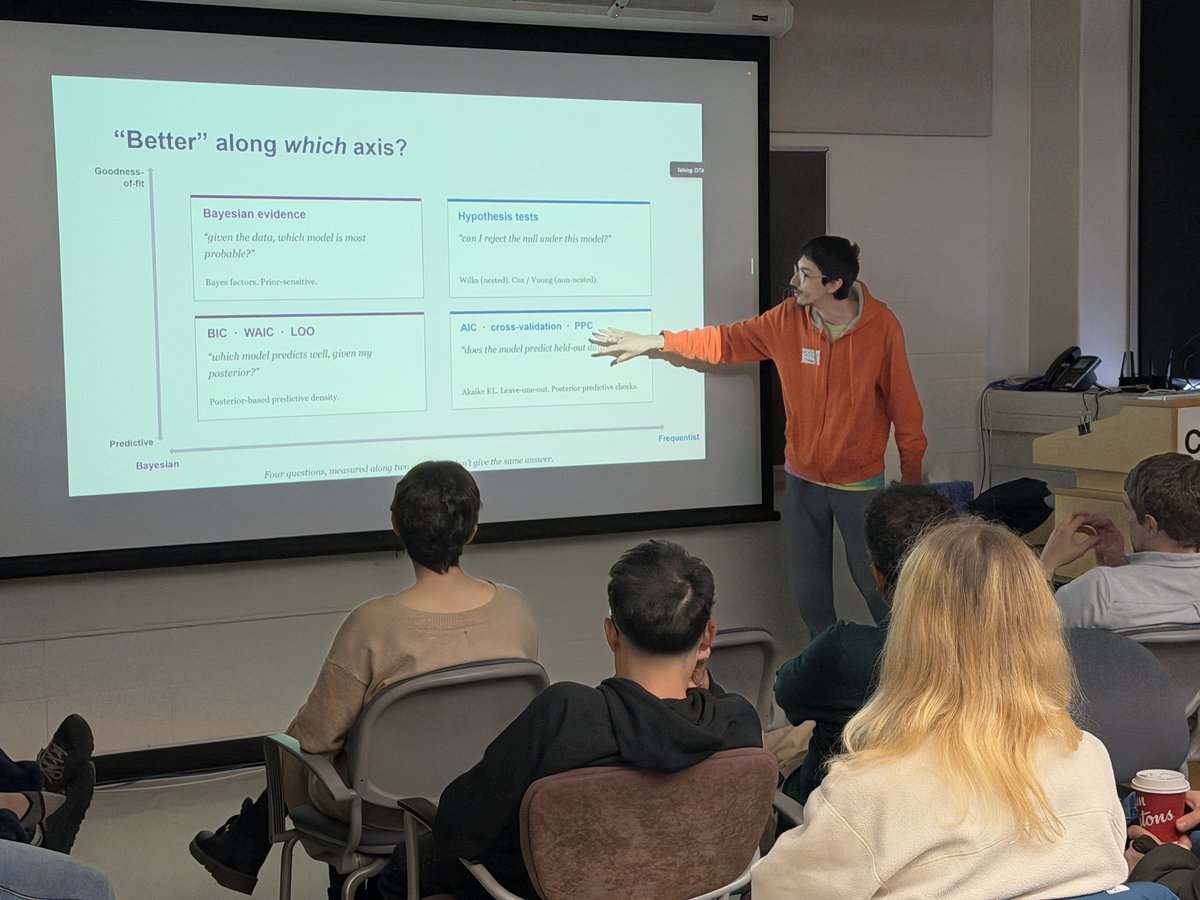
The "GWTC-6: The Bleeding Edge of Gravitational-Wave Populations" workshop at @CITA_ICAT has brought GW research forward! Thank you to all the researchers who came from around the world and the organizers PDF Amanda Farah, @alsogoesbyV, @mayaKfish, @thisaintessic.