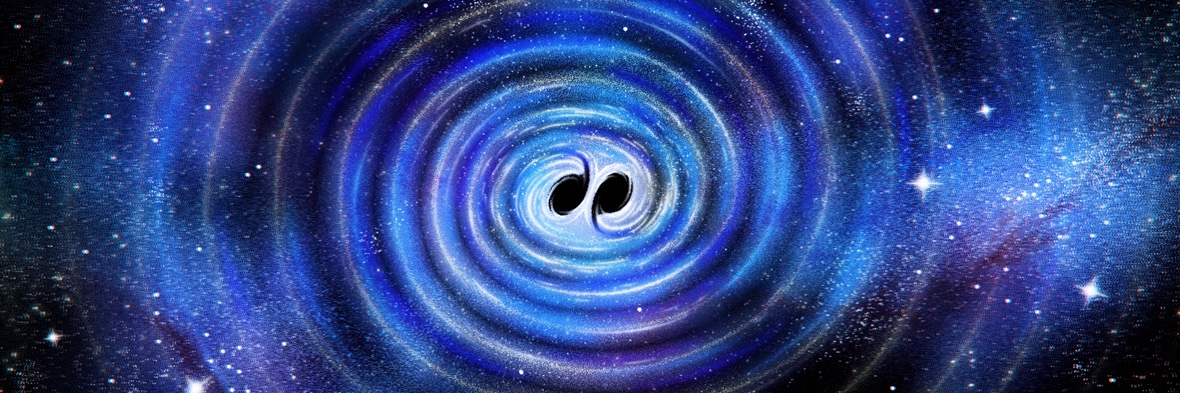
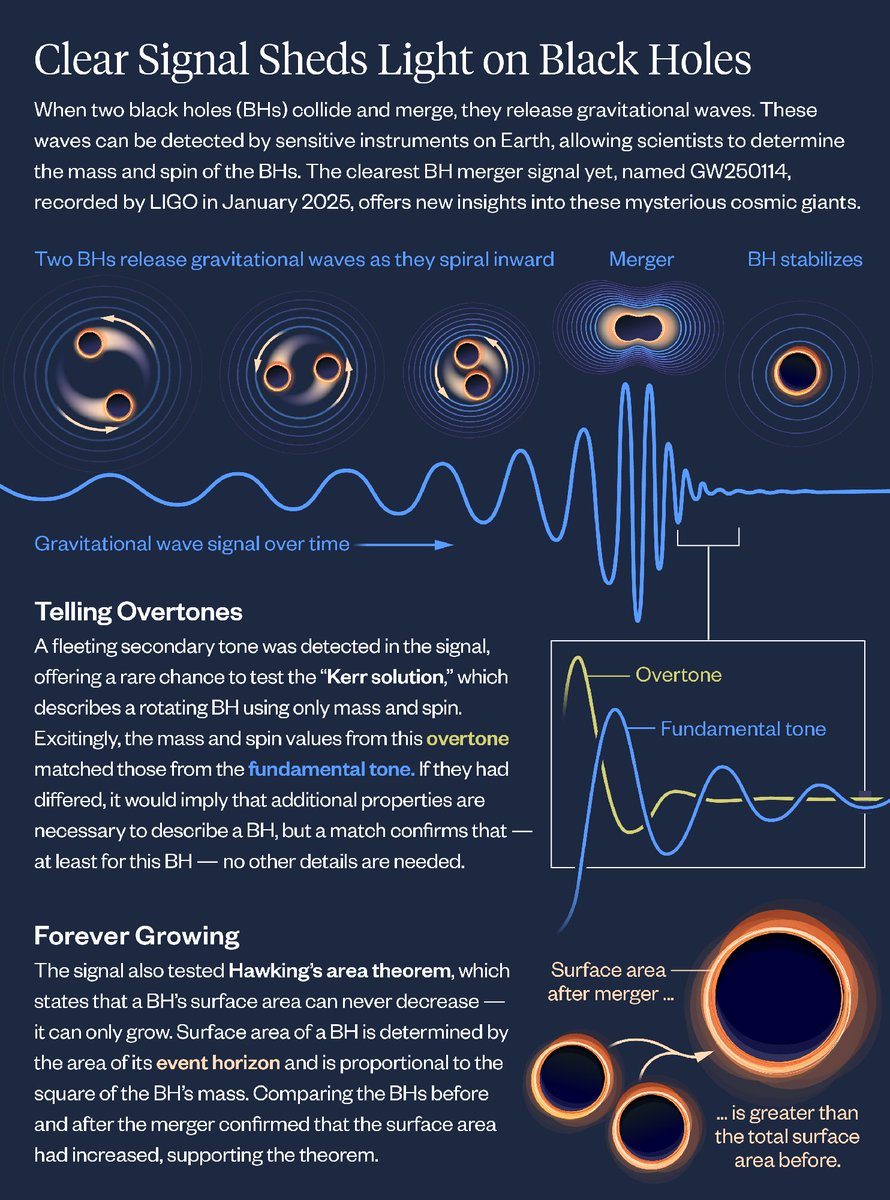
Meet GW250114, a landmark detection of gravitational waves that gives us an unprecedented view of the nature of black holes and the nature of space and time, as predicted by Einstein, Hawking and many others.
https://t.co/SKX3epZYmQ
A collaboration between physicists at Caltech and other institutions has released an expanded and refined catalog of simulations of black hole mergers.
https://t.co/XMwMLswNYr
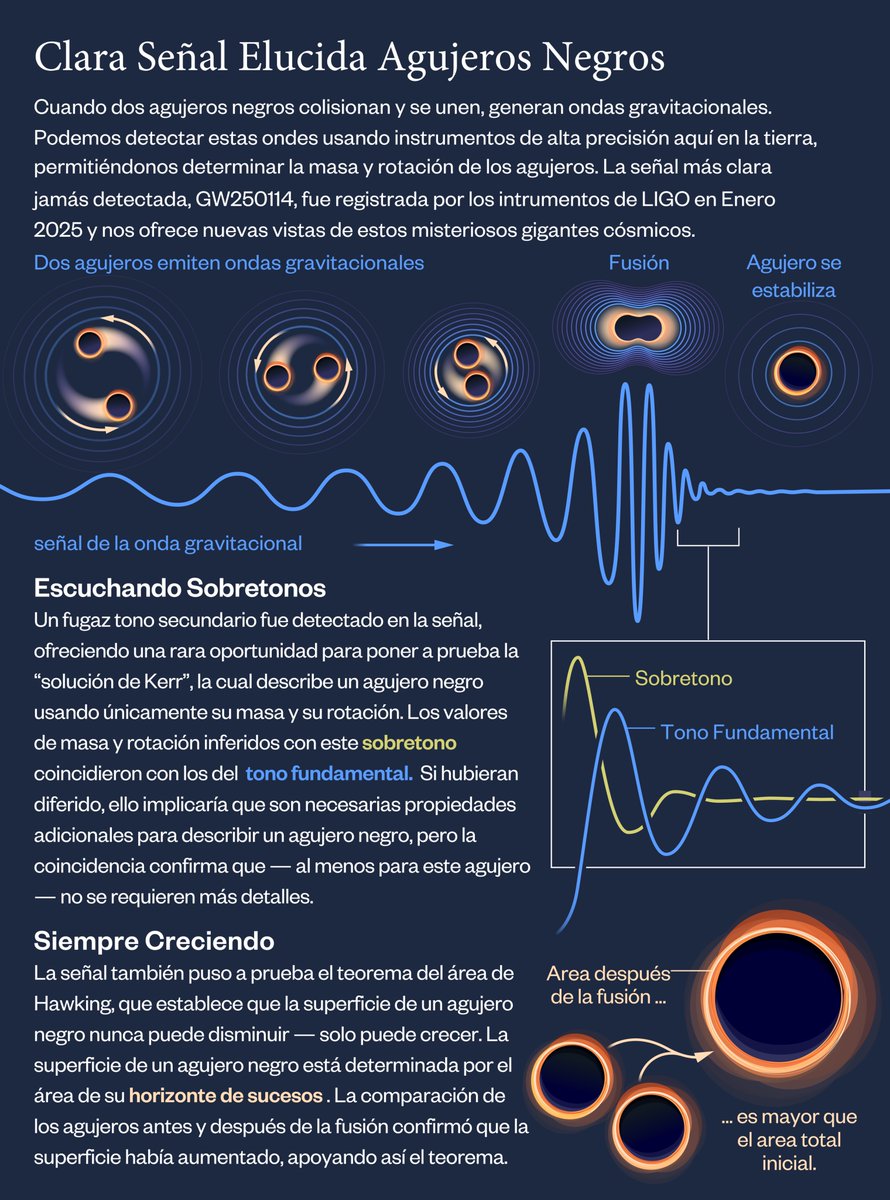
Hoy presentamos la señal más clara de una colisión de agujeros negros. Las ondas gravitacionales detectadas por @LIGO nos permiten poner a prueba nuestro entendimiento de los agujeros negros y el espacio-tiempo curvo, según Einstein y Hawking. Solo es posible gracias a la mejora de nuestros instrumentos en los 10 años desde nuestra primera detección!
Imagen: L. Reading-Ikkanda/M. Isi/Simons Foundation
#GW2501014 #OndasGravitacionales #Einstein #Hawking #LIGO
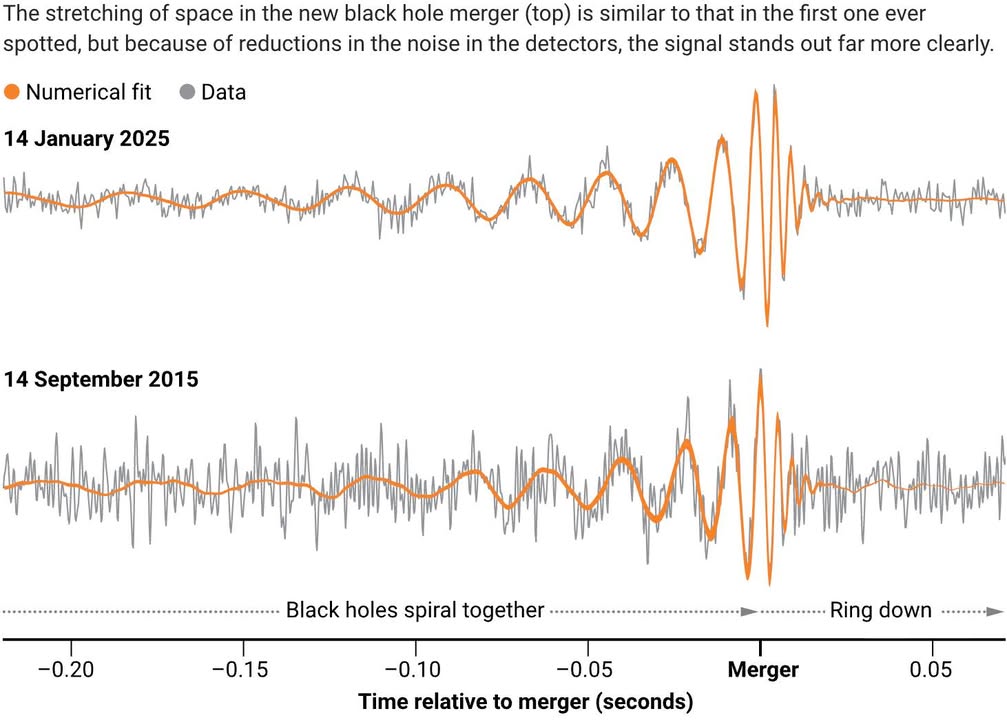
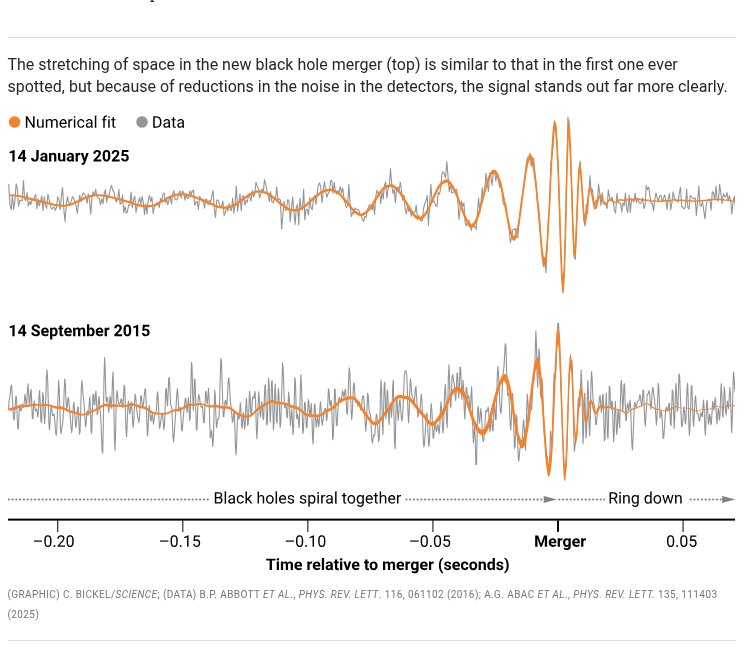
Thanks to improved technology and a bit of luck, a newly detected black hole merger is providing the clearest evidence yet of how black holes work: https://t.co/1maKtyYcja #science#astrophysics
Almost 10 years after the first detection of gravitational waves, physicists have announced the strongest such signal yet.
Produced when two black holes in a distant galaxy spiraled into each other, the merger enabled researchers to test Albert Einstein’s theory of gravity, general relativity, in new ways. In particular, analysis of the event confirmed a theorem derived by Stephen Hawking that a black hole’s surface area can only grow and never shrink: https://t.co/eydbtvLHqO
Meet GW250114, a landmark detection of gravitational waves that gives us an unprecedented view of the nature of black holes and the nature of space and time, as predicted by Einstein, Hawking and many others.
https://t.co/SKX3epZYmQ
Black holes can ring, and we think those vibrations hold clues to the mysteries of space and time. Learn about the latest @LIGO recordings of these fleeting black hole tunes https://t.co/f3YedA4koa
#FlatironCCA astrophysicist Maximiliano Isi and colleagues have used measurements from @LIGO to reveal insights into the properties of black holes and the fundamental nature of space-time, hinting at how quantum physics and Einstein’s general relativity fit together: https://t.co/BsVZ6as1rT @FlatironInst #science #astrophysics
Our Center for Computational Astrophysics is #hiring postdocs! Come undertake independent research in areas that have strong synergy with #FlatironCCA or our other computational centers. Apply by 10/31: https://t.co/yv3RWpxPTH #science#astrophysics
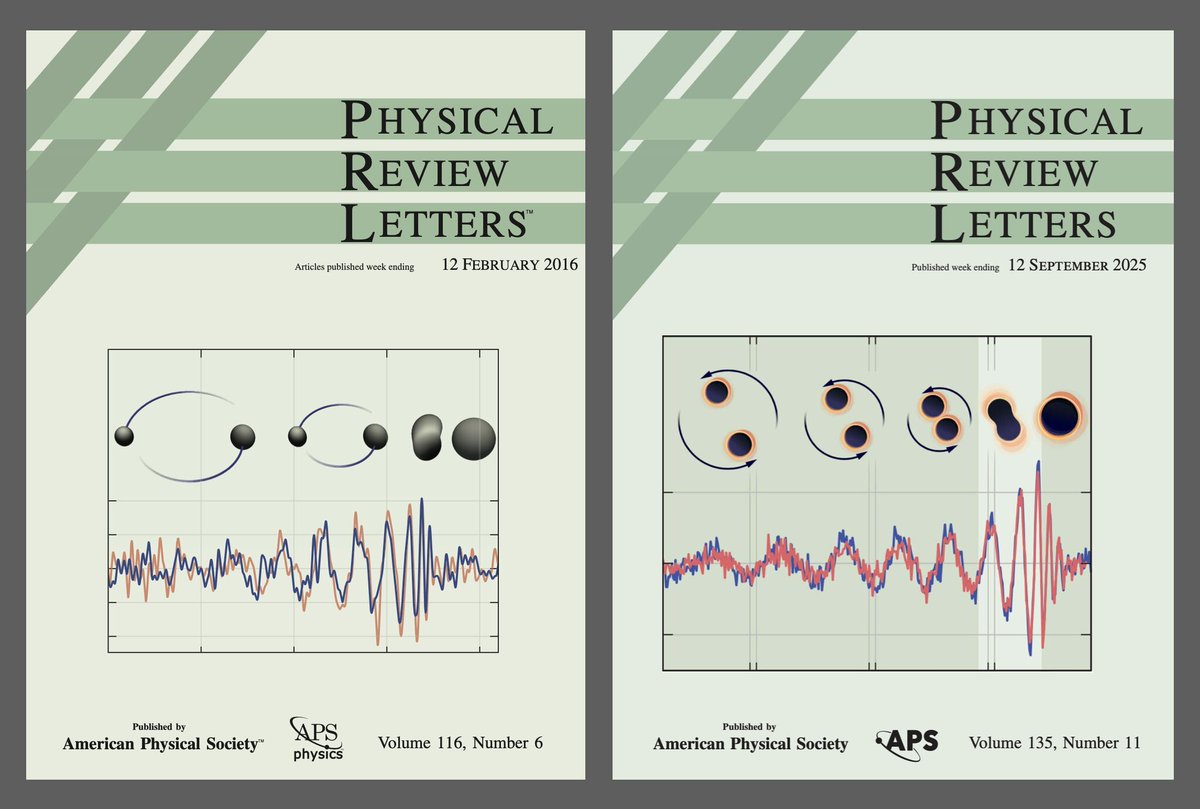
What a difference 10 years makes! I am thrilled that @LIGO's GW250114 will be featured on the cover of the @PhysRevLett just like GW150914, our first gravitational-wave signal, in 2016. You can see the detectors' improvement by eye: notice how much clearer the signal on the right is!
#GW10Years #BlackHole #GravitationalWaves #GW250114
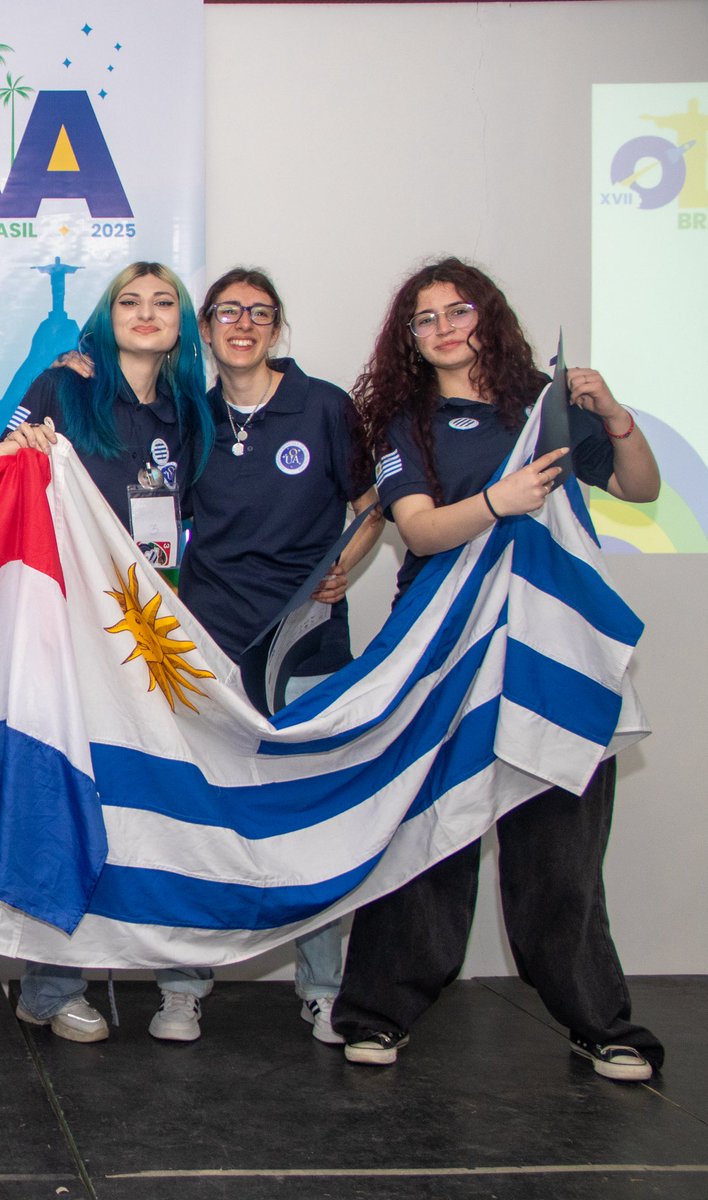
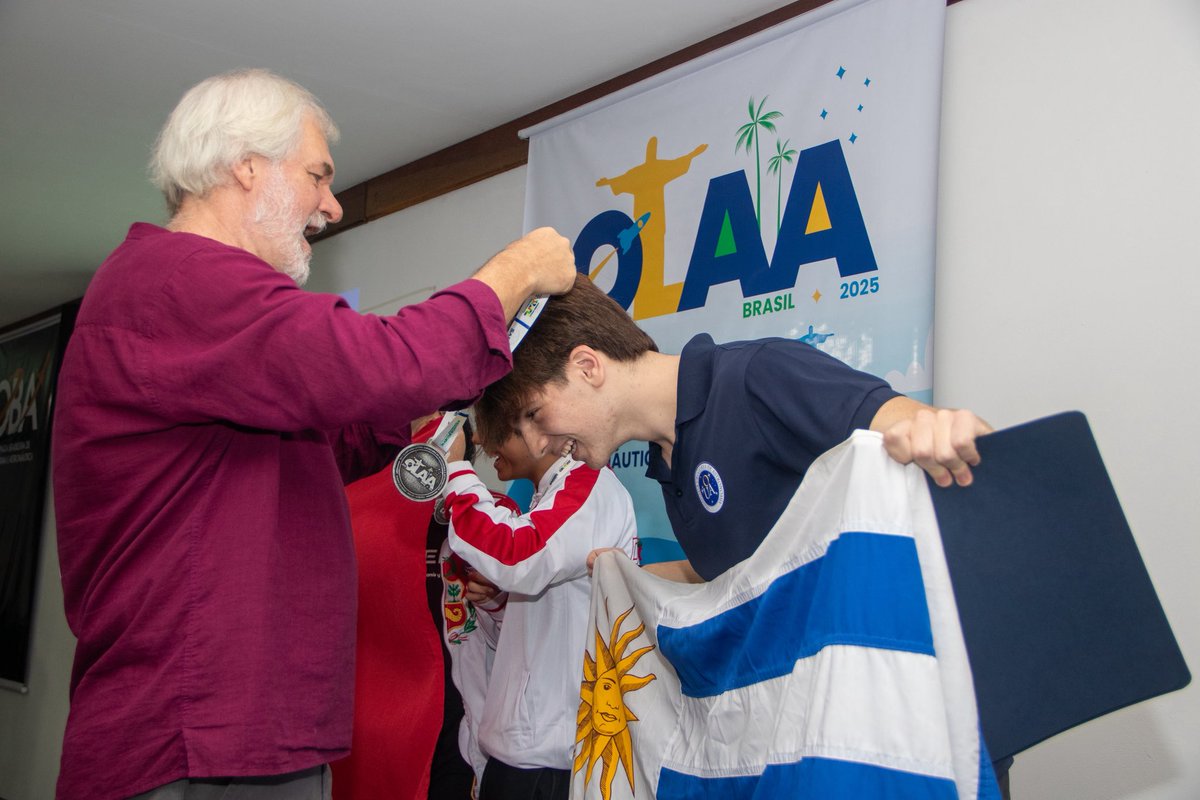
Notable participación de la delegación uruguaya en la XVII Olimpíada Latinoamericana de Astronomía y Astronáutica, en Barra do Piraí- Río de Janeiro, Brasil.
La delegación obtuvo dos menciones de honor, dos medallas de bronce y una medalla de plata.
¡Felicitaciones!
What a difference 10 years makes! I am thrilled that @LIGO's GW250114 will be featured on the cover of the @PhysRevLett just like GW150914, our first gravitational-wave signal, in 2016. You can see the detectors' improvement by eye: notice how much clearer the signal on the right is!
#GW10Years #BlackHole #GravitationalWaves #GW250114
Volume 135, Issue 11
https://t.co/BzxObZOtMF
Cover: Inspiral, merger, and ringdown for a pair of black holes, which allowed confirmation of Hawking’s area law. Data are from @LIGOWA (red) and @LIGOLA (blue)
https://t.co/rgAnX6JoqX
Ten years after scientists first detected gravitational waves emerging from two colliding black holes, a research team that includes @Columbia professor Maximiliano Isi, has recorded a new signal that confirms two important predictions.
https://t.co/MM9OVUdoS5