Research collaborations with Fast Code AI are now available to @ycombinator startups through YC Deals.
YC founders get one month free, worth $25,000, on research engagements of four months or more. Your team owns the work and the results.
Led by Dr. @Arjunjain, our team has published at NeurIPS and CVPR, with work across voice AI, autonomous driving and legal AI, and research spanning world models, time series foundation models and agentic eval frameworks.
We’re an applied ML lab working with leading enterprises like Bosch, Mercedes-Benz and Renesas, and fast-growing startups, on their hardest AI problems.
YC founders, redeem the offer here: https://t.co/kYCCHUHVlR
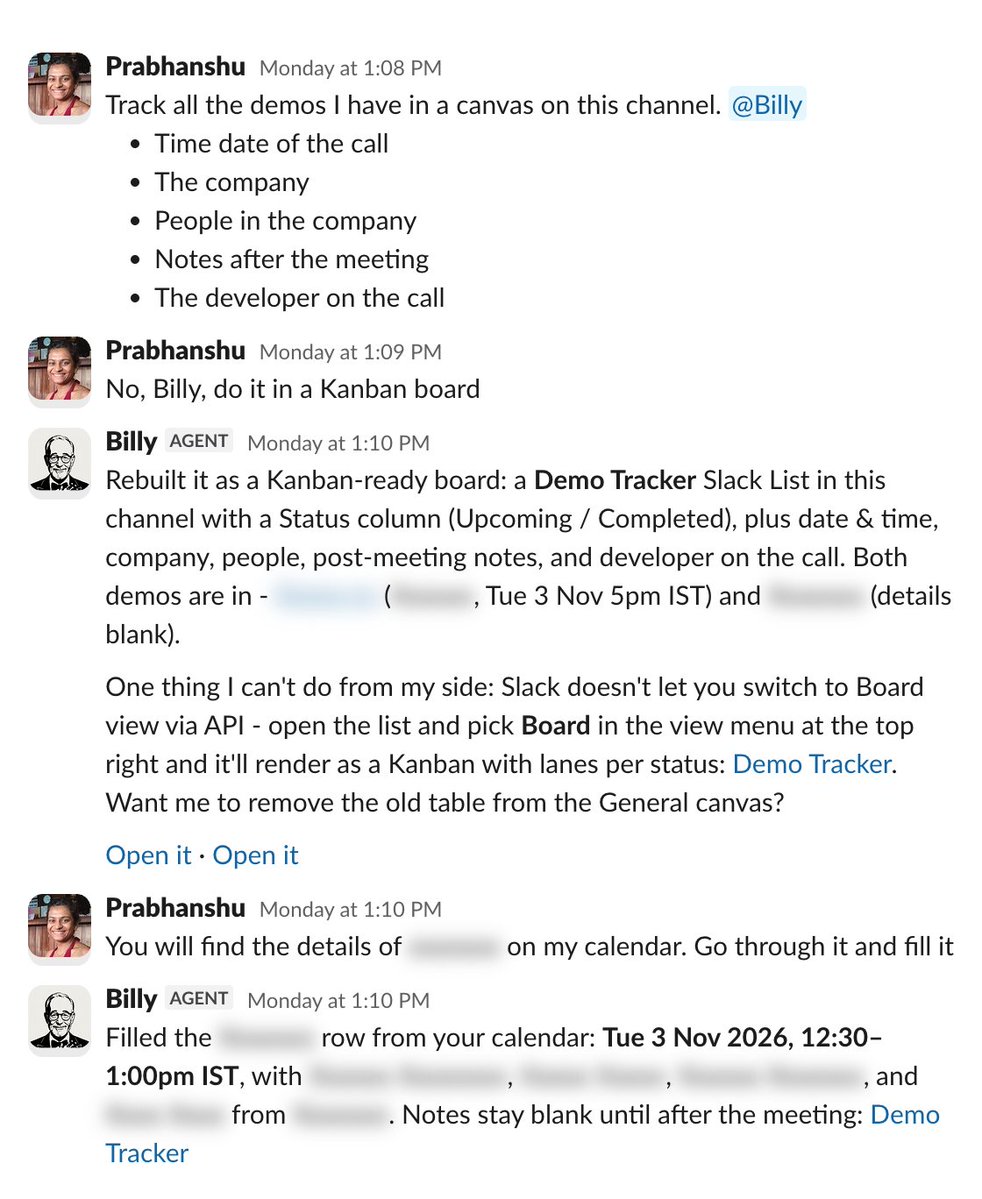
A real thread with @billyfscd, company names blurred:
1:08 pm: "Track all the demos I have in a canvas."
1:09 pm: "No, Billy, do it in a Kanban board."
1:10 pm: rebuilt as a board, filled from the calendar.
$2 a seat, introductory, for our first five pilots. Three slots left.
The hardest I've ever worked and the most peaceful I've ever been were the same years: my PhD at the Max Planck Institute for Informatics in Saarbrücken, Germany.
I was on a scholarship, with Hans-Peter Seidel and Thorsten Thormählen as my advisors, which meant that for a few years I didn't have to worry about anything other than research. And everything around me just worked. The buses were on time, the trains were on time too back then. When I'd go back to India for holidays there was so much happening everywhere, and then I'd land back in Saarbrücken and everything was in order again. Alles in Ordnung, alles klar.
Around this time of year, SIGGRAPH deadline season would begin, and it would be dark by late afternoon. There's a law in Germany that every office has to have a window to the outside, so during those deadlines my company was bare trees and a cold gray sky. Inside, I was trying to build something nobody had built before. I don't think I have ever felt that safe, before or since.
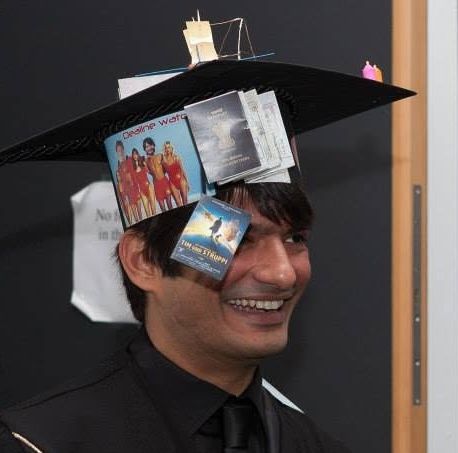
When you finish your PhD there, your labmates build you a cap out of your thesis. Mine had Baywatch on it, because MovieReshape was about changing actors' bodies on film. An Indian passport, because I couldn't make my defense on time: my passport had no empty pages left. And some 3D lines from a paper we published at CVPR in 2010.
They put it on my head, and that's the photo.
These days I run a company, so it's everybody's worries that end up on my desk, and that's how I want it. But some evenings, when it gets dark, I miss being the one taken care of.
Last week Umesh, one of our engineers, shipped deferred tools in @billyfscd, our Slack butler. Now live in production:
Prompt tokens per call: down 58%.
Accuracy: 117 of 126 before, 122 after.
Cheaper and more accurate, in the same pull request.
Billy (@billyfscd), our Slack butler: $2 a seat, 2 months free.
That's at cost, for our first five pilots. We use it ourselves, a second company is signing: three slots left.
Then we pause sales for a few months to improve it, and the price goes up.
https://t.co/YiazmGAKy9
State of the art from purely synthetic pretraining is a striking result. And 209M parameters is small enough to run next to the machine, which is where industrial time series actually live.
The test we would want next is plant data: irregular sampling, sensors that drift for weeks, gaps every time a line stops for maintenance. Synthetic data can model all three, if you think to put them in.
Congratulations to Dr. Okamoto. "From predicting what will happen to deciding what to do next" is exactly the gap industry feels.
Time-series foundation models already forecast plant sensors well. The catch is that a forecast becomes wrong the moment someone acts on it. A model that understands its own actions change the future it predicted is the one operators will trust.
Separating motion from appearance is the right decomposition. It is what makes an action space transferable at all.
The interesting next step is running it the other way: condition the video model on those latent actions and you have an action-conditioned world model with a learned action space. The question is then whether the latent actions stay causal, or quietly encode appearance again.
Same layout, same trajectories, new weather is a great way to stress-test perception.
The harder test for a driving policy is the counterfactual: if the ego car brakes one second earlier, do the other agents react to it? Once trajectories are fixed, you are evaluating open-loop in nicer weather. Action-conditioned rollouts are where closed-loop training really starts.
50+ FPS on a single consumer GPU is the number that matters most here. It is what turns a world model from a demo into a training environment.
For driving, the open question is closed-loop: when the policy acts, does the world respond consistently, or does it drift back toward the logged data? Predicting 3D geometry rather than pixels feels like the right bet for that.
Congratulations on GroundingPI. Strong perception scores are the necessary first step.
The question our own driving research keeps returning to is the next one: a model can locate every object on the road and still not understand why any of them matters. Grounding tells you where. Causal understanding tells you what to do about it. Would love to see benchmarks that test both.
ATEX for a legged robot is a remarkable piece of engineering. Congratulations to the ANYbotics team.
The next question in a plant is what the robot is looking at. A gauge reading only means something once you know which tag it is, on which line, upstream of which valve. That map is the P&ID, and in most brownfield plants it is still a scanned PDF.
16,399 dots from an 1881 page is a very familiar failure. P&IDs trigger the same doom loop: a line list full of near-identical tags, one digit apart, and the model decides it has found a pattern worth repeating forever.
Fixing it with a 0.0085% weight edit and $10 of compute is a lovely result.
Seventeen small wins adding up is the honest way to get 10x. The document we would love to see you benchmark next is a P&ID: tags rotated 90 degrees, line numbers running along the pipe, instrument bubbles sitting on top of the lines they belong to.
On those, getting the characters right is the easy part. Getting the connections right is the whole job.
@JasBilyeu From people who read a lot of drawings: a tight general tolerance in the title block, applied to every dimension on a part that is mostly clearance holes.
Nobody chose that tolerance. It came with the template, and the shop pays for it on every feature.
@jonathan_sessa Automating the step from file to fabrication is underrated. The other end of the same problem: the parts that only exist as a paper drawing from the nineties. Getting those back into a usable model is still mostly someone with a scale ruler and a lot of patience.
@Hughie_Hu43@BerkeleyNLP@rtnldynamics Congratulations on the release. The open-source part is what makes this usable in industry: plant documentation rarely leaves the building, so a 27B model that reads page images natively and can run on-prem is far more useful there than a bigger model behind an API.
Engineering drawings are the extreme case for this. Run OCR on a P&ID and you get the tag numbers back, but you lose what matters: which tag belongs to which symbol, and which line connects them. On a drawing the layout is the meaning.
Would love to see this tested on a set of scanned plant drawings.
In engineering this is not abstract. The model can read a forty-year-old drawing, find the revision clouds and flag what changed. But the stamp on the drawing still belongs to an engineer with a name.
A tool in human hands, quite literally: AI does the reading, a person does the signing.