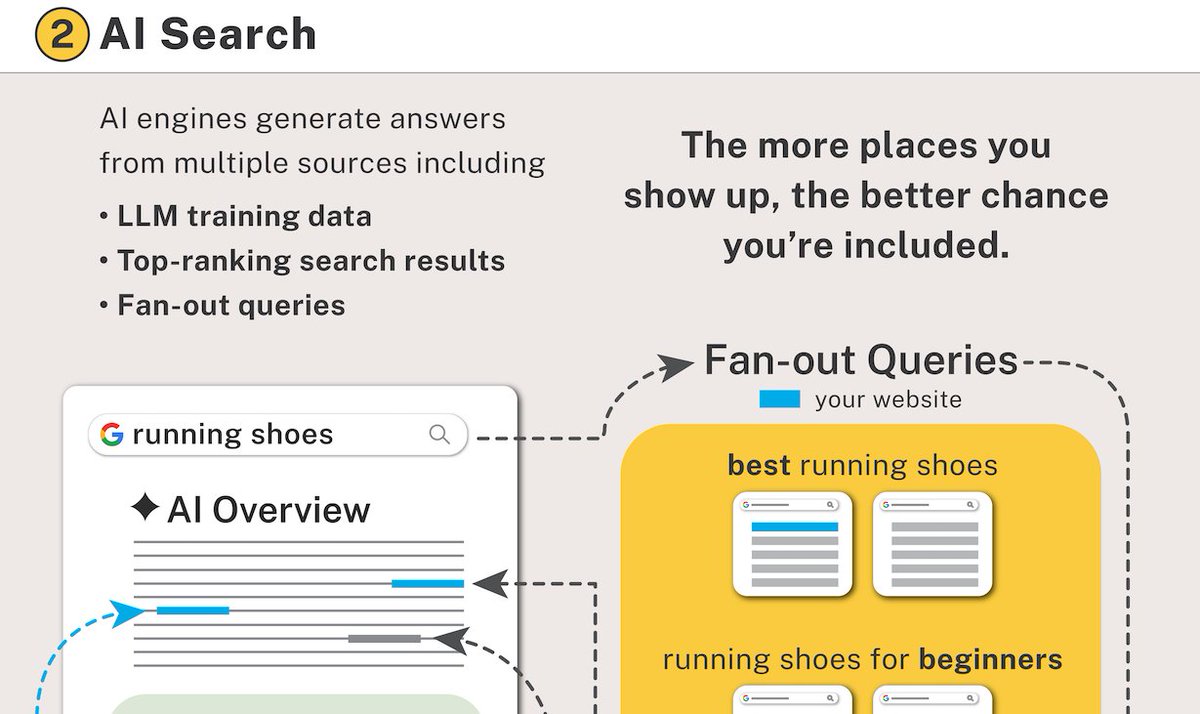
How are companies optimizing for AI fan-out queries? Some marketers do a variation of this process:
1) Use a keyword you already rank for
2) Find common fan-out queries
3) Determine the most important fan-out topics
4) Optimize your page—or create new pages—for the fan-out queries
5) Measure the results
I couldn’t find a great step-by-step guide on how to optimize this process, so I wrote one...
Massive SEO News: Google is launching the most requested report in Google Search Console ever. A new AI performance report!
Here's what we know so far:
• It will include dedicated reports for both Search and Discover
• The data will be reflected within Search for AI Overviews and AI Mode, alongside AI features in Discover
• The report will only be focused on impressions within generative AI features, not clicks
• The rollout will start with a subset of websites, allowing thorough testing (so keep an eye out!)
There are some major limitations to this initial testing phase, where the actual queries that users are searching won't show in the report, with only impressions for pages, countries, devices, and dates.
Though the dataset will be limited, this is certainly a step in the right direction!
I will be covering this rollout within my newsletter, so make sure to subscribe if you aren't already: https://t.co/J6GbI1tB27
We made our B2B client 50k in a day using this ad scripting method.
I just filmed a complete training that covers what we learned after:
- Making $50K in a day on this BRAND NEW ad account
- Building 40 ads in total for this offer
- Hitting a 13X LTV ROAS & 3.2X Cash ROAS
- Booking 87 qualified calls on $11,880 ad spend @ $136/call blended
And I compiled quite literally everything I know into this training.
Inside you'll learn:
1. General market research
2. Individual research and how to mine sales calls (with live examples)
3. Unique angle creation
4. Individualized Ad scripting
5. Andromeda creative strategy (how to keep your ads diverse ads across)
14 Minutes of pure sauce.
If you want it:
Comment "ADS"
And I'll send the video + the miro board
(must be following for DM)
Google just accidentally revealed how its AI search systems actually work.
Now that none of it is a secret anymore, let’s talk about it.
With the new Google Search rolling out as we speak, it has never been more important to understand how to maximize value from this particular marketing channel.
(If you want to see where your site stands across Google and AI search, you can do so for free here:
https://t.co/Pn764BHwyL)
Let’s start from the beginning:
Metehan Yesilyurt, who previously went viral when he expertly analyzed Perplexity’s ranking factors, recently broke down Google AI ranking factors in a blog post.
It was fascinating.
And a lot of the leaked ranking factors validate what SEO Stuff has been doing all year to get customers more traffic and sales over the past year.
https://t.co/eh1auroJF7
Basically, as noted by Yesilyurt, by selling the underlying infrastructure through a product called Google Cloud Discovery Engine (Vertex AI Search), Google revealed a lot about how its AI systems work.
If you understand what Discovery Engine exposes, you understand how Google AI Mode, AI Overviews, and future AI search features are likely ranking and retrieving your content.
I’ll talk about the 7 ranking signals below, but I advise you to read the entire blog post I’m linking to because it goes into way more helpful technical detail:
Base Ranking:
The core algorithm’s initial relevance score.
Gecko Score (Embedding Similarity):
Vector similarity between your content and the query.
Semantic match.
Jetstream (Cross-Attention Relevance):
A more advanced model that understands negation, contrast, context, and nuance better than embeddings.
BM25 Keyword Matching:
Kind of self-explanatory. Yes, keyword matching still matters.
PCTR (Predicted Click-Through Rate):
A three-tier prediction model:
Tier 1: Popularity
Tier 2: PCTR
Tier 3: Personalized PCTR (unlocked only after 100,000+ queries)
Freshness:
Time-sensitive recency scoring.
Boost / Bury Rules:
Manual ranking adjustments based on business logic.
This is the most transparent look we’ve ever had into Google’s AI ranking pipeline.
Discovery Engine also exposes the retrieval pipeline:
Max chunk size: 500 tokens (approximately 375 words)
Optional: ancestor headings travel with each chunk
Tables and images get parsed
Layout parser plus Gemini-enhanced understanding (LLM-augmented indexing)
This means every important point needs to live inside a 500-token block with clean headings and clear structure.
If your content is one massive wall of text, you’re done.
Also, I hate to be the “I told you so” guy on this, but schema matters.
For some reason it has become controversial to say this on social media, but it was obvious and now it is confirmed.
Discovery Engine shows Google processes structured data with three separate flags:
Searchable (affects recall)
Indexable (affects filtering and ordering)
Retrievable (affects what the model can output)
These are independent.
Meaning:
A field can influence ranking without being visible, or be visible without influencing ranking.
A massive hint at how Google uses structured data for AI Mode.
Also, Google revealed the 4-stage AI search pipeline:
Prepare:
Query understanding, synonym mapping (time-aware), autocomplete, NLU.
Retrieve:
Chunking, layout parsing, schema extraction, embeddings.
Signal:
The 7 signals above.
Serve:
Gemini 2.5 Flash generates the final answer, applies instructions, safety filters, related questions, and grounding rules.
Traditional Search, AI Overviews, and AI Mode are simply different configurations of this same pipeline.
So what does all this mean?
Well, it means you must optimize for three layers at once:
Layer 1: Semantic similarity (Gecko)
Your content needs to clearly match the intent of the prompts you want.
Layer 2: Cross-attention relevance (Jetstream)
Jetstream rewards:
Clear definitions
Direct answers
Contrast statements
“X vs Y”
“Best for ___”
“Without ___”
Layer 3: Chunk-level clarity
Your content must be extractable in 500-token blocks with:
Question-based headings
Two to three sentence answers
TLDR summaries
Clean HTML
Factual claims
Lists and comparisons
This is exactly what AI systems quote.
And this is exactly why SEO Stuff (https://t.co/wKpf0EILTx) works so well in AI search.
The Discovery Engine findings validate the entire SEO Stuff approach from long before this documentation was public.
Let me break down the packages through the lens of Google’s architecture:
SEO Stuff Gold Plan:
https://t.co/yEFyM0Ze7W
10 long-form, comparison-based, extractable articles
Structured in 500-token blocks
Question H2s
Two to three sentence direct answers
TLDR blocks
FAQ schema plus product schema
3 DR50+ backlinks to strengthen entity signals
Gold Plan maps to:
Gecko (semantic match)
Jetstream (cross-attention relevance)
BM25 (keyword match)
Freshness
Entity trust (for Boost/Bury)
This is the fastest path to appearing in ChatGPT, Gemini, Perplexity, and Google AI Mode.
SEO Stuff Premium Content Bundle:
https://t.co/4CAnUt07PO
60 comparison-driven articles
Structured to match the exact pattern LLMs extract
Category-defining content
Builds topical coverage and entity clarity
Creates a deep corpus for Jetstream and embeddings
Premium Bundle maps to:
Retrieval depth
Structured chunking
Ancestor heading clarity
Embedding similarity
AI model grounding
This is how you train AI systems to associate your brand with your category.
SEO Stuff Premium Backlink Bundle:
https://t.co/Z9m9D7TjES
3 DR50+ backlinks from domains LLMs already trust
Reinforces brand consistency across the web
Boosts entity recognition
Backlinks help with:
Base ranking
PCTR (popularity and trust)
Boost/Bury eligibility
Entity clarity
This is why so many customers reorder.
It works.
Google is not hiding its AI search architecture.
They literally exposed:
The signals
The ranking layers
The chunk sizes
The parsing logic
The semantic models
The engagement tiers
The answer generation flow
The brands that understand this and structure their content accordingly will run through the next era of search like absolute beasts.
And SEO Stuff (https://t.co/wKpf0EILTx) was built specifically to map to this architecture.
If AI is replacing the first click, your content must replace the first impression.
#GoogleIO📷📷 #Google📷📷 #Gemini
Je positionne une nouvelle page dans le top 3 Google chaque semaine (20m/jour).
Voici comment tu peux faire pareil :
La plupart des gens font du SEO complètement à l'envers. Ils écrivent du contenu d'abord. Et espèrent que ça va ranker.
Ça ne marche plus en 2026. La meilleure façon de faire du SEO aujourd'hui c'est l'inverse.
D'abord : trouve ce qui génère DÉJÀ du trafic dans ta niche.
Ensuite : utilise l'IA pour repérer les gaps exacts que tu peux gagner.
Entre la GSC et les SERPs des concurrents. Et ça change tout.
Parce que le SEO arrête de ressembler à du devinage. Chaque page que tu publies, c'est : "ok, celle là va ranker."
Seul souci :
La plupart des gens n'arrivent pas à faire ça de manière constante.
Voilà ce qui se passe généralement :
→ Ils écrivent 50 articles de blog sur des sujets qu'ils "pensent" qui vont ranker
→ Les pages mettent 6 mois à peut être ranker, ou ne rankent jamais
→ Ils paient des outils SEO qui balancent des audits de 500 pages que personne ne lit
→ Ils embauchent une agence à 3K€/mois pour des recos génériques
→ Ils craquent avant de voir le moindre résultat
→ Résultat : des mois de boulot, 12 clics par mois
Ce n'est PAS comme ça que le SEO marche en 2026.
Donc au lieu d'embaucher une agence, j'ai construit un système qui combine Claude + GSC + data des concurrents.
Maintenant je passe 20 min/jour sur le SEO et je continue à publier des pages qui rankent chaque semaine.
La clé : ne bosser que sur les pages avec une vraie intention.
→ Les mots clés où tu rankes déjà en positions 5 à 15
→ Les pages concurrentes qui perdent du trafic
→ Les requêtes avec des impressions qui montent mais zéro clic
→ Les sujets que tes acheteurs cherchent déjà
→ Les pages à une réécriture du top 3
J'ai documenté tout le process :
→ Comment je trouve des mots clés faciles à prendre en 2 minutes
→ Comment j'audit les pages concurrentes avec l'IA (et je vole ce qui marche)
→ Comment je réécris les meta titles qui se font vraiment cliquer
→ Comment je transforme la data GSC en plan de contenu hebdo
→ Les prompts exacts que j'utilise pour shipper du SEO vite
Ce que c'est : un système qui transforme le SEO en routine quotidienne de 20 minutes.
Ce que c'est PAS : un énième audit de 500 pages que tu ne liras jamais.
-----
Tu veux le playbook complet ?
1. Follow-moi
2. Commente "SMART SEO" en-dessous
3. Reposte ça pour m'encourager à créer plus de guides gratuits
I spent 65 hours creating a NEW Miro board which shows you exactly step by step how I made $15M with my digital products business
it includes case studies of 8+ accounts on X doing $100K/month profits each
( including full funnels )
Comment “Miro” and I’ll send it to you via DM
**must be following + retweet to receive
We built 12 Claude Code skills that run our entire paid media ops across Google, Meta, and LinkedIn at ColdIQ (and we're giving the whole pack away).
Our head of growth Ivan Falco runs $200K/month in ad spend from a terminal. It's how we doubled client load this year without losing quality.
The skills do the work that used to fill our media buyers' calendars: spot creative fatigue, adjust bids, upload audiences, run bulk edits, flag broken campaigns, build reports.
Each skill does a specific job:
Google Ads:
→ keyword-analyzer: audits quality scores and finds keyword gaps
→ negative-keywords: reviews search terms and blocks wasted spend
→ performance-auditor: compares periods and flags what changed
→ search-terms: surfaces queries burning budget with zero conversions
Meta Ads:
→ audience-builder: turns CRM lists into custom audiences
→ creative-fatigue-analyzer: spots declining CTR before the metrics flag it
→ fatigue-monitor: flags when your audience is saturated
→ spend-tracker: tracks budget pacing across every campaign
LinkedIn Ads:
→ audience-builder: builds targeting audiences at scale
→ bid-optimizer: adjusts bids across campaigns in bulk
→ bulk-editor: mass edits campaigns, ads, and naming in seconds
→ creative-builder: generates ad creatives from brand specs
You drop them into Claude Code, connect your ad accounts, and tell it what you need. It reads the skill, plugs into the platform, executes.
300+ hours of work went into building these.
Comment ADS and we'll send all 12 over.
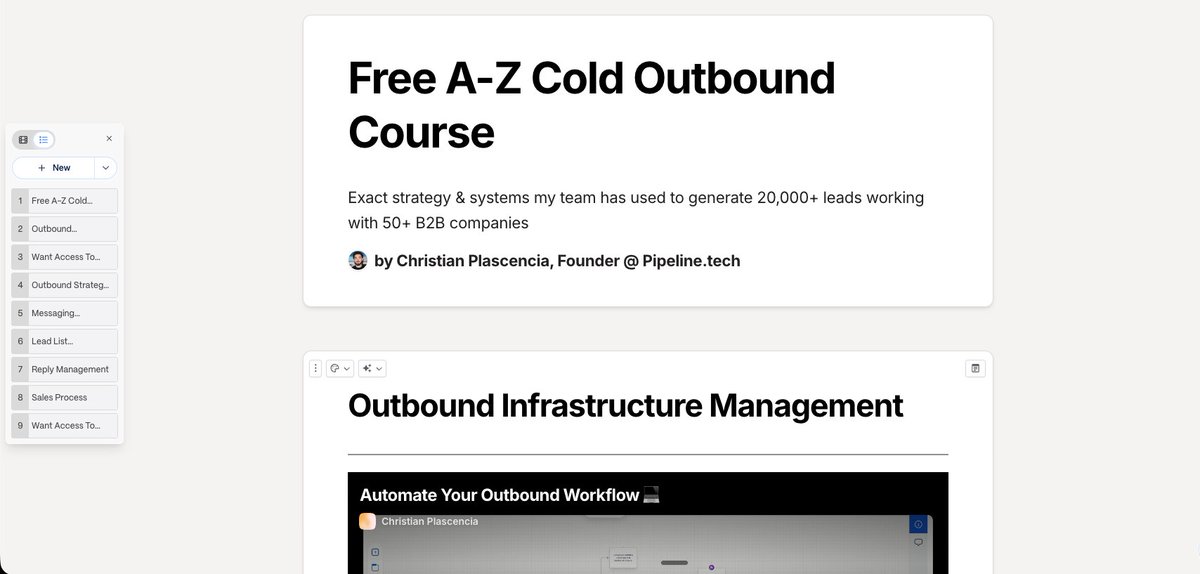
I just put together a free A-Z cold email outbound course that covers the EXACT strategies & systems my team has used to generate 20,000+ leads for 50+ B2B clients.
Here's what this free course covers:
> Entire Outbound Playbook Overview (32-mins)
> Our Essential Outbound Tool Stack
> Outbound Infrastructure Management (10-mins)
> Outbound Strategy Development via AI Prompting (15-mins)
> Messaging Development Full Masterclass (54-mins)
> Lead List Development Fundamentals for 97%+ Qualified Lists (17-mins)
> The Most Effective Way to Build Clay Tables in 2025 (38-mins)
> Reply Management Flow for 30%+ Meeting Conversion Rates (15-mins)
> Sales Process Strategy for 2Xing Close Rate on Cold Leads (8-mins)
This course contains 189 minutes of top-tier outbound training for completely free.
Want to get your hands on it?
👉 Like + Comment “FREE” and I’ll DM you the document link.
plz welcome: masscontent operator
sh*ts on openclaw
sh*ts on claude code
sh*ts on higgsfield
im pretty positive that this is the most powerful mass marketing agent on earth.
just a short list of what he can do:
- full phone farm integration (~$4 per account)
- second brain on u and your competitors
- 500+ marketing .skills pre-loaded
- call 64 ai content models (50% of the cost)
- build full ai vids/slides workflows in bulk (30 at once)
- create consistent influencers and map them to accs
- run ai theme pages by itself
- auto-post everywhere via our phone farm
- setup up lead mag auto-dm’s for every post
- spin ai inbox agent to manage every dm and follow up
- social intelligence scraping on every platform
- clone viral posts with your brand + brain
- fully edit every video
- highly realistic Seedance 2.0 ugc
- render mocked iOS app screen recs w/ your real ui
- write tweets & post any render media
- create saas mini-launch vids with every tweet (real ui)
- scrape top ai influencer pages and clone them
- use our credits or connect your anthropic key for unlimited
- track posts work & edit all workflows to double down
- all analytics mapped in his brain wiki
- track every click and conversion event
- create & post 1,000+ vids/day
i’m not sure how i got here, but 2.1 million lines of code later…
we are locked in.
like, rt + comment “OPERATOR” and i’ll dm it to you. (must follow for dm)
I just filmed a 50-minute Meta Ads training for 2026.
(full course)
This has everything I've ever learned after
- Making $50K in the first 20 days on a BRAND NEW ad account
- Working with 40+ businesses
- Generating over $20M+ through our funnels
And it’s going to help you overcome the 3 BIGGEST mistakes people are making with their Meta ads in 2026.
1. Generic ad messaging
2. Incongruent funnels
3. Poor pre-call systems
Thing is...
They're EASY to fix when you know the system.
And I compiled quite literally everything I know into this training.
Inside:
1. Complete Andromeda creative strategy (how to build 25-30 diverse ads)
2. Funnel structure and how to setup your landing page for paid ads
3. Pixel conditioning done right to get qualified leads only
4. Pre-call nurture system for 70-80%+ show rates
5. Campaign structures for EVERY budget
50 Minutes of pure sauce.
If you want it:
Comment "META"
And I'll send the full course.
(must be following for DM)