And to our new investors Goldman Sachs Alternatives, Morgan Stanley Investment Management, @DEShawCo, Generation Investment Management, @insightpartners, and BroadLight Capital: welcome to the show!
Five years ago, we met @eglyman and @karimatiyeh as @tryramp was entering a crowded spend management category with a different mentality: saving customers time and money.
Since then, Ramp has grown into an AI-powered operating system for modern finance, including spend, workflows, and financial operations, all within one integrated platform.
We’re proud to deepen our partnership with Eric, Karim, and the Ramp team as we lead their Series F.
Read more: https://t.co/Ogweo4wmT3
Disclaimer: https://t.co/fdP8ALDhEm
Today, Ramp raised $750M at a $44B valuation.
Last time we grew this fast, we were 1/20th the size.
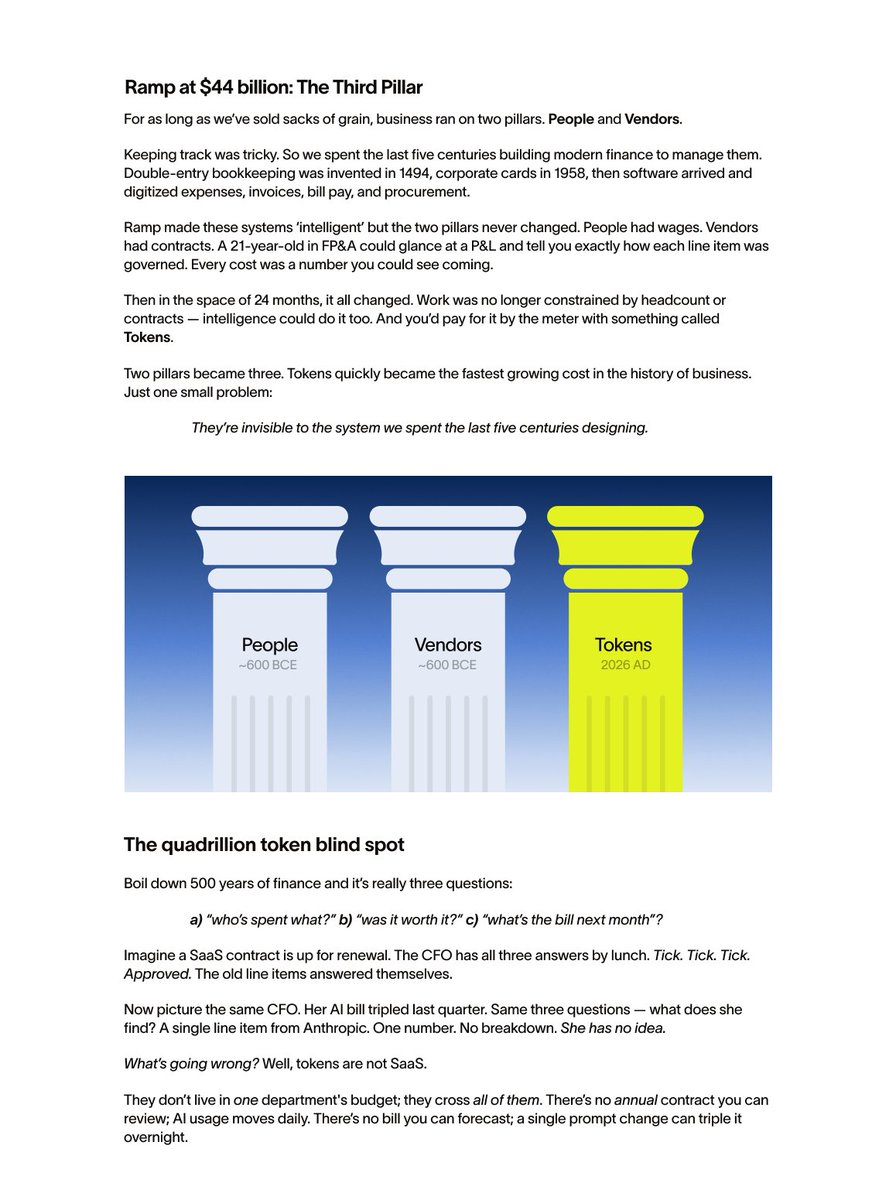
For 2000 years, business was built on two pillars. Today, a third: intelligence.
It’s your least governed cost. It’s also your single greatest opportunity.
The lesson we've learned time and time again while building agentic products: there's no substitute for deeply, deeply understanding the job.
Great read from @ryanlstevens12 and team about how they built Ramp Stack. Before the team wrote a single line of harness code, they talked to accountants, drew out the actual workflows, added every decision point, edge case, and judgement call where two smart humans would disagree or do something differently. That set of evals became our benchmark.
Agents are unreasonably effective when you give them a verifiable goal. The benchmark comes through understanding the job. Understanding the job comes from watching accountants work.
With this foundation, we built and rebuilt our harness. We learned that 2/3rds of skills were actually hurting performance. We identified where we were overfitting on period-specific data points. Our benchmark lets us compound 1% improvements on decisions that would otherwise have been vibes-based.
Month end close will never be the same 🚀🚀🚀
https://t.co/1lrqCVYYvK
Introducing Stack.
The AI operating system that lets accounting firms take on more clients without hiring. Learns your firm's process, runs the close, posts the journals. Fully auditable.
We’re living through the biggest shift in accounting since the spreadsheet.
If I am @sundarpichai, I will bury all competing foundational models in negative gross margin tokens for eternity.
I will NEVER take my foot off the pricing gas: to merely compete, I will force you to dilute your equity into oblivion.
Sam will drown in my tsunami of COGS. $GOOG
Ramp’s product is nearly self-building
Blocker from customer posted to channel -> autonomously scoped spec -> delivery via coding agent
Engineers are still a bit involved today
But soon we’ll have full delivery via software factory
Goal is to scale by tokens, not by headcount
1/ We’ve raised over $1B at a $26B valuation, led by @Lux_Capital, @generalcatalyst, and @8vc.
Our enterprise usage has grown >10x since the start of this year, and our run-rate revenue grew to $492 M.
We launched Devin two years ago as the first AI software engineer. Since then, cloud agents have gone from niche to mainstream, and today they are the fastest growing way to create software.
Scott Wu is the co-founder of Cognition AI, one of the fastest-growing companies in history. He’s also the greatest competitive programmer the US has ever produced. You may have seen him doing impossible card tricks and mental math.
You’ve never seen him asked about weed, Michael Jordan, cancer, and human consciousness over a punnet of strawberries. That is what Colossus editor-in-chief Jeremy Stern did on a recent visit to San Francisco.
For those less familiar with @ScottWu46: In 2nd grade, he entered a math competition for 7th graders, lost, and was so furious he still fumes about it 20 years later. The next year he entered the 9th-grade division as a 3rd-grader and got a perfect score.
Then he won first place at the US national middle-school math competition and three straight gold medals at the International Olympiad in Informatics, where he became the greatest American gold-medalist and coach in history.
Most of the people running the biggest AI companies met as teenagers, competing for their countries on international math and science teams. OpenAI’s Greg Brockman, Anthropic’s Dario Amodei, Meta’s Alexandr Wang, to name just a few.
Most agree that the von Neumann among them was Scott Wu.
In November 2023, a few weeks after his mother died of lung cancer, on the day Sam Altman was fired from OpenAI, Wu founded his own AI company: Cognition.
He was 26 and saw earlier than almost anyone that AI would converge on agents that work in the background, 24/7, like coworkers. He shipped Cognition’s AI software engineer Devin in March 2024. It worked poorly, and he took intense public criticism for it.
Now, in its first 18 months of service, Devin has generated $445 million of revenue run rate and usage has doubled every eight weeks. The US Army, Goldman Sachs, and Mercedes-Benz are all customers. Cognition is raising at a valuation around $25 billion.
@JeremySternLA sat down with Wu, the emperor of the nerds, to ask the questions we’d all ask one of the smartest people in America—building the most consequential technology of our generation—if we ever got the chance.
As well as MJ and weed, they talk about the cluster of competitive math prodigies behind so much of AI, what makes us human when AGI arrives, and why Wu believes he was put on this earth to teach AI how to code.
Read the piece below.
Between us having built this at @tryramp with Inspect, and watching other great companies like @WorkOS, @stripe and @Shopify build this, some clear takeaways are emerging:
1. AI adoption multiplies exponentially when it’s done in public. If you work with tooling that keeps learnings private, you’re doing a disservice to your entire business. When every knowledge role is rebuilding how it works, you need everyone to contribute to the corpus of knowledge by default.
2. Bespoke tooling that’s shaped to your business is easier than ever to build. Losing time trying to shape your processes around other products isn’t a trade off you have to make anymore. Choose platforms that will let you stay flexible to build what works for you and your business.
3. Cultures of experimentation are more important than ever with AI. We are still so early. Shape your business to take big bets, and cut losses early. Whether this be for internal efforts like these, or the product you ship, now’s not the time to be risk adverse. It’s a far greater risk to think that anyone has won the game.
.@RampLabs (the AI unit of @tryramp) has been *cooking* with agentic innovation
Here's @a_levitator discussing and demo'ing code self-maintaining software and the concept of AI software factories #DataDrivenNYC
______________
00:04 - Intro
01:11 - The shift from writing code to code maintenance
01:59 - Introducing Ramp Inspect, the background coding agent
03:05 - The first experiment: Nightly AI code automation
04:23 - The limits of stateless monitoring in large observability surfaces
05:47 - Using Datadog monitors to give the AI state and focus
07:23 - Real-world example: AI autonomously fixing an authentication bug
08:14 - How to control noise and implement an AI triage pattern
09:27 - The old vs. new paradigm for continuous code observability
10:21 - Key learnings on building autonomous AI software factories
no one would design a company today the way companies were designed two years ago.
the line between engineers and everyone else was an artifact of who could write code. that line is gone. 70% of our merged PRs are written by our in-house agent, and over 10% of the PRs weren't written by eng team.
the org chart is the next thing to redesign.