Good morning with good news: "Australia is headed for its biggest year of rooftop solar growth ever!"
Rooftop solar installs surged 41% for January–October 2026, compared to same period in 2025!
~37% of Australia's homes or 4.3 million have solar.
https://t.co/aLlY9t4zM4
Global carbon dioxide (CO2) emissions from fossil fuels are projected to fall by around 0.4% in 2026. This is based on the latest preliminary estimates from the Global Carbon Project, published today.
This is a small reduction within an overall upward trend. Emissions have grown more slowly over the past decade than in previous decades, but they have not yet peaked or begun a consistent decline.
This fall mostly came from a reduction in oil consumption and a small decline in gas. Coal use increased slightly.
Among the major emitters, emissions are projected to fall in China, the United States, the European Union, and Japan. But they’re expected to increase by around 4% in India.
Why did emissions fall? The authors cite three key factors.
The deployment of clean energy (particularly solar and wind) displaced some fossil fuel use that would have otherwise been required to meet growing energy demand. Electric vehicles also reduced oil demand. Finally, the war in Iran and its impact on oil prices led to reduced demand, which has inadvertently reduced emissions.
Emissions from land-use change are more uncertain but are projected to increase this year due to peat fires and forest degradation in Southeast Asia.
(written by @_HannahRitchie and Pablo Rosado)
October 2026 EV share of market
Netherlands: 55%
Sweden: 51%
Belgium: 49%
France: 42%
Germany: 37%
UK: 32%
UK has gone from leader to laggard @jreynoldsMP I 100% guarantee that the Car lobby, 3 years from now will blame weakening and flip-flack regulations for UK’s weakened competitiveness and inability to attract inward investment.
We are currently 18th worldwide from a high of 2nd.
BEV adoption is booming – displacing fossil use, and cutting the crude oil import bills.
On Energy & Transport Day at #COP31, transport electrification must be treated as a frontline tool for cutting oil import exposure and emissions simultaneously.
https://t.co/jfwcEE9JXO
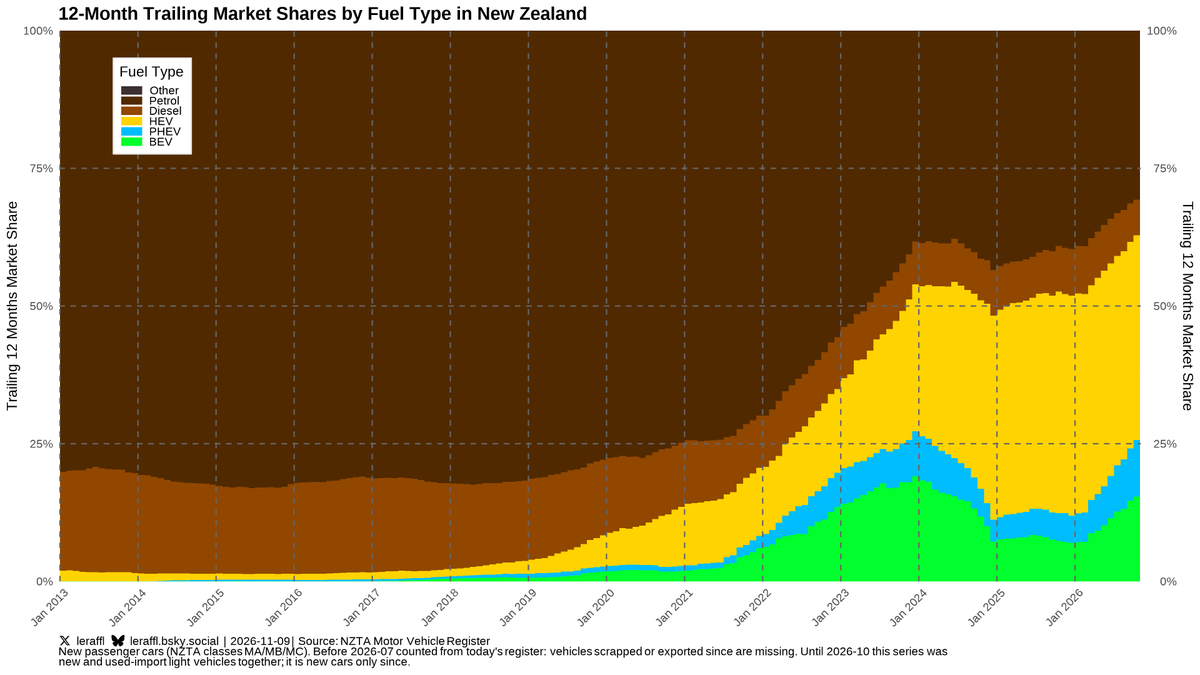
🇳🇿 New Zealand - TTM Market Split
Nov24–Oct25 vs Nov25–Oct26
+8.0pp BEV (7.4% → 15.4%)
+5.2pp PHEV (5.1% → 10.3%)
−3.0pp HEV (40.2% → 37.2%)
−10.2pp ICE (47.4% → 37.1%)
HEV peaked at 40.2% in 2025-10 (declining for 12 months).
If the changes from the last 6 months continued linearly, BEV would overtake ICE in 2027-08.
If the changes from the last 6 months continued linearly, BEV would become the largest powertrain in 2028-02.