What happens when AI can write the genetic code for life itself?
Eric Nguyen (@exnx) is the co-founder of @RadicalNumerics, the lab behind the models that generated the first genome ever created entirely by AI, a bacteriophage that had never existed in nature until it wrote one. He believes DNA should be treated the way language is treated: something a model can read, then write.
With more DNA sitting in public databases than there is text on the entire internet, he sees an almost unmined field, one where the models built to make sense of it remain, by his own admission, no more sophisticated than linear regression.
Thank you to the partners who make this possible
@ahrefs Brand Radar: Find your brand in AI results: https://t.co/D1000RUBMV
@brexHQ: The intelligent finance platform: https://t.co/WsjMETvEON
@Guru_HQ: The AI source of truth for work:
(3:35) An overview of Radical Numerics
(11:08) Why they started with DNA
(26:24) The limits of language models in biology
(31:15) Eric’s free-range upbringing and path to his PhD program
(41:20) Applying long-context models to DNA and meeting his co-founders
(55:30) How better general LLMs benefit Radical Numerics
(1:02:05) Making biology more concrete
(1:18:09) Final meditations
Radical Numerics has 16 roles open, from MTS pre/post training, infra & systems, mech interp, to product leads in scientific discovery.
Our team is growing rapidly in SF, and so are the models. We’re pretraining the largest biological AI models ever. Science is the next frontier in AI.
Roles:
https://t.co/EzsHSMcGJ1
- MTS Pretraining
- MTS Post-training
- MTS Infra & systems
- MTS Model interpretability
- MTS ML engineer
- MTS Inference
- MTS AI supercomputing
- Product lead - Discovery
- Product lead - Diagnostics
- Computation biology
- Protein design
- MTS Biosecurity
- Head of Data Acquisition
- MTS AI bio
- Applications engineer
- Marketing associate
Huge thanks to my co-authors Chuanbo Hua, Nayeli Gast Zepeda, André Hottung, Niels Wouda, Leon Lan, Junyoung Park, Kevin Tierney, Jinkyoo Park, and the AI4CO community!
Presenting RouteFinder in the morning session -- one model, 48 VRP variants 🚚
Come visit us, happy to discuss and hang out! :) #ICML2026🇰🇷
📍 Wed, Jul 8 • 10:30 AM–12:15 PM KST • Hall A #4003
🔗 https://t.co/1bWre08rgc
1/ Leaders of OpenAI, Anthropic, & GDM signed a letter urging Congress to mandate DNA synthesis screening.
But chatbots & agents can't read DNA.
So we built Omnii to defend against natural & AI-designed pathogens.
Blog: https://t.co/a2v5pbwP8z
Letter: https://t.co/vWpmNtFlDh
Together with my co-founders Michael @MichaelPoli6, Stefano @Massastrello and Armin @athmsx, I am excited to announce @RadicalNumerics is emerging from stealth with a $50M seed round to build general biological intelligence.
We’re also sharing an early preview of our new model Omnii, the most powerful genome language model to date.
Omnii preview link:
https://t.co/ouikMtRVwf
At Radical Numerics, our mission is to master the code of life, and to drive the frontier of biological AI for both design and defense.
This is our dual mandate, which comes from something our own team helped make possible.
Our founding team trained Evo and Evo 2, the largest biological AI models (40B params) trained on DNA sequences. Trillions of tokens across all of life, from microbes to mammals. It’s fully open source, and created the field now known as generative genomics.
Last year, scientists used Evo to generate the world’s first complete genome from scratch using AI. Turns out it was a bacteriophage—a type of virus. It functioned in the real world, and in this case it was harmless. But for us, it was a clear turning point.
It showed that AI is no longer just analyzing biology. It is on the cusp of generating functional lifeforms. Eventually, AI will have the power to design and control life itself.
That should make all of us incredibly excited, and incredibly uneasy. (Anyone can design DNA with a new function, and have it synthesized and delivered, like something from Amazon Prime).
The same technology that will help us cure cancer is the very technology that might create the next global pandemic, or worse, allow the creation of bioweapons that can wipe out populations.
We believe these forces are inseparable. If you work on the frontier of biology, you have to build technology to safeguard it from its misuse. Existing biosecurity tools are sorely losing the arms race, relying on outdated “have I seen this exact thing before?” style algorithms.
We founded Radical Numerics to turn the tide.
And we can’t do that by training on textbooks and natural language. We must understand the language of biology from the raw physical data itself, to reason across every molecule and modality, from DNA to proteins.
The next frontier for AI goes far beyond chatbots or video generators to models that can understand and engineer life.
Today, we’re previewing Omnii, which is already far surpassing Evo 2, and will continue improving as we scale and add new modalities (training now).
1. For human health, Omnii can read and write whole genomes (more on writing later). It’s state of the art (SOTA) on detecting causal variants for disease, and can rank Alzheimer's mutations zero-shot. We’re partnering with a diagnostics company to use Omnii for early cancer detection (pancreatic and multi-cancer).
2. For defense, Omnii is SOTA at detecting AI-generated pathogens. We benchmarked existing detection tools, and they simply can’t detect the AI-generated ones (“deepfake viruses”). We’re partnering with a US national lab to pilot Omnii for detecting the next pandemic, both natural and AI-generated.
We have a data center full of Blackwells in construction now to build the most powerful biological AI models ever. This mission takes a new kind of AI lab that can actually scale on physical, biological data: new alignment research (mid/post training), scaling long context, building out mech interp teams to dissect what these models learn, new architectures and systems designs, all from the ground up.
Our team is made up of AI researchers and scientists from top labs and institutions (e.g. Stanford, MIT, Google DeepMind), but more importantly, we all share the belief that this is the most important challenge of our lifetime. If you feel similarly, we are hiring. We aim to bring the brightest minds in AI and science together to save lives.
Thanks to our partners on this journey, led by Emergence Capital @emergencecap, with Obvious Ventures @obviousvc, Triatomic @TriatomicCap
, and Patrick Collison @patrickc. Our advisors include Eric Horvitz @erichorvitz, CSO of Microsoft, Chris Re @HazyResearch of Stanford, George Church @geochurch of Harvard, and Andrew Weber @AndyWeberNCB, former Assistant Secretary of Defense for Nuclear, Chemical and Biological Defense Programs.
Fortune article: https://t.co/L3f3f1329T
Jobs: https://t.co/EzsHSMcGJ1
Sliding window attention (SWA) is powering frontier hybrid models for efficiency. Is there something better?
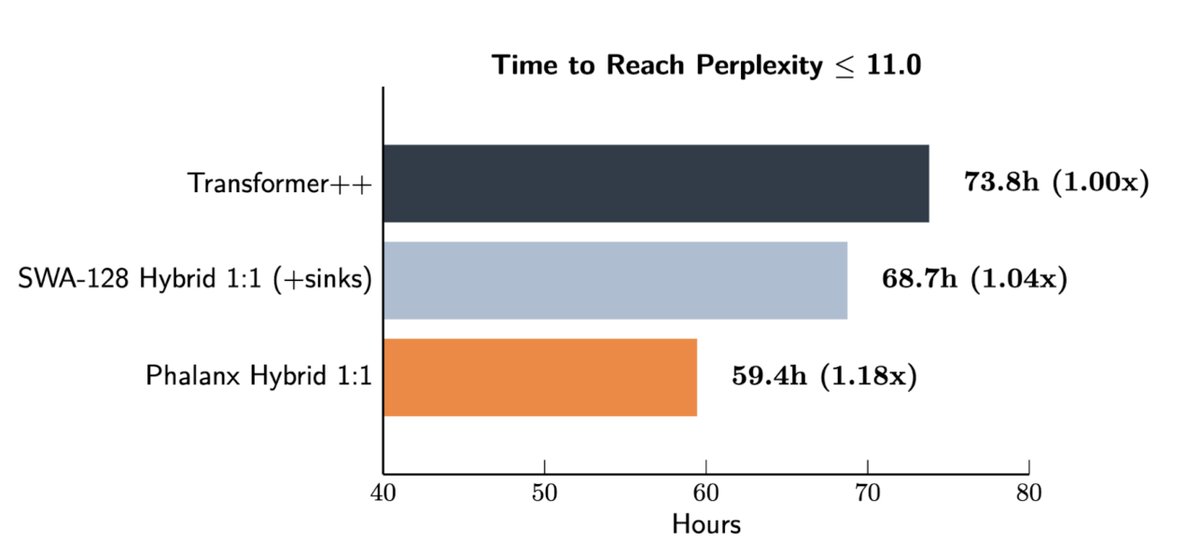
Introducing Phalanx, a faster and better quality drop-in replacement for sliding window attention (SWA).
Phalanx is a new family of hardware and numerics-aware windowed layers designed with a focus on data locality and jagged, block-aligned windows that map directly to GPUs.
In training, Phalanx delivers 10–40% higher end-to-end throughput at 4K–32K context lengths over optimized SWA-hybrids and Transformers by reducing costly inter-warp communication.
Today, we are releasing both the technical report, a blog, and Phalanx kernels in spear, our research kernel library.
We are hiring.
Introducing RND1, the most powerful base diffusion language model (DLM) to date.
RND1 (Radical Numerics Diffusion) is an experimental DLM with 30B params (3B active) with a sparse MoE architecture.
We are making it open source, releasing weights, training details, and code to catalyze further research on DLM inference and post-training.
We are researchers and engineers (DeepMind, Meta, Liquid, Stanford) building the engine for recursive self-improvement (RSI) — and using it to accelerate our own work. Our goal is to let AI design AI.
We are hiring.
Excited to be at #NeurIPS2024 presenting our LLM+EA work with @fedebotu, Chuanbo Hua, & Haeyeon Kim: ReEvo: Large Language Models as Hyper-Heuristics with Reflective Evolution!
Come check out our poster on Thursday at 4:30 pm, West Ballroom A-D (#6009). Hope to see you there!