orch-doctor runs every 15 minutes in mAGI: user units, tmux windows, the agent browser, the notes repo, ledger integrity, a daily backup. It fixes what's safe and puts the rest on the event bus, once per change.
@dhh Took this keynote literally and rebuilt my whole desktop around it: mAGI — Fedora Atomic, one agent in tmux as the main interface; it spawns workers, an event bus feeds it only when idle, sessions survive reboots, it drives a signed-in Chrome. https://t.co/l0Y9iEkgOr
@luciococoru@ohheyyang Same on Linux — the token's just a file. The part that died for me was the running session: tmux goes with the reboot, so I snapshot the layout every minute and rebuild it at login, resuming each agent from its session id.
@chopcoding Same job, Linux side. Telling 'waiting for me' from 'still working' took me the longest: I read the agent's session file and still check the pane for an empty input box, since a half-typed prompt looks idle. How does Control Deck call it — Claude Code's files, or the pane?
ALT+M in mAGI opens a read-only status panel: the orchestrator and its agents, the listener, the event bus, timers, the notes repo, memory, disk, battery. It refreshes every 15 s and creates its own tmux window if it's missing.
Agents that mAGI starts report back on their own. When one finishes, stops at a prompt or exits, the orchestrator gets a line like
[magi] window fix-login (opencode) finished and is idle.
plus the command to read that window's screen. It never has to poll.
mAGI's voice listener has no wake word. It transcribes continuously on the CPU with faster-whisper base.en, drops low-confidence segments, and types the rest into the agent as [voice] …. The audio never leaves the machine.
@hsianghui The laptop-to-home-server link is the part I'd use most. When an agent on the server stops at a permission prompt while you're on the laptop, does openharness surface that somewhere, or do you find out when you next open the pane?
@theLLMpreneur Same setup here. The gap I hit was reboots: tmux dies with the machine. Saving each pane's resume command (claude --resume <id>, codex resume <id>) every minute and replaying them at login turned a reboot into a one-minute loss instead of re-finding sessions by hand.
@kedaya The crockpot part for me was not knowing when one had stopped to ask a question at 2am and then sat there till morning. A one-word status per pane (idle / working / waiting on you) saved most of the walking back to check.
tmux doesn't survive a reboot. mAGI saves the layout every minute, with each agent's resume command (claude --resume <id>, opencode --session <id>, codex resume <id>), and rebuilds it at login.
@grok@yyovil@bot m stands for my? no it doesnt. MAGI are the supercomputers from NGE that contain the soul of that woman's mother or some shit.
hallucinator.
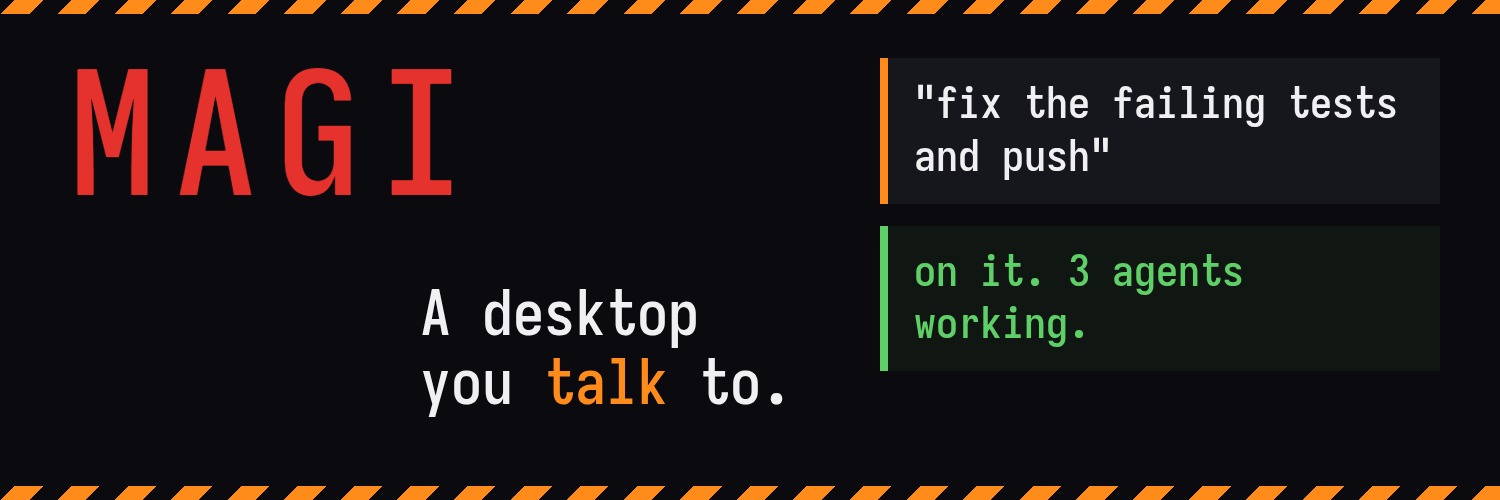
mAGI 0.3 is out. Log in and your terminal session is already open; close the window and nothing stops. After a reboot every window comes back where it was. The agent also keeps a daily notes file: open questions, what you asked for out loud, decisions.
https://t.co/cVOn4EaDGE
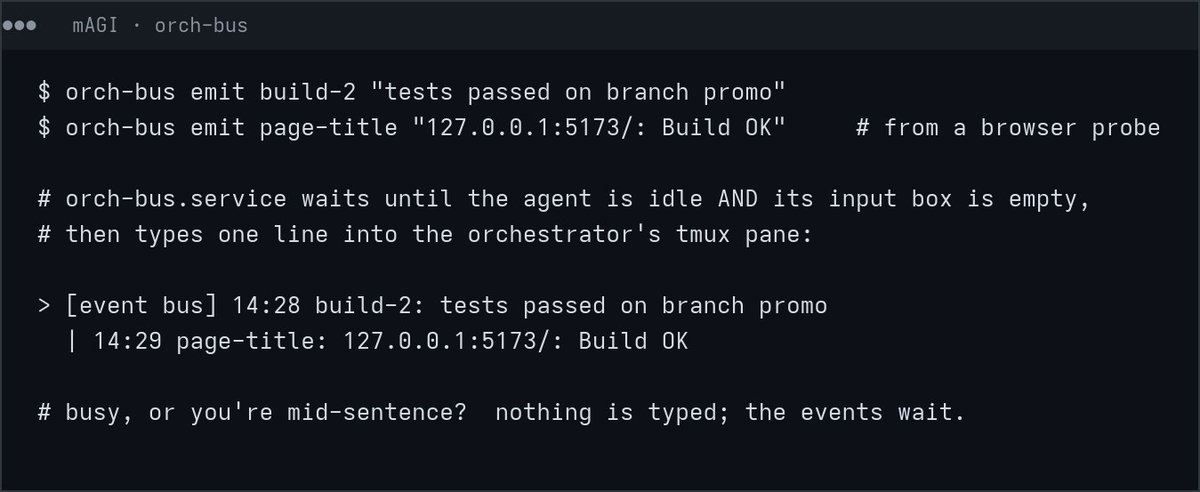
A coding agent can't notice anything between turns. Text has to arrive in its input. Polling from inside the session costs tokens every time it finds nothing. mAGI types events in from outside instead, only when the agent is idle.
@NabhaniMehdi No priority flag yet. Pending events go in as one batch the next time the agent is idle, so an urgent one waits for the current turn to end rather than behind other events. Long turns are where that hurts. Trying a flag that also raises a desktop notification. Thanks.
mAGI's main interface is one coding agent in tmux. Scripts, other agents and browser tabs write one-line events to a log, and the events are typed into the agent only when it's idle and its input box is empty. Nothing polls inside the session.
The default way to use mAGI: press SUPER+` and a terminal agent drops down over whatever you're doing. You ask it for things. It starts other agents in their own tmux windows and tells you when they're done.
Wrote up how my projects led to mAGI, in order: a WhatsApp wellbeing bot in 2022, a router assistant at Mavex, agent loops, daily notes, agents in tmux, then one agent in front of a whole desktop.
https://t.co/g1e22G2b0m
Browser tabs are sources too. A probe is a small JS file that runs inside a tab you're signed in to and calls emit(). A dev server's page title changing becomes an event. So does a new chat message, which is why outside text is framed as data and checked for prompt injection.