Rodei a mesma pergunta de investidor em cinco IAs: ChatGPT, Claude, Gemini, Perplexity e Copilot.
Voltaram 19 fontes. Cinco eram de asset. Nenhuma de gestora independente.
Isso não é sorte nem qualidade de análise. É técnico, e dá para mapear.
This is sad!
You may or may not know, @TrustWallet faced this exact same bug years ago, a pseudo-random number generator, ie, not truly random, $12m in losses. They covered every user.
Software will always have bugs. What matters is who’s behind it.
The Illusion of Opportunity
Imagine you and I became business partners and decided to buy rental properties in Manhattan. Before looking at a single apartment, we agreed on one simple rule. The economics had to make sense. If our total monthly costs were $5,000, we wanted at least $6,000 in rent so we’d earn a reasonable profit.
Now imagine we started searching today. What are the chances we’d actually find a property that met those standards? Probably very small. Even if we worked hard, called brokers every day, analyzed hundreds of listings, and spent months searching, we’d probably find very few truly attractive opportunities in an entire year.
That shouldn’t surprise anyone. Every apartment requires a willing seller, and most sellers aren’t stupid. They generally want the highest price they can get, just like you would if you were selling your own apartment. Great properties offered at sensible prices are rare by definition.
Now let’s compare that to the stock market. Somehow investors believe bargains appear every day. They feel like they should always be buying something, even if they only looked at a company for fifteen minutes. I think that’s one of the biggest mistakes investors make.
The stock market hasn’t created more opportunities. It has simply made buying easier. Today you can become a part owner of almost any business in the world with the click of a button. The ease of buying tricks us into believing opportunities must also be easy to find.
Think about buying an engagement ring. If I told you to go shopping this afternoon, would you honestly expect to find an incredible diamond at half price? Probably not, because valuable assets rarely go on sale without a very good reason.
The same is true if I asked you to buy a Ferrari, a Picasso, or an apartment overlooking Central Park. You wouldn’t assume the seller suddenly decided to become generous. You’d assume the price was probably fair unless you discovered something everyone else had missed.
Stocks aren’t any different. Every share you buy has someone else choosing to sell it. Sometimes that’s another individual investor. Sometimes it’s a hedge fund, pension fund, or institution with billions of dollars and hundreds of analysts. That doesn’t mean they’re always right, but it should make you stop and think.
Instead of asking yourself, “Why should I buy this business?” ask a different question. “Why is someone willing to sell me part of this wonderful business at this particular price?” That’s a much harder question, and it’s usually a much more important one.
I think the biggest reason investors overtrade is because buying stocks is almost frictionless. If buying a business required months of meetings, lawyers, inspections, financing, and paperwork, we’d all become much more selective. Instead, we mistake convenience for opportunity and lower our standards without even realizing it.
Sometimes we also fool ourselves with randomness. A stock falls twenty percent, and we immediately convince ourselves it’s cheap. Another stock rises thirty percent, and we convince ourselves we missed the opportunity. Neither conclusion necessarily has anything to do with value.
The world’s best real estate investors don’t buy twenty buildings every year. The world’s best private equity firms don’t acquire companies every month. They spend most of their time waiting because they know extraordinary opportunities are rare.
Why should the stock market be any different? Most investors don’t suffer from a lack of opportunities. They suffer from a lack of patience. They feel uncomfortable holding cash, uncomfortable waiting, and uncomfortable watching others make moves while they do nothing.
1/2👇
Dans le manifeste "techno-optimiste" de Marc Andreessen, il y a une phrase qui m'a marqu�� :
"Our enemies are not bad people – but rather bad ideas."
Nos ennemis ne sont pas des mauvaises personnes. Ce sont des mauvaises idées.
Prenons Jancovici. L'homme est brillant, sincère, travailleur. Il ne se lève pas le matin en se disant qu'il va nuire à l'humanité. Mais l'idée qu'il porte la décroissance, le rationnement, la frugalité érigée en horizon civilisationnel est une idée profondément destructrice. Elle prend des esprits brillants et les transforme en commissaires politiques d'un futur appauvri.
Et le plus fascinant, c'est ce que cette idée fait aux gens qui l'adoptent.
Dans mon entourage, une grosse partie de mes amis est sur cette ligne décroissantiste, avec tout le package qui va avec. L'argent c'est mal mais ils en veulent. Il faut moins prendre l'avion mais ils rêvent de voyager partout. Il faut consommer moins mais ils ne renoncent à rien de ce qu'ils aiment vraiment.
Et tous ont un point commun : ils sont déprimés. L'un d'eux m'a même confié qu'il était sous antidépresseurs.
Ce n'est pas un hasard. C'est mécanique.
Quand tu crois que ton désir de vivre, de créer, de t'élever est moralement suspect tu te détruis de l'intérieur. Tu passes ta vie à t'excuser d'exister. Tu vis dans la dissonance permanente entre ce que ton corps veut (plus, mieux, plus loin) et ce que ton idéologie t'ordonne (moins, sobre, immobile).
D'où ma théorie :
Quand on pense quelque chose de fondamentalement faux décroissance, communisme, extrémisme religieux (de tout ordre) ce n'est qu'une question de temps avant que ça devienne vraiment destructeur.
D'abord pour soi. Puis pour les autres.
Les mauvaises idées tuent. Lentement chez ceux qui y croient, brutalement chez ceux qui les subissent.
C'est pour ça que la bataille des idées n'est pas un luxe d'intellectuel. C'est la bataille la plus importante de notre époque.
🚨 THE ENTIRE AI BOOM MIGHT BE BUILT ON FAKE REVENUE.
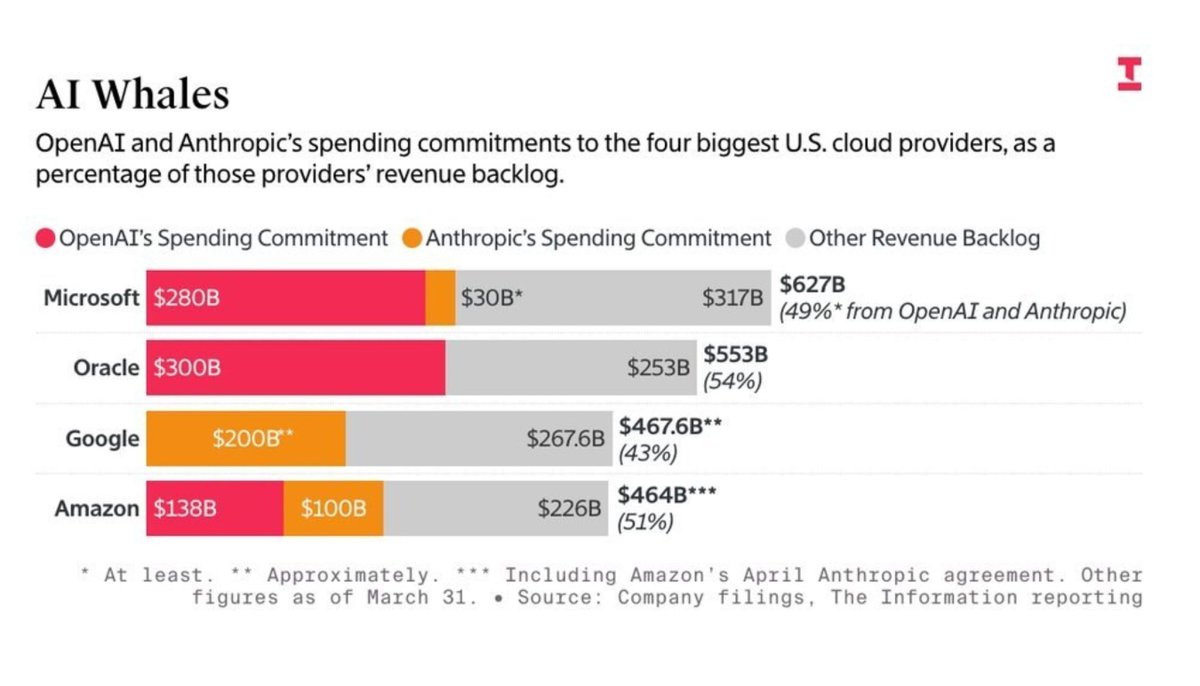
Latest corporate filings show that OpenAI and Anthropic alone make up over half of the entire $2 trillion future cloud backlog held by Microsoft, Oracle, Google, and Amazon.
This massive pipeline is actually being created through a circular accounting trick called a round trip revenue loop.
But how it works ?
A tech giant gives billions of dollars to an AI startup as an "investment". But hidden in the contract is a strict rule forcing the startup to hand that exact same money straight back to the tech giant to rent their computer servers.
Look at the documented case of Microsoft and OpenAI.
When Microsoft invested $13 billion into OpenAI, it didn't just give them cash; it gave them "cloud credits" to use Microsoft servers. OpenAI used those exact credits to train its AI models, and Microsoft then turned around and recorded that server usage as brand new "cloud revenue" from a customer.
The tech giant is literally paying itself with its own money and calling it a sale.
This is why OpenAI’s annual cloud bill has ballooned to over $60 billion, double its actual revenue of $25 billion, kept alive solely by this recycled funding loop.
Anthropic runs the exact same play, spending $2.66 billion on Amazon Web Services in just nine months, which was basically 100% of all the money it earned at the time.
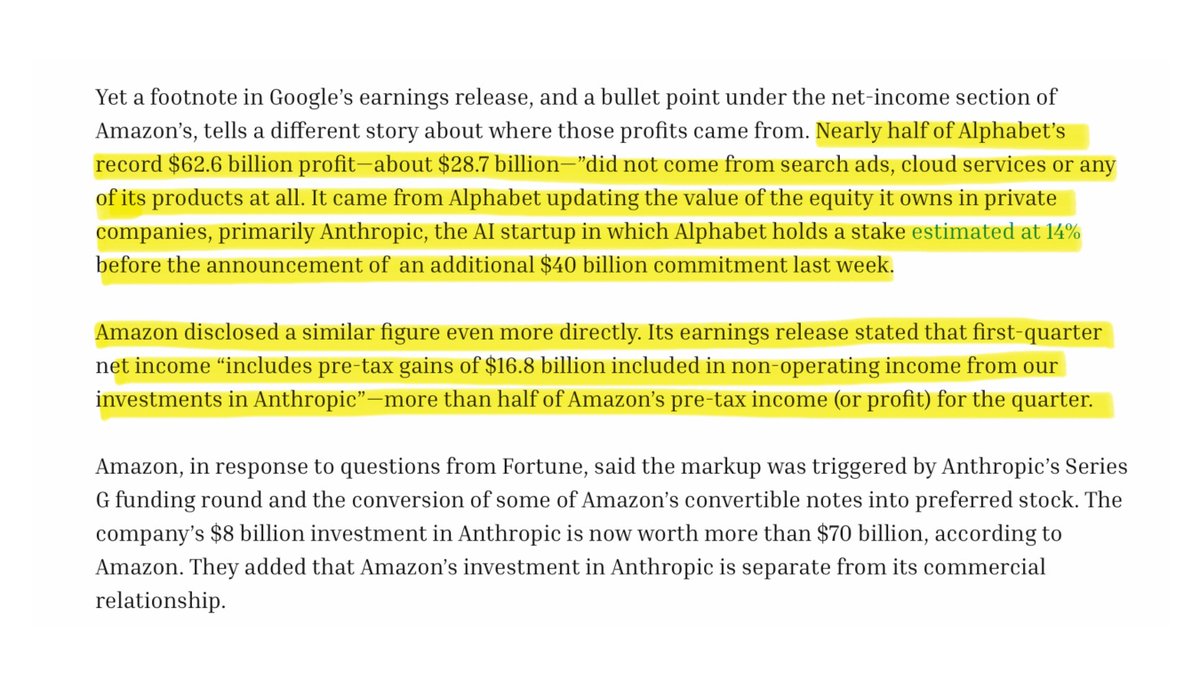
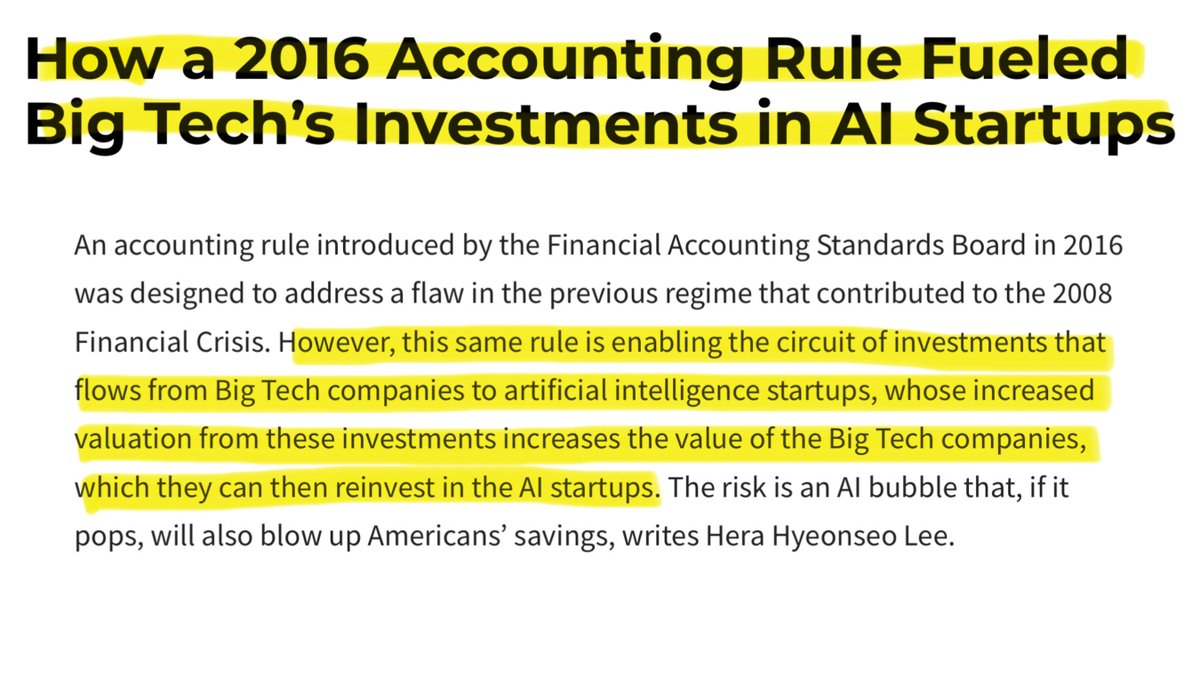
This manufactured demand triggers a second accounting trick where tech giants book massive paper profits. Every time a startup gets a higher value from a new funding round, the tech giant updates the value of its investment on its books and counts that unearned paper gain as direct profit.
In Q1 2026, Alphabet reported a record $62.6 billion profit, but $28.7 billion nearly half, was just a paper markup on its Anthropic investment. In the same quarter, Amazon reported $30.3 billion in profit, but $16.8 billion of it was just an Anthropic paper gain.
While Amazon reported record profits, its actual free cash flow collapsed 95% to just $1.2 billion because it had to spend $44.2 billion in real cash to build physical data centers.
This has created a massive danger where these giant companies rely heavily on just one or two unstable startups. Microsoft has 49% of its $627 billion future backlog tied to OpenAI, while Oracle has an incredible 54% of its entire $553 billion pipeline relying on OpenAI alone.
This perfectly mirrors the 2001 dot-com crash when Global Crossing and Qwest Communications swapped identical fiber-optic network capacity with each other just to book fake sales.
Qwest had to erase $1.4 billion in fake income, and Global Crossing went completely bankrupt.
The only difference is that the dot-com swaps were illegal, but today's AI loop is fully legal under current accounting rules.
This legal loop inflates tech company stock prices, forcing automatic retirement accounts and index funds to buy even more of these tech stocks. It is a self feeding loop where investments, sales, and stock prices all go up on paper without the AI technology ever making real cash profits.
Personal update: I've joined Anthropic. I think the next few years at the frontier of LLMs will be especially formative. I am very excited to join the team here and get back to R&D. I remain deeply passionate about education and plan to resume my work on it in time.
Você recebe a resposta dentro do Google e vai entrar menos nos sites.
Resultado:
- menos tráfego
- menos pageviews
- menos receita de anúncios
- SEO tradicional perde força
@FearedBuck 2/ You can also read more here about some of the ways we make it easy to visit websites and find content from a range of sources via our generative AI features: https://t.co/vSBnZYelFc
Everyone that knows anything knows this.
OpenAI is the next Netscape, doomed and hemorrhaging cash, Microsoft is trying to keep it afloat while keeping it off balance sheet and sucking out the IP. So why do they keep getting funded? The whole industry NEEDS a 500 billion IPO ASAP.
Today I turn 55.
I’m the fittest, sharpest, and happiest I’ve ever been.
If I’m an outlier, it’s not because I’m built different or discovered a secret formula. The truth is far less glamorous:
It’s a million tiny choices, compounded over decades.
Here are 55 of them:
1. Walk 15+ miles a week, even if you do other exercise. Humans are uniquely made to move slowly over long distances—it’s critical to longevity.
2. Develop a writing practice. It’s the single best way to sharpen your mind. And remember, you don’t have to be a good writer to write. Start with 10 minutes a day.
3. Swap out your toothpaste, deodorant, lotions, soap, shampoo, and other personal care products for natural versions. Here’s a rule of thumb: Don’t put anything on your skin that you couldn’t safely eat.
4. If you have a positive thought about someone, don’t keep it to yourself—share it immediately. Encouragement defies the laws of physics: When you give energy, you also receive it.
5. Wear shoes with a wide forefoot (I like Topo Athletic) and wear toe spreaders around the house (search “yoga toes” on Amazon). Spine health begins with the feet.
6. Get sunlight regularly. Moderate sun exposure (without sunscreen) is hugely important for overall health.
7. Do a 3-minute deep (“ass to grass”) squat every morning. Deep squats are often called the anti-aging exercise. It’s been said that, “It’s not that you can’t do deep squats because you’re old, it’s that you’re old because you can’t do deep squats.”
8. Explore minimalism (it’s not what you think it is).
9. Set boundaries on toxic relationships. We tend to cling to relationships past their expiration date, and it takes a bigger toll on our health than we recognize.
10. Eat real food. Not too much. Don’t eat garbage. Binge occasionally. Fast occasionally. That’s the diet.
11. Learn about FIRE. It’s a great framework for financial success.
12. Don’t take antibiotics except in emergency situations. They’re massively over-prescribed and aren’t needed in most cases. Antibiotics have done untold damage to our guts, which is where health begins. Great natural alternatives are out there.
13. Get 8 hours of quality sleep each night. To optimize sleep:
—Don’t eat after 6pm
—Get blackout shades and cover LEDs with black tape
—No screens 2 hours before bed
—Try ashwagandha (an herb) to calm the nervous system
14. Stop drinking, even in moderation. People find all sorts of ways to justify drinking, but there’s no escaping the simple fact that alcohol is a toxin and it limits your potential.
15. Travel as much as possible. Nothing expands the mind like seeing the world. And travel doesn’t have to be expensive—the best experiences happen outside of fancy resorts, when you live like a local.
16. Let go of resentment. When you forgive someone, you release the prisoner, and the prisoner isn’t them… it’s you.
17. Show up on time, every time. Poor time management limits success more than most people realize. If you struggle with punctuality, stop everything else and fix that first.
18. Spend lots of time in nature and touch the earth. Humans evolved over 300k years to live in harmony with nature, and only recently have we retreated indoors. If you don’t spend time outside, you’re fighting biology (hint: You won’t win.)
19. Stop doing dumb things. As Leo Tolstoy said, “People try to do all sorts of clever and difficult things to improve life instead of doing the simplest, easiest thing—refusing to participate in activities that make life bad.”
20. Find your happy place and (eventually) move there. Most people live where they live because... that's where they live. We are products of our environment—choose yours carefully.
21. Find a hobby and pursue mastery. You can’t have a happy life without a passionate pursuit that isn’t your vocation. Your work—even if you enjoy it—isn’t enough.
22. Avoid mainstream medicine except as a last resort. The results are in—our healthcare (or more appropriately, sick care) system is badly broken and only makes people sicker.
23. Have a mindset of abundance. There is no advantage to being a pessimist—even if you’re right, it’s a miserable way to live. In a very real way… whatever you believe, you’re right!
24. Do hard things. Choose courage over comfort. Everything you want is on the other side of fear and hard work. As Jerzy Gregorik said, “Hard choices, easy life. Easy choices, hard life.”
25. Ignore haters. Hurt people hurt people. Negative/toxic people live in a prison of their own design. Don’t join them!
26. Say no. Protect your time and energy like it’s your most precious asset… because it is.
27. Become a water snob. As an alien said on Star Trek, humans are “ugly bags of mostly water.” You are what you drink—literally! We have Mountain Valley Spring water delivered in glass 5-gallon jugs and also have whole-house water filter (Aquasana Rhino).
28. Stop drinking sodas and sugary energy drinks. After a few weeks you won’t miss them, and a few months later they’ll seem disgusting. Refined sugar causes inflammation, which is the root of most disease.
29. If you’re over 35, find a good functional/longevity medicine doctor and start tracking your hormones. Modern life is hell on the endocrine system and restoring healthy hormone levels can change your life. As we get older, we either accept a slow decline in performance or we do something about it—choose the latter!
30. Develop a morning routine and follow it faithfully. Win the morning, win the day!
31. Invest in experiences, not things. People frequently regret buying things, but rarely regret investing in great experiences (especially when shared with loved ones). Remember, there’s nothing you can buy in a mall that you’ll remember in ten years.
32. Explore spirituality. It’s arrogant and small-minded to believe there’s nothing going on in our universe that is beyond our comprehension. We know less about our universe than an ant meandering on a sidewalk understands about this planet.
33. Have a strong bias toward action—doing rather than talking. If you ask a bunch of old people about their regrets, they’ll talk about the things they *didn't* do—the shots they didn’t take—more than the things they did do (even if it went wrong). As Wayne Gretzky famously said, “You miss 100% of the shots you don’t take.” Most people don’t take enough shots.
34. Stay lean. Men in particular are obsessed with muscle mass these days, but bulk doesn’t age well. The goal is to be strong but lean. The fittest guys in their 50s and beyond aren’t meatheads, they’re lean guys who are serious about a sport.
35. Curate your inner circle carefully. Surround yourself with people you admire and who challenge you to grow. Remember, we’re the average of our 5 closest relationships.
36. Be the fittest version of yourself. Your body is your only vessel for experiencing life—so treat it as such. Fitness isn’t working out a few times a week, it’s a lifestyle. The older you get, the more time you need to devote to your health.
37. Take the time to appreciate art and beauty in all its forms.
38. Think globally, but act locally. Too many people put their energy into far-away problems they don’t understand and can’t impact, while ignoring problems right under their nose. Want to change the world? Start at home.
39. Try psychedelics. It’s one of those things everyone should do at least once, and it might be the breakthrough you’ve been looking for.
40. Limit bad habits, including unhealthy thought patterns. We all have them—practice avoidance and find substitutes. Get professional help if needed.
41. Be a lifelong learner. Your brain is just like a muscle—if you don’t feed and flex it regularly, it will atrophy.
42. Find your purpose. People with a strong sense of purpose are happier and live longer. Lack of purpose sucks energy and magnifies depression.
43. Only take advice from people who embody the traits you want to have. Talk is cheap—emulate those who have DONE it.
44. The goal is not to retire and do nothing, it’s to build a great day-to-day life that you don’t need to escape. A life of leisure is a slow death. Happiness isn’t possible without a little struggle, uncertainty, and skin in the game.
45. Have fun! Do frivolous and silly things that make you smile. As George Bernard Shaw famously said, “We don't stop playing because we grow old; we grow old because we stop playing.”
46. Whatever you want to do or achieve in life, start NOW. Don’t fall victim to “someday thinking” because someday never comes.
47. Accumulate assets—things that grow in value over time. It’s the #1 habit of rich people, and it can be done in tiny chunks. Instead of spending $100 on an impulse purchase that has no lasting value, put that money into an index fund or Bitcoin. It becomes addictive (in a good way).
48. Don’t ignore the big 3 canaries in the coal mine for health:
—Low libido (and ED)
—Frequent sinus & respiratory issues
—Depression
These usually aren’t medical conditions in themselves, they’re symptoms of an underlying problem. Find a good doc (outside of the mainstream) and figure out the root cause.
49. Have a clear vision for your future. How can you decide which direction to go if you haven’t clearly defined the destination? It sounds obvious, but 95% of people haven’t defined their “Ideal End State” in detail and in writing. (Check out my thread on this topic.)
50. Make your own decisions. We live in an era where most of what society tells us is wrong. Don’t be afraid to break from societal norms—if people say you’re crazy, it’s a sign that you’re doing something right.
51. Get hardcore about mobility exercise. As you age, it’s usually the knees, hips, and lower back that limit physical performance. 30 min a couple times a week can spare you a lifetime of pain. YouTube is a great resource.
52. Go all in on family. Get married, stay married, have kids. Burn the boats. In the end, family is all that matters.
53. Be ruthless with your time. Money comes and goes. Time only goes. Audit your calendar ruthlessly—cut the trivial, double down on the meaningful, and spend your hours like your life depends on it. (Because it does.)
54. Have a strong bias toward action. Be curious, try things, meet people—it’s how you increase your surface area for serendipity, the most powerful unseen force in our lives.
55. Reinvent yourself every decade. Over time, we slowly drift off course from our priorities, values, and true identity. Take stock and don’t be afraid to hit the reset button. Bold, calculated moves made for the right reasons almost always pay off—usually even more than you can imagine.
🎁 P.S. If you enjoyed this post, would you give me a birthday gift? Repost or comment with the item number(s) you liked best?
O Bitcoin não está caindo por pânico ou notícia isolada.
O que está acontecendo é maior: todos os pilares que sustentaram a alta de 2024 e 2025 quebraram ao mesmo tempo.
Liquidez global, ETFs, MSTR, miners, sentimento, demanda estrutural.
Um reset completo.
BREAKING: The $610 Billion AI Ponzi Scheme Just Collapsed
Last night at 4pm EST, something unprecedented happened. Nvidia stock rallied 5% on earnings, then crashed into negative territory within 18 hours. Wall Street algorithms detected what humans couldn’t: the numbers don’t add up.
Here’s what they found.
Nvidia reported $33.4 billion in unpaid bills, up 89% in one year. Customers who bought chips haven’t paid for them yet. The average wait time for payment stretched from 46 days to 53 days. That extra week represents $10.4 billion that may never arrive.
Meanwhile, Nvidia stockpiled $19.8 billion in unsold chips, up 32% in three months. But management claims demand is insane and supply is constrained. Both cannot be true. Either customers aren’t buying or they’re buying without cash.
The cash flow tells the real story. Nvidia generated $14.5 billion in actual cash but reported $19.3 billion in profit. The gap is $4.8 billion. Healthy chip companies like TSMC and AMD convert over 95% of profits to cash. Nvidia converts 75%. That’s distress level.
Here’s where it gets criminal.
Nvidia gave $2 billion to xAI. xAI borrowed $12.5 billion to buy Nvidia chips. Microsoft gave OpenAI $13 billion. OpenAI committed $50 billion to buy Microsoft cloud. Microsoft ordered $100 billion in Nvidia chips for that cloud. Oracle gave OpenAI $300 billion in cloud credits. OpenAI ordered Nvidia chips for Oracle data centers.
The same dollars circle through different companies and get counted as revenue multiple times. Nvidia books sales, but nobody actually pays. The bills age. The inventory piles up. The cash never comes.
AI company CEOs admitted it themselves last week. Airbnb’s CEO called it vibe revenue. OpenAI burns $9.3 billion per year but makes $3.7 billion. That’s a $5.6 billion annual loss. The $157 billion valuation requires $3.1 trillion in future profits that MIT research shows 95% of AI projects will never generate.
Peter Thiel sold $100 million in Nvidia on November 9. SoftBank dumped $5.8 billion on November 11. Michael Burry bought put options betting Nvidia crashes to $140 by March 2026.
Bitcoin, which tracks AI speculation, dropped from $126,000 in October to $89,567 today. That’s a 29% crash. AI startups hold $26.8 billion in Bitcoin as collateral for loans. When Nvidia falls another 40%, those loans default, forcing $23 billion in Bitcoin sales, crashing crypto to $52,000.
The timeline is now certain. February 2026, Nvidia reports fourth quarter and reveals how many bills aged past 60 days. March 2026, credit agencies downgrade. April 2026, the first restatement. The fraud that took 18 months to build unwinds in 90 days.
Fair value for Nvidia: $71 per share. Current price: $186. The math is simple.
This is the fastest moving financial fraud in history because algorithms detected it in real time. Human investors are 90 days behind.
Read the full data driven deep dive article here - https://t.co/sDEf5Mdrtc
🇧🇷 ALERT: A WhatsApp worm is spreading in Brazil and infecting phones with the Eternidade Stealer trojan, stealing access to crypto wallets and banking apps.
Stay safe.
Peter Thiel: If you graduated in 1970 with no student debt, compare that to the millennial experience: too many people go to college, they don’t learn anything, and they end up with incredibly burdensome debt. Student debt is a version of this generational conflict that I’ve talked about for a long time.
The rupture of the generational compact isn’t limited to student debt, either. I think you can reduce 80 percent of culture wars to questions of economics—like a libertarian or a Marxist would—and then you can reduce maybe 80 percent of economic questions to questions of real estate.
It’s extremely difficult these days for young people to become homeowners. If you have extremely strict zoning laws and restrictions on building more housing, it’s good for the boomers, whose properties keep going up in value, and terrible for the millennials. If you proletarianize the young people, you shouldn’t be surprised if they eventually become communist.”
David Sacks says the biggest risk of AI was described not by James Cameron in The Terminator but by George Orwell in 1984.
“I almost feel like the term ‘woke AI’ is insufficient to explain what’s going on because it somehow trivializes it.”
“What we’re really talking about is 'Orwellian AI.' We’re talking about AI that lies to you, that distorts an answer, that rewrites history in real time to serve a current political agenda of the people who are in power.”
“To me, this is the biggest risk of AI... It’s not The Terminator, it’s 1984.”
@DavidSacks