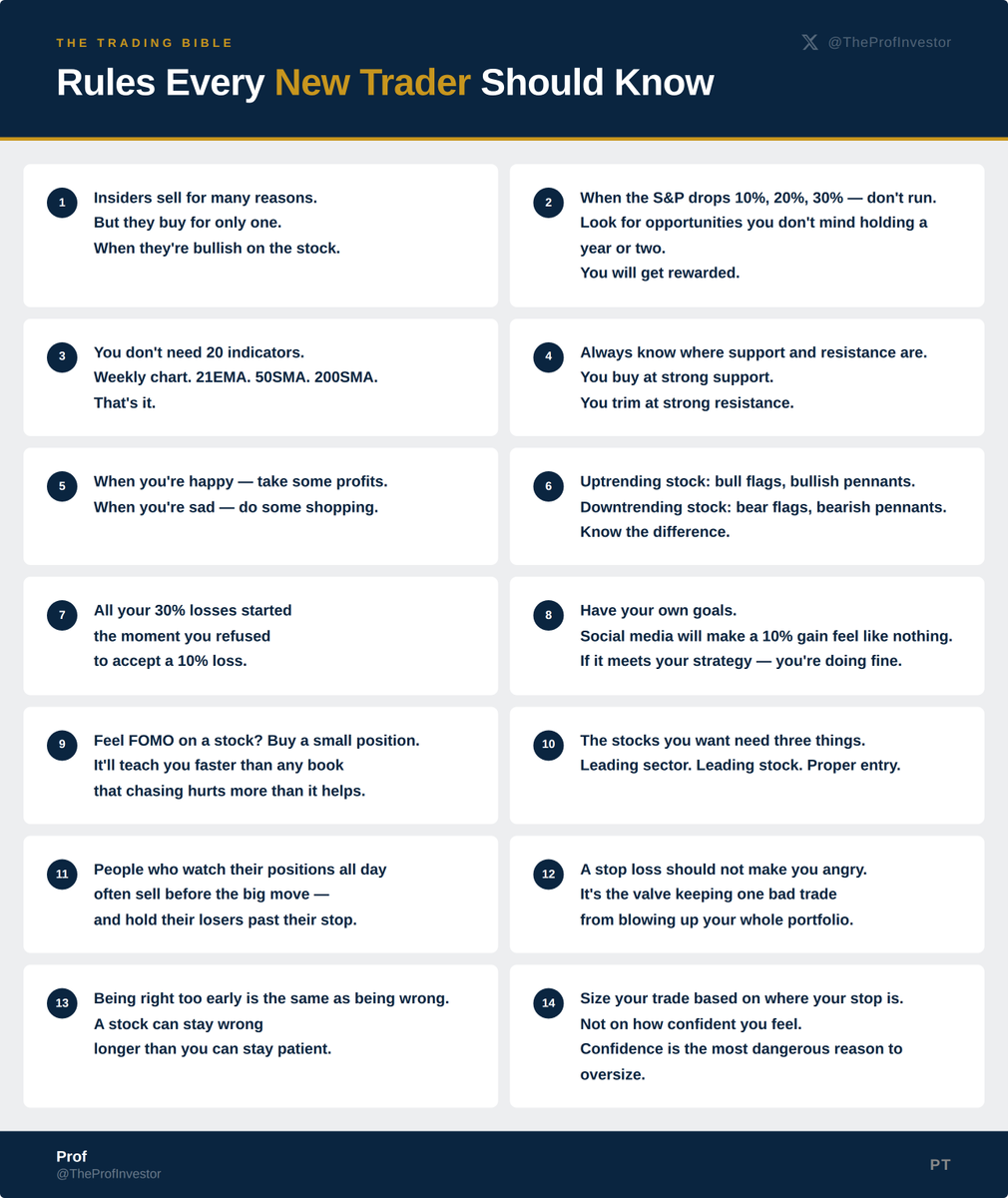
Rules that every New Trader must know about.
I broke every single one of them more times than I'd like to admit. And they taught me expensive lessons.
Save this. Share it with someone who needs it.
-Prof
The myth of buy and hold.
Funny how it works. So many "advisors" out there say, time in the market, not timing the market.
You probably guessed by now what I want to say: it's bullshit.
If one bought stocks in 1999, they got breakeven in 2015, 16 years. If one bought stocks in 1966, they got breakeven in 1984, 18 years. If one bought stocks in 1929, it took 45 years to break even.
The markets are always the same, in a manner that they always keep changing.
Second myth: I can't possibly know and avoid the decline, they tell me I need financial advisors, they have employees, they know better.
Wrong on both counts. It can be easy to not hold downtrends. And they tell you that cause you are what they make living out of.
Trying to say, you're better than you think.
How can I have almost 24 000 followers and only get 89 reposts on this great work?
You do realize I’m probably the best X account in the world when it comes to sharing money making actions for free to you guys right?
Atleast step the game up sometimes and help out with some interaction and reposts! 👊🏽
I’m dissapointed!
@graddhytrading@graddhytrading I am subscribed for more than a year and still don't understand, you holding through DC or try to time them and sell before/on the day?
I can’t stress enough how important it is to trade stocks in a Stage 2.
If you’re a momentum trader, understanding market cycles can completely change the way you look at charts.
Stocks generally move through 4 stages:
Stage 1 — Basing / Accumulation
Stage 2 — Advancing / Markup
Stage 3 — Topping / Distribution
Stage 4 — Declining / Markdown
There are so many stocks coming out of a stage 1 into stage 2..
BUT
Most are focusing on stocks in stage 3/4 that have already "moved"
You NEED to trade stage 2 stocks because this is where the real momentum is.
This is when a stock has finished building its bottoming base, breaks out, and begins trending higher.
Instead of fighting through overhead supply, price is consistently making progress.
You start seeing:
-Higher highs and higher lows
-Price holding above rising moving averages
-Breakouts from established bases
-Strong volume coming into the breakout
-Lower volume during consolidation
-Relative strength compared to the overall market
-Momentum attracting more momentum
This is the setup I want to focus on.
One of the biggest mistakes newer traders make is thinking:
“This stock is down a lot, so it must be cheap.”
But a stock being down 50%, 60%, or 70% doesn't automatically make it a good opportunity.
It could simply be in a Stage 4 decline.
&
Trying to constantly pick the bottom of a Stage 4 stock can leave you catching falling knives while stronger stocks elsewhere in the market are already trending higher.
The same problem exists in Stage 1
A stock might be building a beautiful base…
But that base can continue for MONTHS.
Your job isn't necessarily to predict when Stage 1 will end.
Let the stock prove itself by transitioning into Stage 2:
You can have the greatest story in the world, but if price is stuck in Stage 4, you're fighting the trend.
Meanwhile, another stock could already be breaking out of a major base with expanding volume and entering Stage 2.
As momentum traders, we're not trying to predict where stocks should go.
We're trying to identify where momentum already exists and position ourselves around that strength.
Find the strongest stocks.
In the strongest sectors.
Breaking out of strong bases.
With volume confirming the move.
Then let Stage 2 do the heavy lifting.
Stop trying to force momentum where it doesn't exist.
Trade where the momentum already is...
So many good stocks coming out of a massive stage 1 base, that's where you focus should be
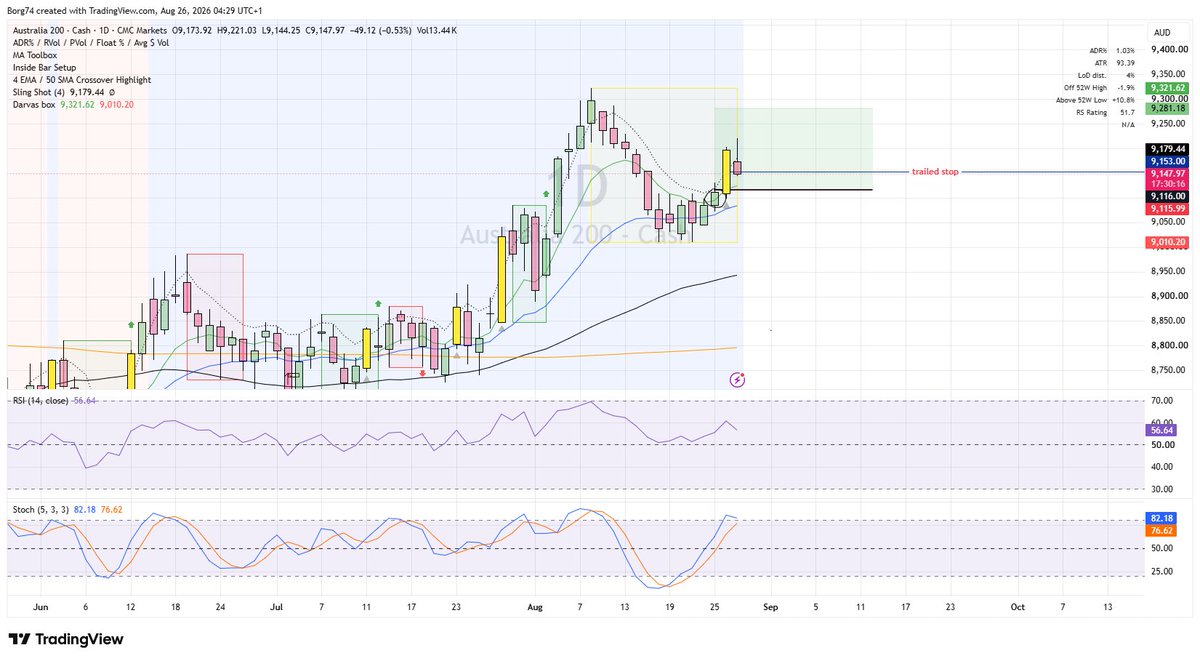
#Aussie200 No follow-through on the Aussie Index despite the Slingshot setup, so I tightened things up with a trailing stop and banked a smaller winner than I had hoped for.
You take what the market offers you.
Of course, you want to give a good trade room to run and capture the bigger move. But equally, at what point do you protect what the market has already given you rather than watch a profitable trade turn into a loser?
There is no perfect answer to that conundrum. Trade management will always be a balance between giving a winner room to breathe and protecting open profits when the expected follow-through fails to materialise.
Intelligent people live a boring life. They go to bed at 10. Wake up at 6. Eat simple foods. Go for long walks. Read thick books. Say no to things that drain them. The world chases excitement. But they chase calm. Things that align with their soul. A calm routine. A quiet mind. A healthy body. Meaningful work. A small circle. A private life. Their life may look boring from the outside. But from the inside, they experience a kind of freedom most people spend their entire lives searching for.
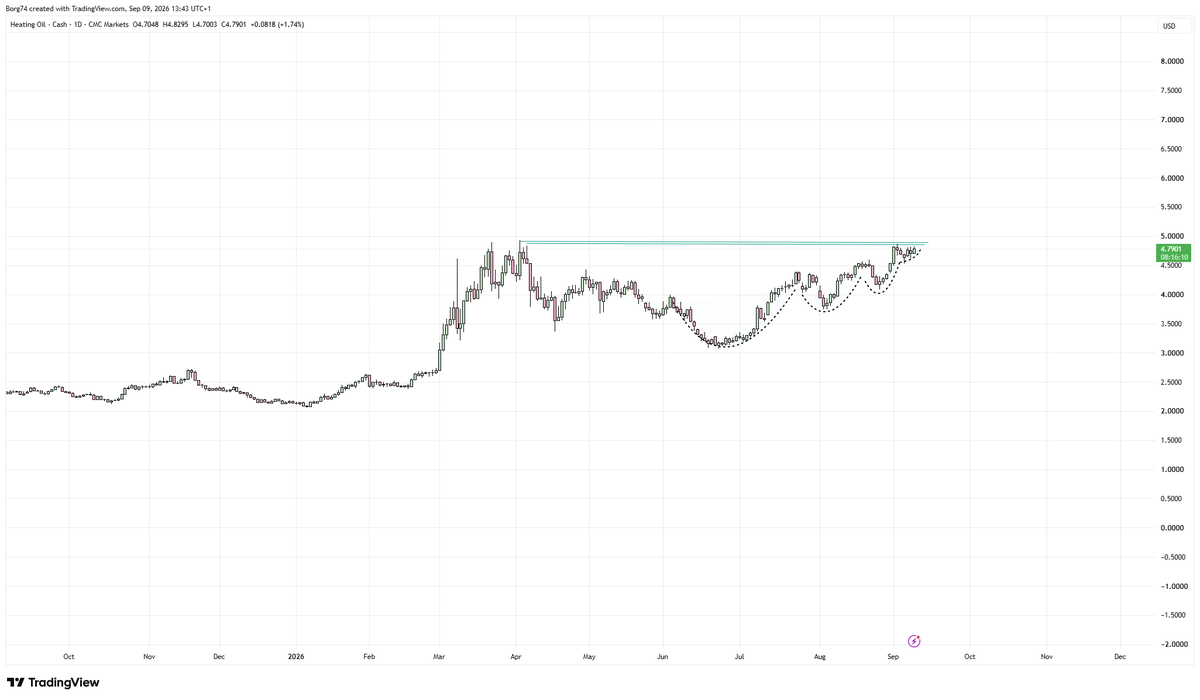
If you are a financial advisor and are not aware of this chart... you'll eventually be doing a disservice to your customers.
The next important market down turn, will fuel the ensuing capital rotation from speculative stocks to gold, silver, oil and other commodities.
TRADER WEEKEND ROUTINE
1: PROFESSIONAL TRADER PLAN
FRIDAY — REVIEW
Review every trade from the week.
Identify what worked, what failed, and why.
Study your biggest mistake—not your biggest win.
Update your trading journal.
Check your weekly P&L and risk management.
SATURDAY — STUDY
Review the weekly and daily charts.
Mark major support & resistance levels.
Study volume, price action, and market structure.
Build a watchlist of stocks showing strength.
Study one trading concept deeply.
SUNDAY — PREPARE
Scan the overall market: Bullish, bearish, or neutral?
Build your watchlist for the week.
Mark potential entry, stop-loss, and target levels.
Create different scenarios: If this happens → I do this.
Check the economic calendar and major market events.
Decide what you will NOT trade.
MONDAY — EXECUTE THE PLAN
Don't come to the market looking for a trade.
Come looking for your setup.
2: BEGINNER TRADER PLAN
FRIDAY
Check how much money you made or lost.
Blame the market for the bad trades.
Forget about the losing trades.
Start searching for the next “hot” stock.
SATURDAY
Watch random trading videos.
Jump between different strategies.
Add 20 new indicators to the chart.
Look for someone else's signals.
SUNDAY
Build a watchlist from social media.
Search for “100% breakout” stocks.
Change your strategy again.
Enter Monday without a real plan.
MONDAY
“Let’s see what the market gives me.”
And that's where the trouble usually begins.
The professional prepares before the market opens.
The beginner prepares after the trade goes against him.
Last week #gold +5.6% #silver +6.9% but still in a correction from the big gains earlier this year. If #PreciousMetals follow a normal seasonal pattern, expect an upward trend & higher prices into Q1. Then break out of the consolidation oval into new highs later this year or 2027