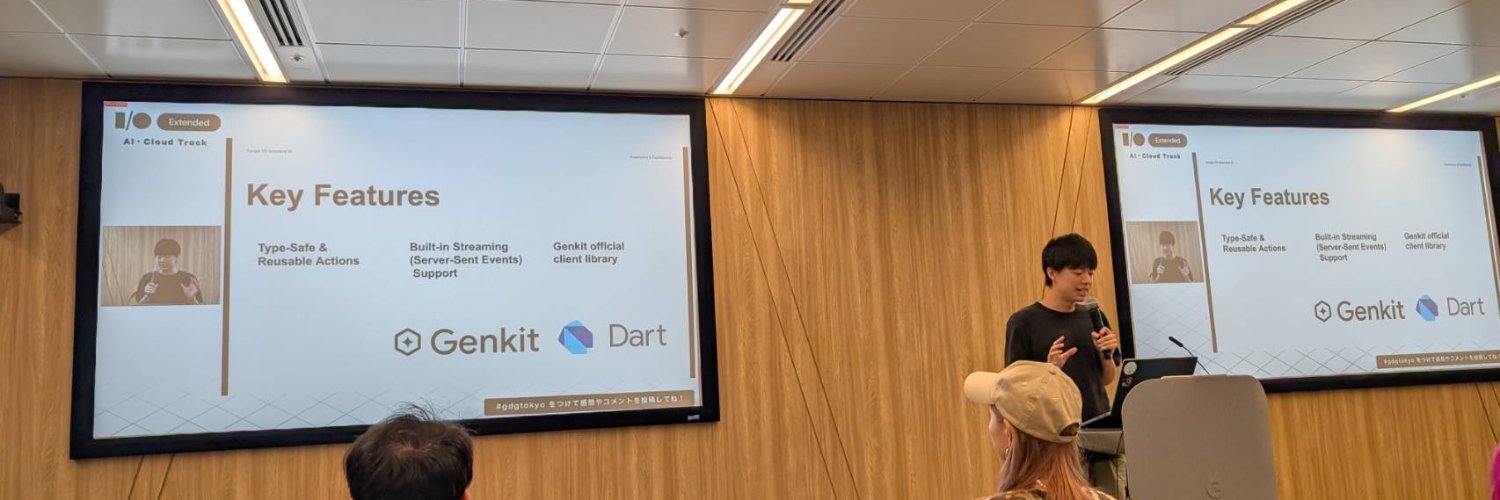
Since connecting through @GenkitFramework —a product I'm a big fan of—last summer, we ended up co-authoring a book, and today we finally met in person in Vegas!
This has been such a rich and meaningful time in my life.
Next time, let's meet up in Tokyo 🗼
I'd love to show you around! @Xavidop
Last summer I met a Japanese guy online and, somehow, we decided to write a book together about AI and @GenkitFramework .
Today, we finally met in person.
Funny how the internet works sometimes 🤝📚
It was a pleasure meeting you in person @fender_kn !!!
TerraDart 0.37.0 is out 🚀
Install the CLI with:
dart install terradart_cli
`dart install` builds an AOT-compiled native executable, so terradart starts faster than the old `dart pub global activate` setup, which ran on the Dart JIT VM.
Also in this release:
- Dart 3.12 is the new minimum
- `terradart --version`
- Provider updates: Google Cloud 8.12.0, AWS 6.73.0, Azure 5.14.0, Cloudflare 5.29.0, Appwrite 2.7.0
Built for the @dart_lang and @FlutterDev community.
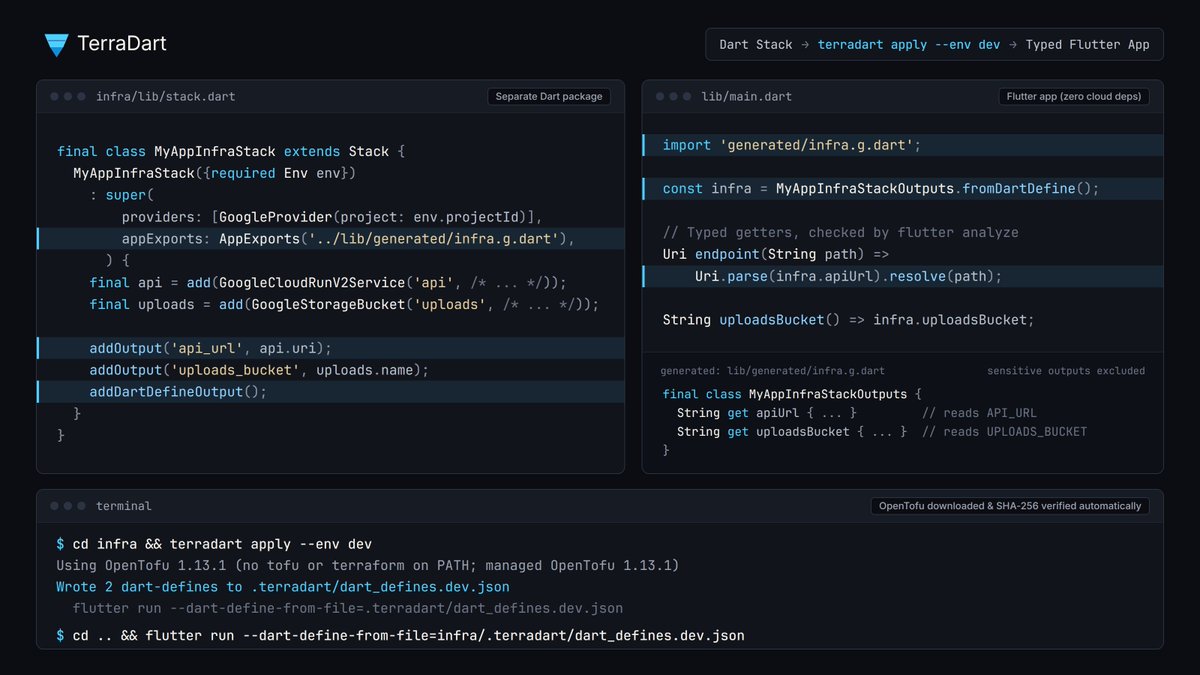
Write your cloud stack in Dart, run terradart apply --env dev, and read cloud outputs (API URLs, bucket names, and more) in Flutter with full type safety.
In a Flutter repo, terradart init creates a separate infra/ package writing lib/generated/infra.g.dart. Zero cloud deps.
After apply, terradart writes infra/.terradart/dart_defines.dev.json and prints the exact flutter run --dart-define-from-file command to boot with those values.
In Flutter:
const infra = MyAppInfraStackOutputs.fromDartDefine();
infra.apiUrl
infra.uploadsBucket
What you no longer wire by hand:
- No separate Terraform install: terradart fetches a pinned, SHA-256 verified OpenTofu binary on first use when tofu or terraform is not on PATH.
- No string-key drift: rename an output in Dart, run terradart synth, and flutter analyze flags every stale use in the app.
- Secrets stay out of the client binary: sensitive outputs are excluded from the define file by design.
- No infra write access in app CI: terradart outputs --env prd reads applied state and writes the define file with no plan and no apply.
Install: dart pub global activate terradart_cli
Walkthrough: https://t.co/gGDCYMcwZR
#FlutterDev #DartLang
we don't have to live this way. senior engineers have the duty of building guardrails and teaching the next generation of programmers the practices that lead to high quality software.
AIs may write most of the code, but you still decide what ships. we should never lose our taste for quality software.
i made this analogy a while back: everyone can cook at home but yet restaurants still exist. the floor is rising, but so is the ceiling. the best software will always be made by those who care.
@fender_kn It's so funny that I never heard of it until the release notes. Sounds like a phenomenal project that's potentially useful for everyone doing infrastructure work.
Great job!!!
Thank you, this made my day! I started TerraDart because I felt writing cloud infra in Dart too would bring out the best of the Flutter ecosystem. I've seen libraries I loved stop being maintained, so I'm building this one to last, with a dev experience that works for both AI agents and the humans building with them. Been doing it solo, so feedback like this means a lot 🙌
TerraDart is featured in What's new in Flutter 3.50 🎉
Highlighted in the package ecosystem section as a standout community package for defining cloud infrastructure in pure Dart.
Thank you to the Flutter team, to @AbdallahSh07 for always supporting TerraDart, and to everyone who has tried and shared it 💙
https://t.co/hbFzXY0S3J
Built for the @dart_lang and @FlutterDev community.
#Dart #Flutter
quick fixes considered harmful: you might be making your agents write worse code when you ask for the smallest or quickest possible change
what seems like a harmless bandaid may lead to that pattern being copied by the next agent. before you know it that pattern has spread everywhere
we used to write bandaid fixes by hand because we rarely had the time to do the right thing. agents change this calculus. sometimes you want it to fix the root cause instead even if it’s more invasive
How to turn slop into gold. Super concrete steps from awesome @poteto on making coding agents trustworthy:
1. Clean up the code your agents learn from.
Your codebase is one of their biggest inputs. Agents copy whatever looks like an established pattern, including workarounds, deprecated code, and yesterday’s questionable decisions. Clean those up, or watch them reproduce.
2. Turn corrections into enforceable checks.
Every time you correct an agent, ask: can this become a lint rule, a type constraint, a test, or a better API? Put the correction somewhere the system can enforce it. A growing AGENTS.md still requires the agent to follow every instruction.
3. Remove opportunities for predictable mistakes.
Her team @spacexai restricts React’s useEffect to framework internals because agents repeatedly misuse it in product code. They also enforce import boundaries between application processes. These constraints eliminate whole categories of mistakes that would otherwise keep coming back in review.
4. Give agents a reliable way to run and inspect the product.
Provide debugging tools, reusable CLIs, and a “feature map” describing the application from the user’s perspective. Now “that thing in the left sidebar” has a shared meaning, and each agent can reuse the tools for checking it.
5. Review evidence of behavior.
Have agents produce screenshots, videos, and state diagrams. These help you check what the product actually does and how closely that matches your intent. A convincing explanation of a fix is easy to generate; seeing the fix work is considerably more useful.
6. Spend serious effort on verification.
Her team uses runtime verification and is experimenting with property-based UI testing and formal methods, including TLA+ model checking. Lauren says most of her token usage goes toward verification. Agents make some previously expensive testing work much more practical.
7. Automate once that loop is reliable.
Her team now has agents exercise new releases, find bugs, open fixes, and merge them automatically. Getting to that level of trust took her about six months of investing in the environment.
The results she reports: 11,000 pull requests shipped by her team in a month, a revert rate around 0.5%, and improvements in startup, typing, and switching chats.
And what about infamous “software factory”?
if your coding loop produces slop, automating it produces more slop, faster, with a larger token bill.
Start by making good code the easiest thing for an agent to produce. Then scale it.
As always, content at @aiDotEngineer is gold 🏆
Introducing Grok Bot 1.0. AI teammates that work alongside your whole team.
Share Bots, collaborate with them in Slack and Teams, invite them to meetings, and watch them learn and become more helpful.
Your agents can now coordinate with your teammates’ agents.
Projects has been rebuilt for multiplayer: every teammate and their agents can now work together in one unified workspace.
Very cool getting this working across our ecosystem.
If you have a tool you use via `dart pub global` - make SURE it works with `dart run` and `dart install`.