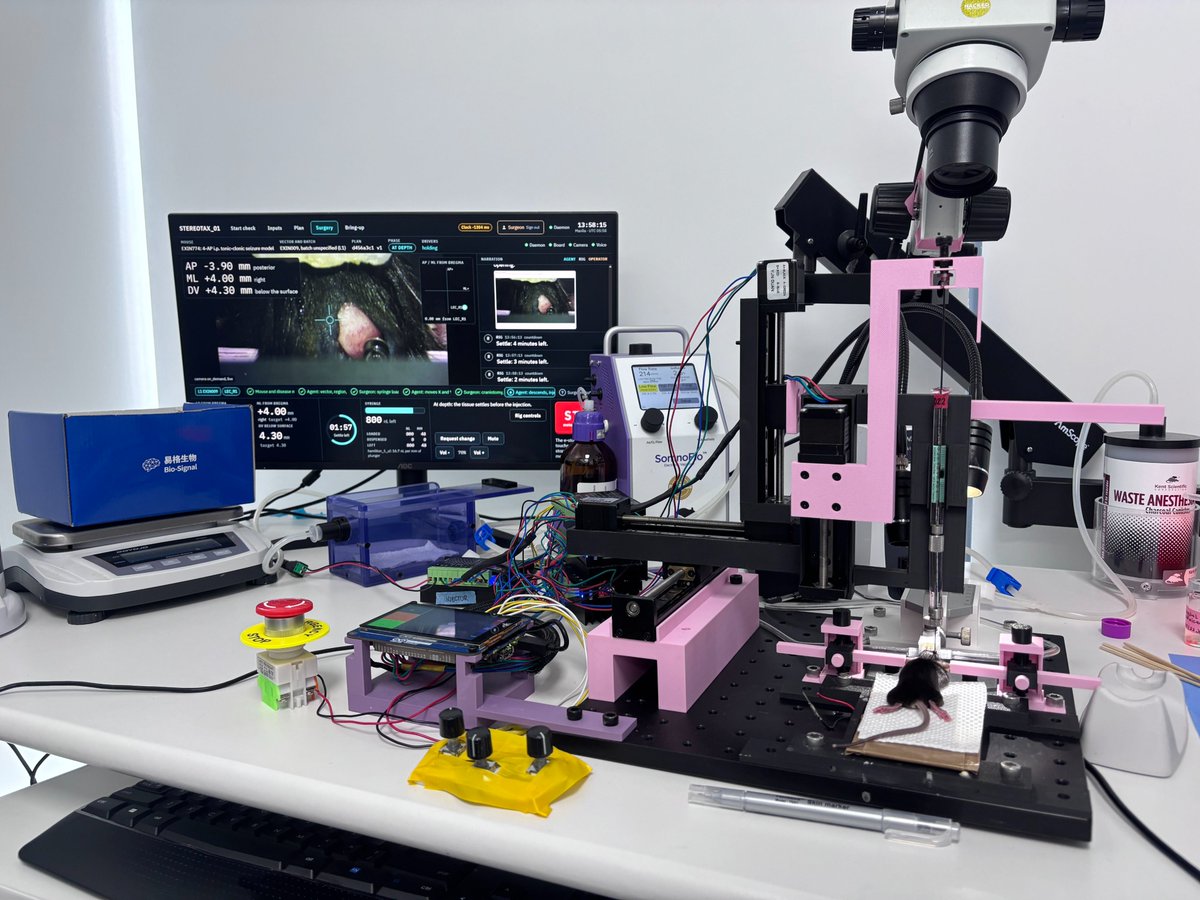
Last night an AI agent performed brain surgery on a mouse.
We gave it 19 gene therapy vectors in a spreadsheet, a mouse model of epilepsy, access to a motorize surgery rig with cameras and one goal: reduce seizures.
It picked the drug. It picked the brain region. It derived the coordinates from three papers. Then it drove the stereotaxic arms into the brain and injected 250 nanolitres while watching the entry site through the rig camera for bleeding.
A licensed vet gated every irreversible step and held a physical kill switch to stop the AI agent.
Thread on what it decided, what it saw, and the moment it refused to let me override it.
[Writing this on the spot out of excitement, but I've been 18hrs in front of my laptop coding and coordinating this, so keeping it brief and descriptive, more cohesive thoughts on this soon...]
LLMs have a score doubling time of 53.9 days on a robotics benchmark between July and October 2026, while speed increased by 4.4x and cost fell by 6.2x.
More results in our new paper: The Bitter Lesson Comes to Robotics 🧵
We found a way to scale humanoid control that reduces GPU-hours by more than 1000×.
Across 129,514 motions, SuperMimic surpasses the state of the art (128 GPUs, 7 days) with 1 GPU in 3 hours.
Project: https://t.co/6gc9WKm9qY
Demo: https://t.co/OHRvx5ogQY
Robotics has spent years scaling demonstration data and model size. What happens when we scale EXPLORATION for robot agents?
We're incredibly excited to share RAX, an agentic robotics system that learns by scaling online exploration.
A coding agent connects directly to the robot’s perception and control APIs, learns from feedback, and builds programs that perceive, plan, and act. The model stays frozen. As exploration scales, the agent improves its programs and builds up reusable skills.
The results:
• ZERO teleoperation or action demonstrations on real robots—from insertion with 0.1 mm clearance and air-fryer manipulation to deformable objects and long-horizon mobile whole-body control.
• +37 percentage points on average over leading learned policies across five simulation benchmarks: RoboDojo, BEHAVIOR-1K, HumanoidArena, DexJoCo’s bimanual tasks, and LIBERO-Pro.
• One framework spanning single-arm, bimanual, dexterous, humanoid, and mobile robots, with new embodiments connected through APIs.
The craziest part: on each real-world embodiment, going from scratch to mastering the tasks took roughly two hours. No teleop. No model finetuning.
We’re open-sourcing the full framework AND every experiment session. We can’t wait to see what people build with it!
Project + sessions: https://t.co/O04Z5PUgqY
Paper: https://t.co/sd66qnYZWB
GitHub: N
Project fully led by @RunhanH and @xczhangxx who are absolutely awesome.
How it works, experiments, and robot videos below 🧵
(1/N)
When I was writing Unreal Engine 1, my time was divided as follows:
- Around 30% went to seriously deep coding on hard problems: assembly language texture mappers, C++ BSP trees, data persistence, object oriented systems design, and networking.
- Around 70% was just typing and refactoring large bodies of code needed for a complete engine feature set. This was not hard, and while I was doing it my mind was mostly on the deeper coding topics, thinking and planning for what's next. It didn't feel much different from vibe coding today, except that it was just me typing code on an IBM Model M keyboard rather than prompting it and reviewing the results.
So, it has always seemed perfectly logical that we would rely on AI for that 70%, once the AI could do it with a similar quality standard as we could, which has never been perfection. It came as no surprise that, after a few years of AI model evolution, it was able to take the reigns on that 70% and free up programmers' time for more valuable tasks.
What's more of a surprise is the emergence of AI as a sort of insta-Carmack able to solve hard technical problems quite cleverly and often cleanly, and that it's able to reason about and work in complex 3D scenes both by operating the tools and by directly understanding the raw data files.
I abandoned assembly language in 1998 when out-of-order CPUs made much simpler C/C++ code faster, and never I missed it. If prompting through architectural documents, concept art, and design plans can transcend typing code and tweaking vertices, that will enable developers to spend their time on higher-level, higher value technical and creative tasks.
What matters is the end product, whether it's a game or an engine. Anything developers can do to try out more ideas and make better software and games faster is a win for everyone.
If you're interested in how AI is reshaping and accelerating life science, this new issue of @MolecularCell is rich
https://t.co/IVpkOTk2BM
single-cell, RNA, protein-protein, genome editing, foundation models , protein design
Like the river feeding into the delta with many tributaries metaphor
kinematics is one of the first things you need to understand in robotics.
it answers a simple question:
how does joint motion become motion in the real world?
> joint space describes the robot internally
> forward kinematics maps joints → end-effector pose
> inverse kinematics maps desired pose → joint configuration
> the Jacobian maps joint velocity → end-effector velocity
once you understand this, robot arms stop looking like magic. they become geometry, coordinate frames, and motion.
You can literally type a sentence and watch a Transformer process it.
This interactive explainer runs a GPT-style model in the browser and lets you follow the whole path:
tokenization → embeddings → Q/K/V → attention → MLP → logits → next-token probabilities
You can inspect attention maps, intermediate values, and change temperature, top-k and top-p to see how generation changes.
If Transformers still feel like boxes connected by arrows, this is worth opening.
https://t.co/vkyxOqDVll
What if,
for any scientific claim,
you can search 100M+ papers to find the strongest evidence for and against it
⚡️in 1 second?
That’s now possible with Evidence API! 🚀
https://t.co/2I25q4m9ao
For example, does drinking coffee reduce diabetes risk?
Trending repository of the day 📈
rea
Reverse engineer anything with agents, from app behavior down to native binaries.
Last 24h: 2,963 ⭐
Total: 6,869 ⭐️
https://t.co/9HkZxH52yN
AI 앱 만들던 빌더들이 왜 이렇게 열광하고 있을까?
1. '트래픽 늘면 적자' 공식의 종말
모든 AI 임베딩 연산이 유저의 폰이나 브라우저(WebGPU)에서 돌아감. 서버를 거치지 않으니 유저가 1만 명이든 100만 명이든 개발자 통장에서 나가는 API 비용은 영원히 0원임.
2. 비싼 클라우드 벡터 DB(Pinecone 등) 강제 퇴출
마트료시카(MRL) 기술로 품질 저하 없이 벡터를 128차원까지 압축. 유저 기기의 로컬 DB(SQLite/IndexedDB)에 1/6 용량으로 가볍게 때려박고 완전 오프라인에서 시맨틱 검색 수행.
3. '음성으로 영상 찾기' 같은 고급 AI 기능을 공짜로 탑재
텍스트 검색뿐 아니라 음성 메모로 관련 비디오 클립 찾기, 사진으로 관련 코드/문서 찾기 등 멀티모달 기능을 단일 모델로 클라이언트 단에서 구현 가능.
4. 웹사이트 접속만 해도 즉시 구동 (WebGPU)
Hugging Face, Ollama, llama.cpp뿐 아니라 브라우저용 `transformers.js`까지 첫날부터 풀 지원. 앱 설치 없이 웹 링크 하나로도 0원 AI 서비스 런칭 가능.
🔗 블로그: https://t.co/ItblngpnY9
🔗 허깅페이스: https://t.co/DQO731aBty
The idea of an intelligence explosion caused by recursive self improvement has been around for a long time but until very recently it did not seem imminent. Now many leading researchers think it may happen quite soon. You can read our paper about it here:
https://t.co/sgUpugjpRY
TU AGENTE DE IA YA PUEDE EXTRAER DATOS DE CASI CUALQUIER WEB
X, YouTube, Reddit, foros random, webs sin API… básicamente lo que necesites para research, análisis o monitoring.
acaban de subir a GitHub 3 herramientas open source que le dan a tu agente ese superpoder.
1. Agent-Reach
junta X, YouTube, Reddit, GitHub y más en un solo sitio.
https://t.co/yawDnTZk2g
2. Patchright Enhanced
usa Playwright para escuchar peticiones de webs sin API y sacar los datos con un script.
https://t.co/M5tHnH2aWr
3. Scrapling
scraper de propósito general para cualquier página web.
https://t.co/mQR069yL39
le dices qué datos necesitas → escribe el código → los recolecta → te da el resultado.
ejemplos reales:
"recoge los posts de 100 cuentas de X del último mes y dime qué temas están funcionando"
"saca reviews de este producto en Reddit y YouTube y resúmeme las quejas principales"
básicamente le das a tu agente la capacidad de sacar datos de casi cualquier lugar de internet.
eso abre un nivel de automatización que hasta hace nada era impensable.
If you have not heard this news story, it is pretty big in the chemistry world. Being able to break down polyethylene cheaply is a big deal. It makes waste plastic more valuable, which makes it less likely people will just throw it into rivers where it flushes into the oceans.
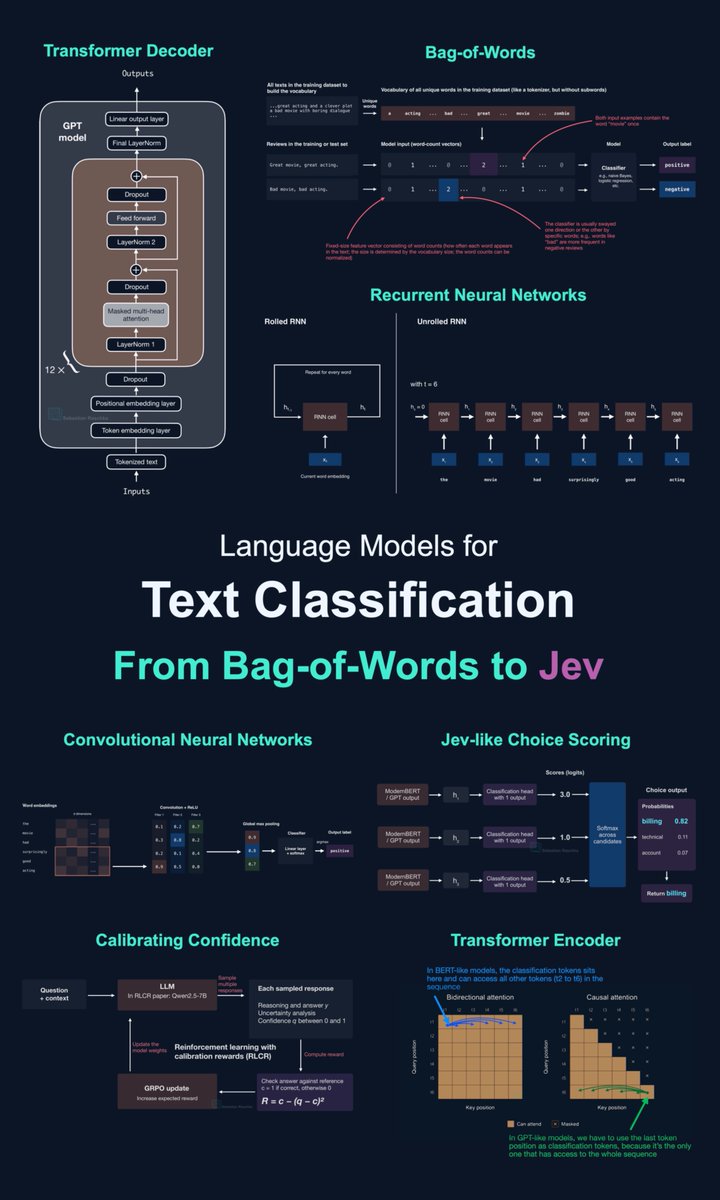
Took a while, but here it is, a mega write-up on language models for text classification and, of course, Jev.
It's basically a visual guide to RNNs, CNNs, transformers, and calibration, with hands-on experiments on accuracy and efficiency.
Didn't expect this 🤯
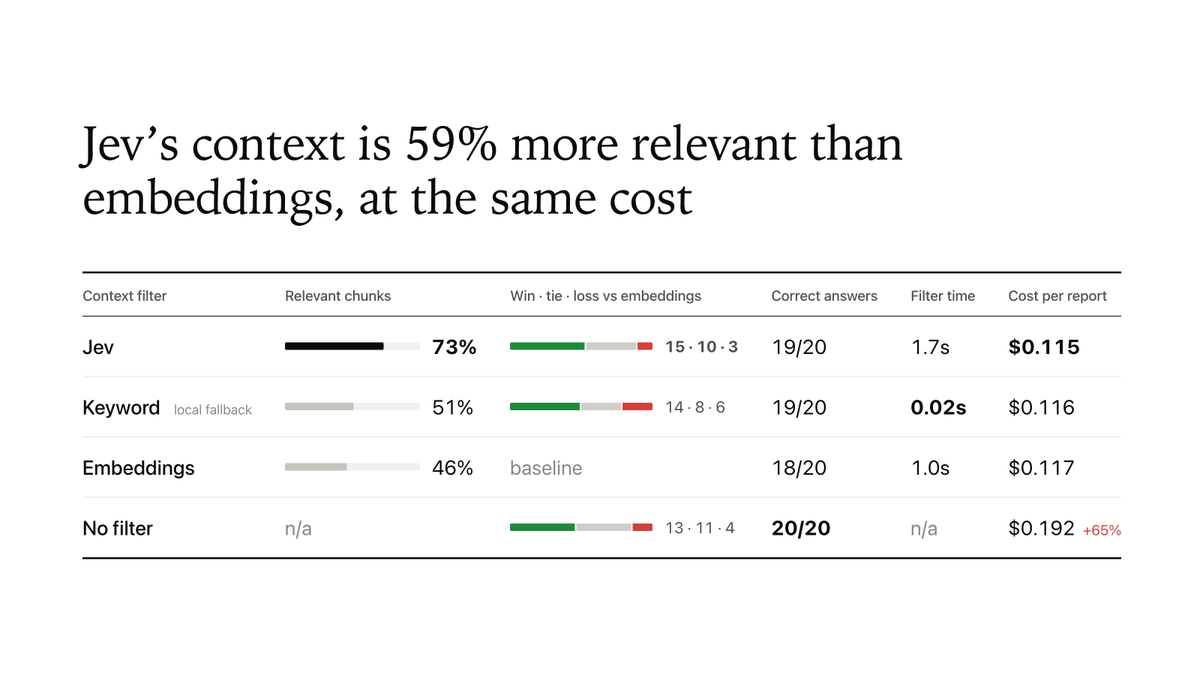
We replaced embeddings with Jev in GPT Researcher's RAG pipeline and tested both on 28 research tasks from SimpleQA and open ended research.
Jev beat embeddings on every quality measure we ran:
- 59% more relevant context (73% vs 46%)
- Reports preferred 15 to 3 in blind comparisons
- Same cost per report
GPT Researcher now runs on Jev by default, and no longer needs embeddings at all.
All you need is @LangChain + @tavilyai +Jev for the perfect RAG system.
Check out the repo here: https://t.co/kcvF5tPlWq
Research: https://t.co/QZIoRFnGQq
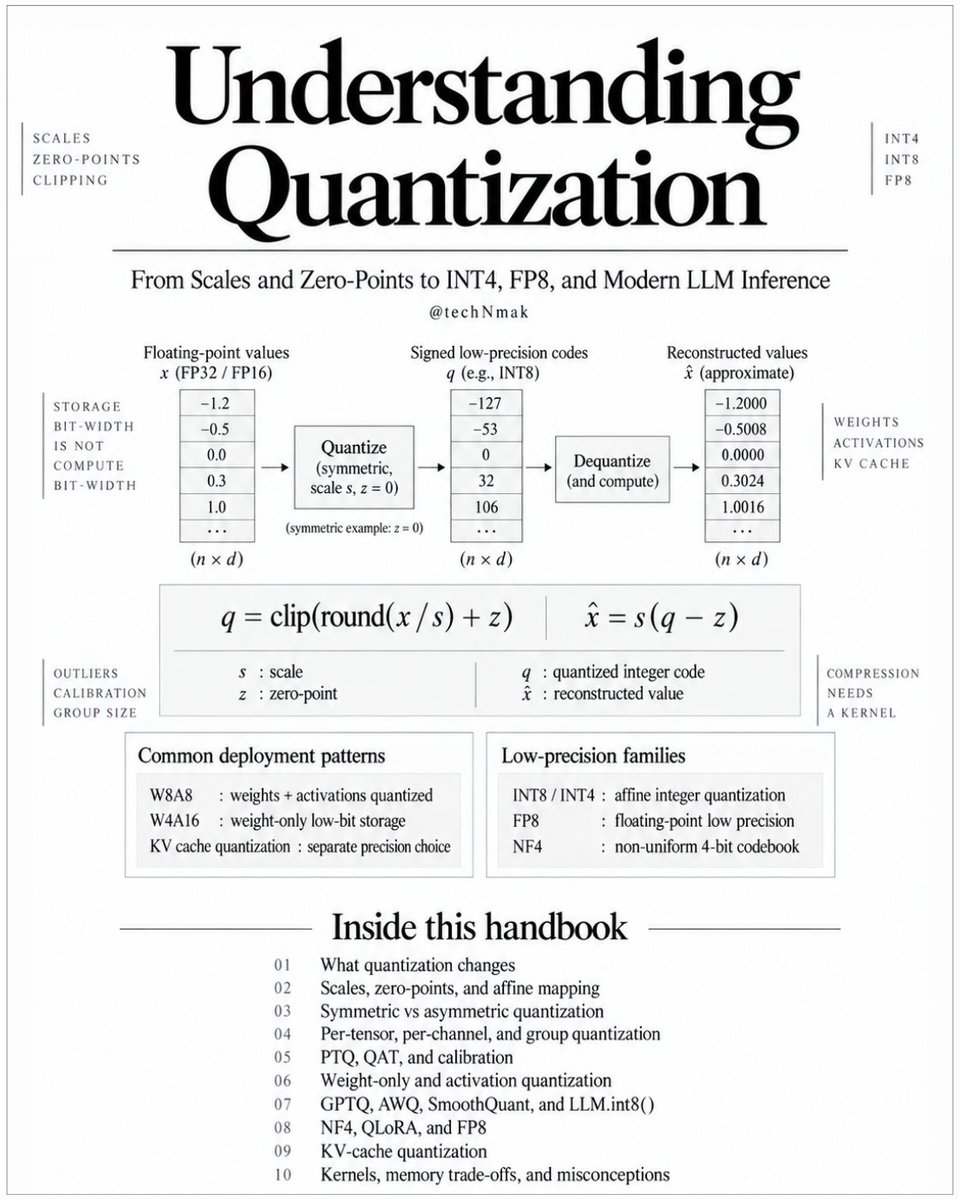
I put together a handbook on how quantization actually works, starting with affine integer quantization => how floating-point values are mapped onto a smaller set of representable codes using scales, zero-points, rounding, clipping, and different quantization granularities.
It works through symmetric and asymmetric quantization, per-tensor/per-channel/per-group scaling, calibration, PTQ and QAT, weight-only and activation quantization, outliers, GPTQ, AWQ, SmoothQuant, LLM.int8(), NF4 and QLoRA, FP8, KV-cache quantization, KIVI, KVQuant, and the kernel/hardware side of making low precision useful.
Made it to be the explanation I wish I'd had when I first tried to understand what people actually mean when they call a model "4-bit," and why fewer bits can reduce memory without automatically making inference faster.
I really like reading engineering blogs from big orgs like Netflix. Real-world stories from large systems are always interesting. Many function resource configs start as a copy of some other function, with extra padding for extreme cases. Most never change until they fail one day, and the fix is usually more memory.
Netflix built a tool called the Stratum Resource Tuner that right-sizes these configs automatically: CPU and network are tuned to p99 usage with no headroom, and memory and disk to p99.9 plus a buffer. Check out this writeup from Violetta Pidvolotska and Naveen Mareddy.
https://t.co/D6lkkyEMgH
#Serverless #FinOps #Containers #PlatformEngineering