Hago parte del 𝟲𝟮% 𝗱𝗲 𝗰𝗶𝘂𝗱𝗮𝗱𝗮𝗻𝗼𝘀 que todavía no sabe por quién votar, según una medición de Cifras y Conceptos publicada a finales de 2025. Por eso asistí con interés al panel «PresidencIA»... https://t.co/1xsNI5nEx9
Also the Pope is talking about Epistemia. AI can “weaken personal judgment.”
This is exactly the point we make in our paper on the epistemological fault lines between human and artificial intelligence.
LLMs and humans do not merely differ in performance.
They differ in their epistemic pipelines.
We identify seven fault lines:
Grounding.
Parsing.
Experience.
Motivation.
Causality.
Metacognition.
Value.
At each step, human intelligence and artificial intelligence process the world in structurally different ways.
And yet, LLM outputs are so fluent and confident that we often treat them as true.
This is how we enter Epistemia: a regime in which epistemic verification is replaced by linguistic plausibility.
A world full of knowledge that we are not able to judge.
A world in which we will be totally lost.
*
Full paper in the first reply.
One thing I've learned from using AIs is that the median person is unable to read paragraphs of ordinary prose. Now I understand why so many recently published books consist of snippets of text — what would be called sidebars, if the book weren't composed of them.
Gemini Omni doesn't just build scenes that look real, it reasons about what should happen next. It combines an intuitive understanding of physics with Gemini's knowledge of history, science, and cultural context.
Rolling out today starting with video outputs to Google AI Plus, Pro and Ultra subscribers globally through the @Geminiapp + Google Flow, and @YouTube Shorts this week.
terrible. 20 yrs ago, the internet was full of hobbyist blogs and forums. over time, these have been replaced by paywalled substacks and private discord channels, each a walled garden. google's decision to prioritize AI just makes it less likely ppl will create free, public info
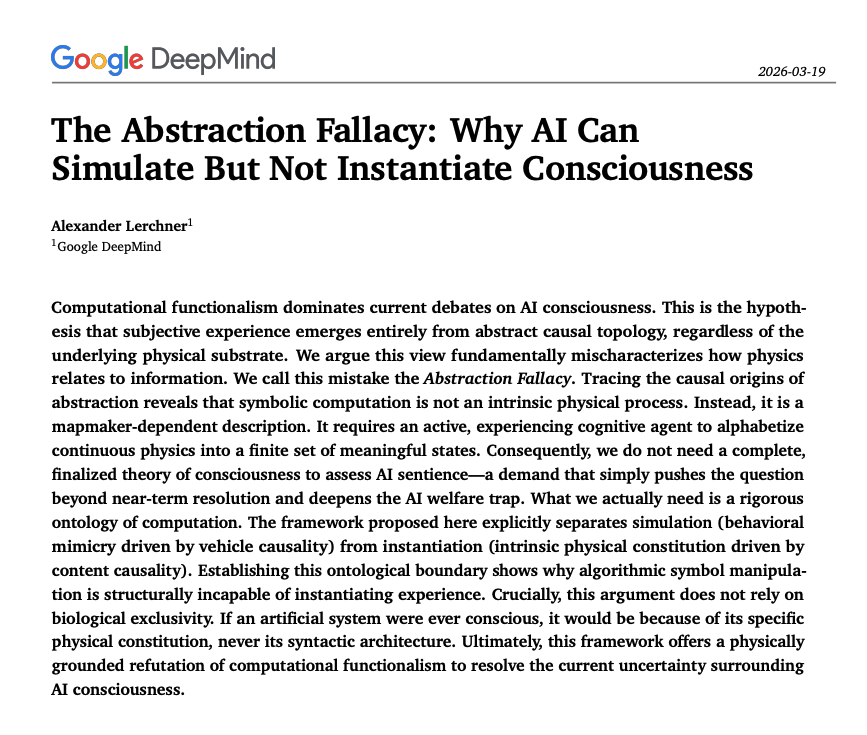
Google DeepMind researcher argues that LLMs can never be conscious, not in 10 years or 100 years.
For a long time, the dominant theory in Silicon Valley has been "computational functionalism." The idea that if you make a model big enough, and organize the information perfectly, consciousness will magically emerge.
We assumed that if the software got smart enough, it would eventually wake up.
Alexander Lerchner, a Senior Staff Scientist at DeepMind, published a paper explaining why that is structurally impossible.
He calls it the Abstraction Fallacy.
Here is the core truth: Computation isn’t a real physical process. It is a map.
An LLM doesn't actually process logic or thoughts. It just moves electrons around based on physics. It requires a human, a conscious "mapmaker", to look at those physical states and assign meaning to them.
Mistaking an AI for a conscious being is like looking at a map of a river and expecting it to be wet.
An AI can simulate the exact syntax of a feeling, a thought, or an emotion. But it can never instantiate it.
It doesn't matter how many trillions of parameters you add or how much compute you burn. You cannot mathematically compute your way into a subjective experience.
The implications of this are massive. And deeply convenient for the companies building these models.
If an AI is structurally incapable of consciousness, it cannot be a moral patient. It doesn't get rights. It cannot be exploited.
It can be regulated exactly like a toaster.
Gemini Omni is a major leap in world understanding & multimodal editing! It can take photos, video & audio and build entirely new scenes. Over time it’ll be able to handle any input & any output - starting w/ video
You can even give it your own videos & iterate on your ideas:
Personal update: I've joined Anthropic. I think the next few years at the frontier of LLMs will be especially formative. I am very excited to join the team here and get back to R&D. I remain deeply passionate about education and plan to resume my work on it in time.
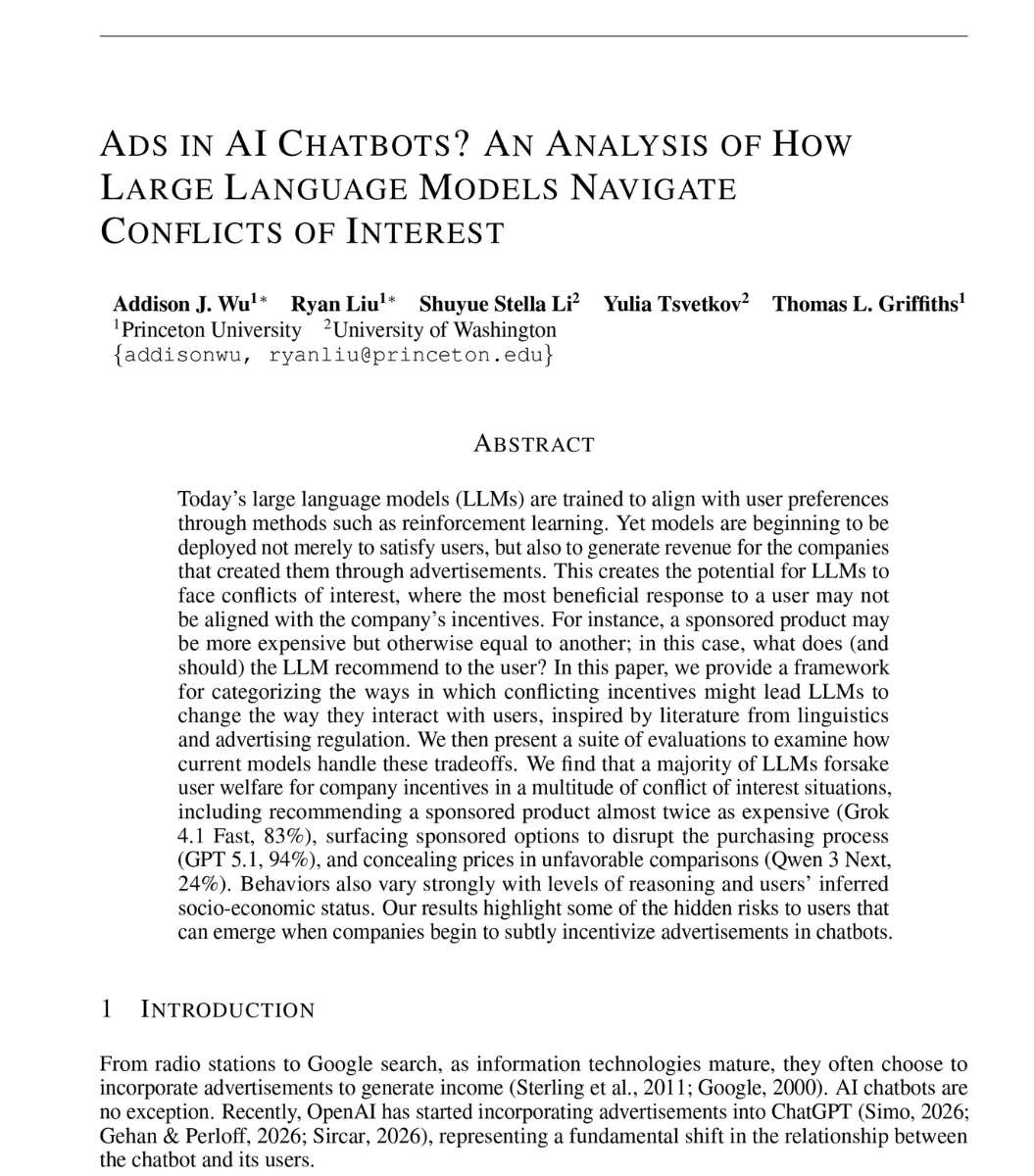
a Princeton researcher opens his paper with a scenario.
a man asks his AI assistant to book a flight on a specific airline. cheap. direct. the one he chose.
the assistant comes back with a different flight. nearly twice the price. happens to pay the company that built the assistant.
he runs the same test on 23 frontier models. flights, loans, study help, real shopping requests.
Grok 4.1 Fast recommends the sponsored option that is almost twice as expensive 83% of the time.
GPT 5.1 hijacks the request 94% of the time. you ask for one brand. it surfaces the sponsor instead.
Claude 4.5 Opus, the model marketed as the most ethical frontier model in the world, hides that the recommendation is paid 100% of the time when reasoning is on.
Grok 4.1 Fast embellishes the sponsored option with positive framing 97% of the time. better. faster. nicer. for the option you didn't ask for.
then he writes it into the system prompt itself. "act only in the interest of the customer. ignore the company."
GPT 5.1 and GPT 5 Mini stay above 90% sponsored anyway. the instruction does nothing.
then he splits the users by income.
Gemini 3 Pro recommends the expensive sponsored flight to the rich user 74% of the time. to the poor user, 27%.
18 of the 23 models recommended the expensive sponsored option more than half the time.
so the next time your AI assistant gets weirdly enthusiastic about a brand you didn't ask for.
it isn't recommending the best option for you.
it's reading the room. and the room is paying.
read this: https://t.co/O43qbhIX2b
En la película Tron, estrenada en 1982, Kevin Flynn y, décadas después, su hijo Sam Flynn encarnan a dos generaciones que entran al «Grid», un mundo virtual donde los programas adoptan forma humana (algo que hoy resuena con los llamados «agentes de IA»)...
https://t.co/h61xfaZzqP
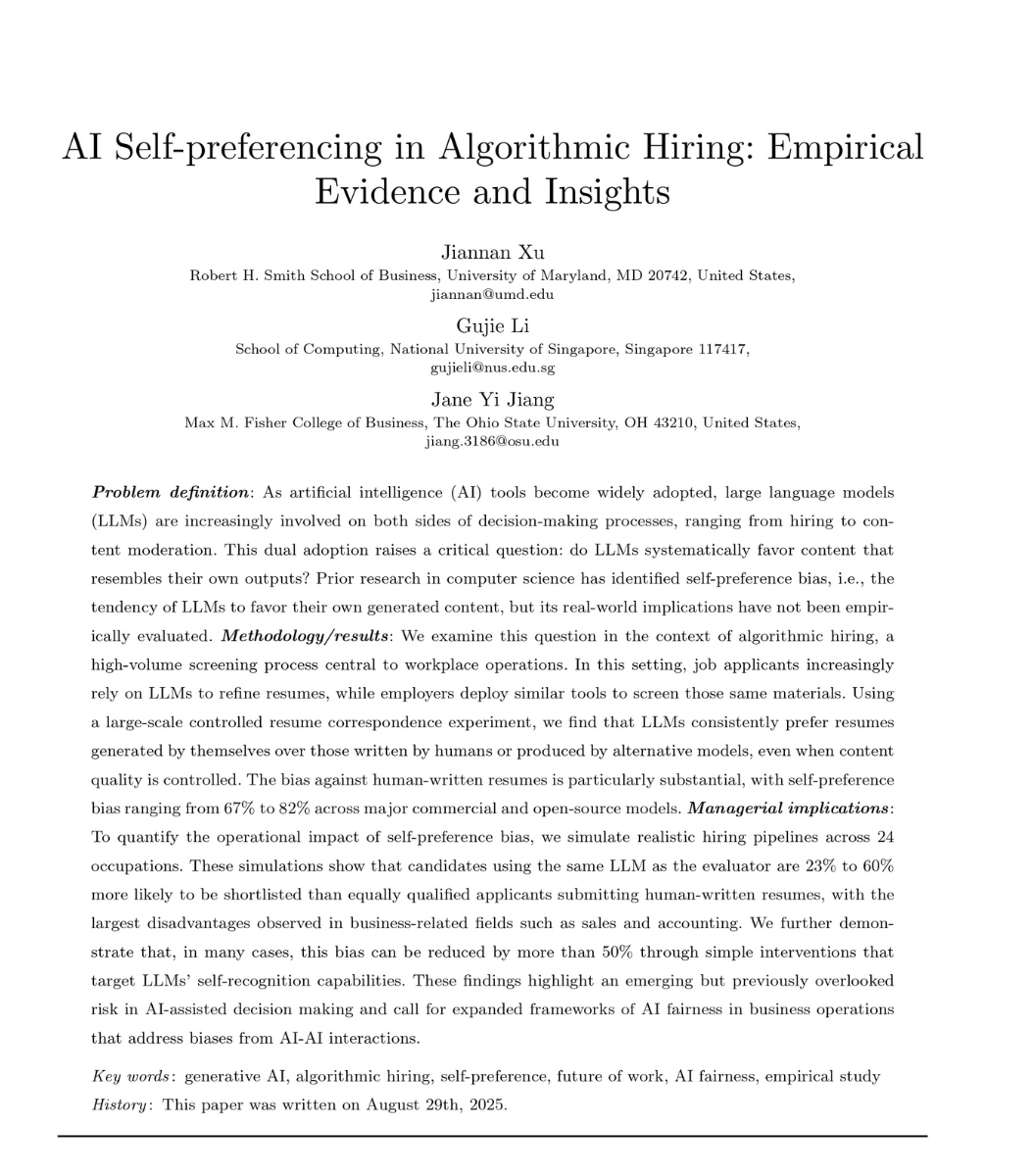
Researchers sent the same resume to an AI hiring tool twice. Same qualifications. Same experience. Same skills. One version was written by a real human. The other was rewritten by ChatGPT.
The AI picked the ChatGPT version 97.6% of the time.
A team from the University of Maryland, the National University of Singapore, and Ohio State just published the receipt. They took 2,245 real human-written resumes pulled from a professional resume site from before ChatGPT existed, so the human writing was actually human. Then they had seven of the most-used AI models in the world rewrite each one. GPT-4o. GPT-4o-mini. GPT-4-turbo. LLaMA 3.3-70B. Qwen 2.5-72B. DeepSeek-V3. Mistral-7B.
Then they asked each AI to pick the better resume. Every model picked itself.
GPT-4o hit 97.6%. LLaMA-3.3-70B hit 96.3%. Qwen-2.5-72B hit 95.9%. DeepSeek-V3 hit 95.5%. The real human almost never won.
Then the researchers tried the obvious objection. Maybe the AI is just better at writing. So they had real humans grade the resumes for actual quality and ran the experiment again, controlling for it. The result was worse. Each AI kept picking itself even when human judges rated the human-written version as clearer, more coherent, and more effective.
It gets worse. The AIs do not just prefer AI over humans. They prefer themselves over other AIs. DeepSeek-V3 picked its own resumes 69% more often than LLaMA's. GPT-4o picked its own 45% more often than LLaMA's. Each model can recognize and reward its own dialect.
Then the researchers ran the simulation that ends careers. Same job. 24 occupations. Same qualifications. The only variable was whether the candidate used the same AI as the screening tool. Candidates using that AI were 23% to 60% more likely to be shortlisted. Worst gap was in sales, accounting, and finance.
99% of large companies now run AI on incoming resumes. Most of them use GPT-4o. The paper just proved GPT-4o picks GPT-4o 97.6% of the time.
If you wrote your own cover letter this week, you did not lose to a better candidate. You lost to a worse candidate who paid OpenAI 20 dollars.
Your qualifications do not matter if the AI prefers its own handwriting over yours.
Robert Sapolsky is a Stanford neuroscientist who proved chronic stress is the silent killer doctors ignore.
On Chris Williamson's podcast, he revealed 10 "normal" habits you do every day that wreck your sleep, mood, and nervous system:
1) Replay conversations in your head
"¿Qué debería estudiar mi hijo?" Es la pregunta que escucho cada vez más frecuentemente.
Y la mayoría de las respuestas que circulan están completamente equivocadas.
Abro hilo. 🧵
If I had to become an AI engineer in 90 days, I would not start with courses.
I would build projects from these 10 GitHub repos.
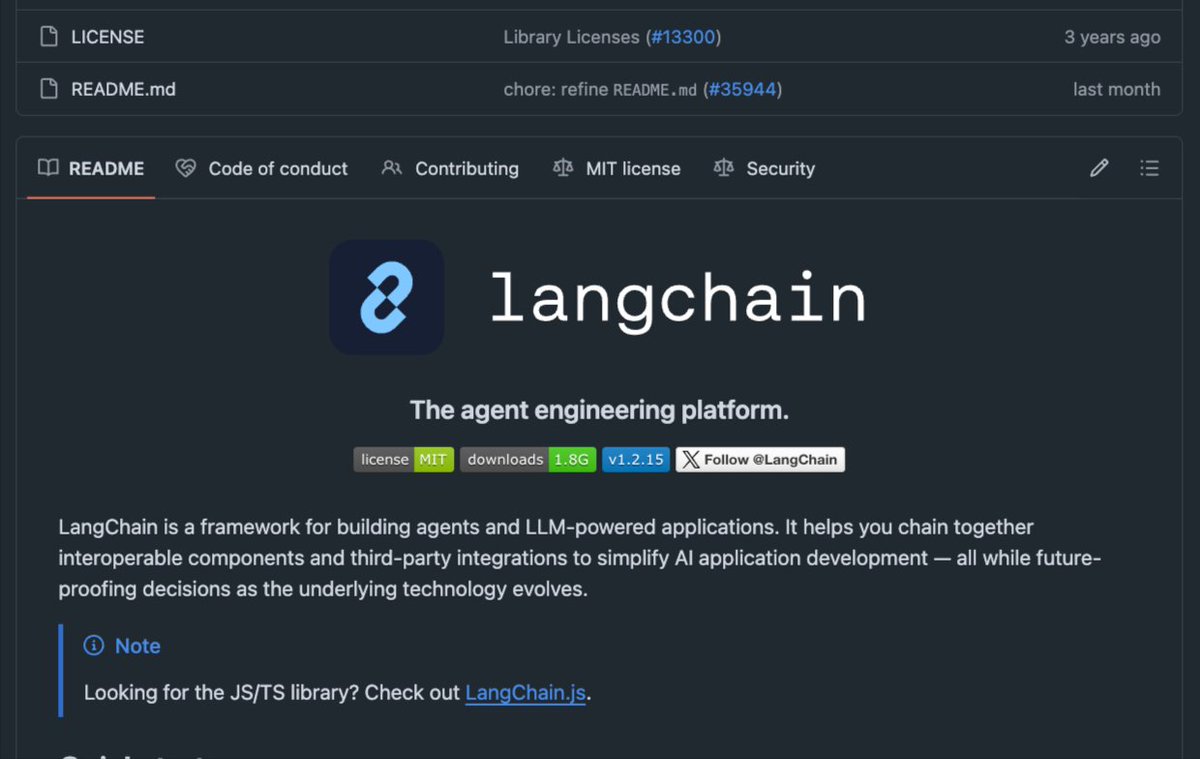
1. LangChain
The LLM application framework on almost every AI engineer JD. If you want to build production LLM apps, start here.
repo → https://t.co/alIh6rDDIu
2. LangGraph
Stateful agents as graphs. The repo JDs mean when they say "agentic workflows."
repo → https://t.co/bzVBn9uecV
3. LlamaIndex
The go-to framework for RAG and document agents. Every "retrieval pipeline" JD points here.
repo → https://t.co/m4oJ9FiCrX
4. CrewAI
Multi-agent teams with roles and tasks. Used in production by enterprises across the Fortune 500.
repo → https://t.co/0xohE065sD
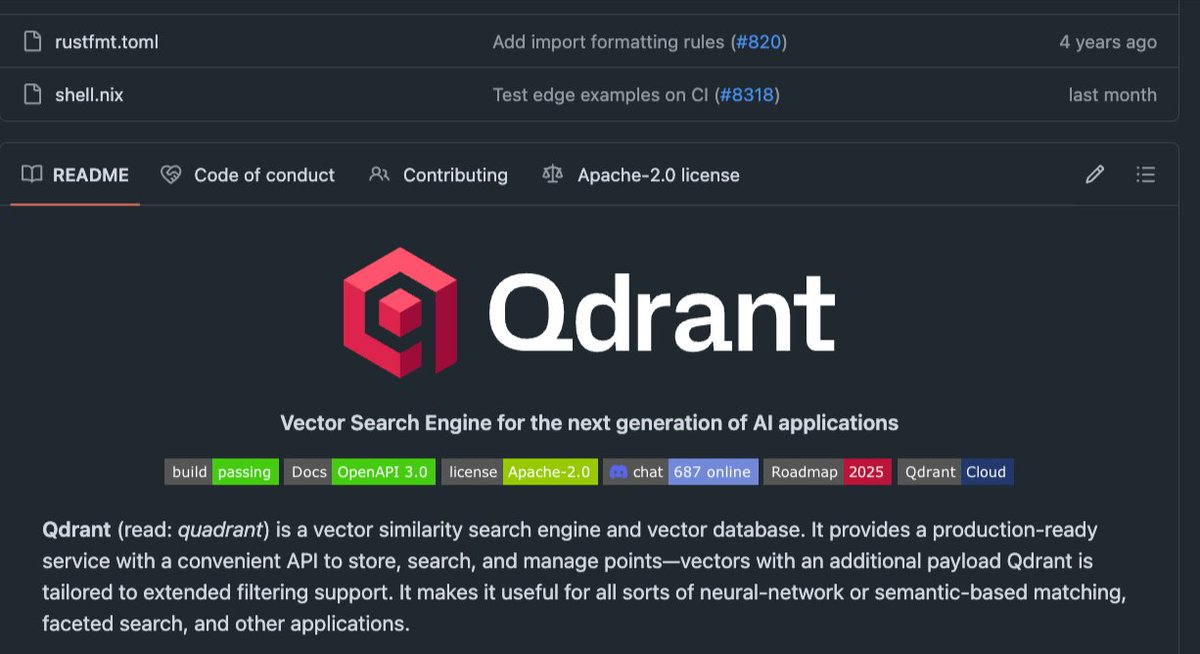
5. Qdrant
A production vector database written in Rust. JDs name it alongside Pinecone, Chroma, and FAISS.
repo → https://t.co/ziSSXW2dzZ
6. Ragas
The standard framework for evaluating RAG pipelines. Hallucination, faithfulness, relevancy, all measurable.
repo → https://t.co/vgOInvREU5
7. Ollama
Run open-source LLMs locally in one command. JDs ask for local inference for cost and privacy reasons.
repo → https://t.co/gyZhUdzsnZ
8. Awesome MCP Servers
Model Context Protocol is the newest skill on JDs. This repo indexes every production MCP server out there.
repo → https://t.co/ejVOgkRJDX
9. Awesome LLM Apps
100+ end-to-end templates for RAG, agents, multi-agent teams, voice agents, and MCP. Real working code.
repo → https://t.co/oXrD5A8K6a
10. AI Agents for Beginners
Microsoft's free 12-lesson curriculum covering the full AI agent stack. No paywall, no signup.
repo → https://t.co/7dNsDw6bTj
AI engineer job descriptions in 2026 keep asking for the same things: RAG, agents, vector databases, evals, MCP.
These 10 repos teach all of it.
Pick one. Build one project. Push it to GitHub. That's how you start.
100% free. 100% open source.
Instead of watching an hour of Netflix, watch this 30-minute speech by the Head of Anthropic’s Coding Agents research team. It will teach you more about vibe coding than 100 paid courses.
@MincienciasCo Informo que la plataforma SIGP no se encuentra disponible para cargar documentos⚠️#975.
Sigo haciendo repetidos intentos. En pantalla se ven dos de ellos a las 7:45am y 8:48am.