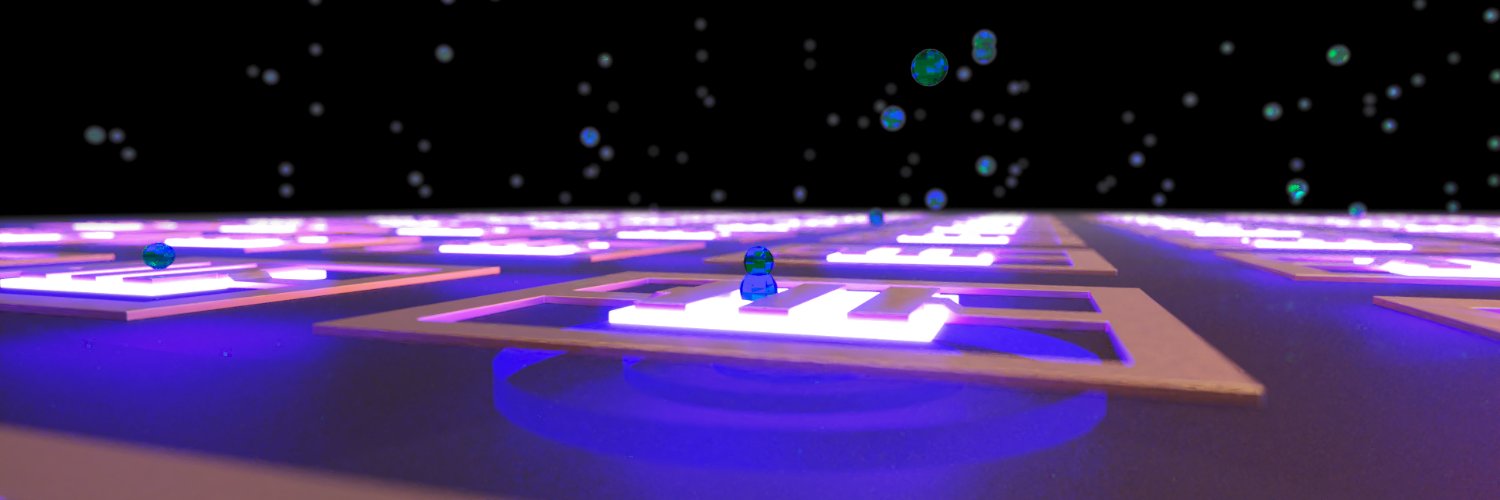
We develop ultrafast lightwave-driven scanning tunnelling spectroscopy to investigate how the spin-orbit-split energy levels of an isolated Se vacancy within a WSe2 monolayer shift under phonon displacement. Read the full story in @NaturePhotonics.
https://t.co/JUUApETCwI
@NaturePortfolio listed our Review on Lightwave electronics in condensed matter among the articles related to the Nobel Prize in Physics 2023🤩
Article: https://t.co/oPwQQ9uLcW
Paper collection: https://t.co/qoYcLCTrQ9
Floquet bands form after a single optical cycle!
New study just published @Nature - by S. Ito @ et al. @Uni_MR, @Uni_Regensburg, with theoretical modelling by M. Schüler @psich_en and our former group leader Michael Sentef @sentefmi (now @UniBremen).
https://t.co/U33Rkqdzdg
We observed the ultrafast emergence of a Floquet-Bloch band structure for the first time. Strong-field #ARPES revealed that Floquet-Bloch states form already after a single optical cycle.
The results have been published in @Nature:
https://t.co/KLSMZ4gxSY
Together with @UMengineering, we realized a stopwatch for delocalized Bloch electrons in crystals that achieves attosecond precision. This way, many-body correlations can be directly measured.
Our results were published in @Nature.
https://t.co/fa7wAj6VBC
In collaboration with @MalicGroup, we used ultrafast near-field microscopy to study the Mott transition of strongly-bound excitons in an atomically thin heterostructure of WSe₂.
https://t.co/qTqWzhRlDw
Ultrafast acceleration of Dirac Fermions leads to unusually efficient emission of high-harmonic radiation, which can be continuously shifted to arbitrary non-integer multiples of the driving frequency. @Nature
https://t.co/5Uo0QtsIBx
Dressing Landau electrons with a vacuum field 𝘢𝘯��� with a strong coherent field at the same time gives rises to nonlinear inter-polariton correlations beyond the normal-mode approximation of ultrastrong coupling. Check out our @PhysRevLett:
https://t.co/V30uqoS13g
Our measurements of a novel saturable absorber structure based on ultrastrong light-matter coupling may enable self-starting, modelocked QCLs emitting few-cycle pulses. The results have just been published in @NatureComms: https://t.co/4tKkunnDWk
My latest research on "Non-adiabatic stripping of a cavity field from electrons in the deep-strong coupling regime" has just been published with @SpringerNature
in @NaturePhotonics . Read here: https://t.co/vEst5mt2f1
My latest research on "Non-adiabatic stripping of a cavity field from electrons in the deep-strong coupling regime" has just been published with @SpringerNature in @NaturePhotonics. Read here: https://t.co/aHzK9o0ZWr