Researchers love to offer '1st best' advice to policymakers & then walk away when advice is ignored due to political incentives.
If we care about impact, let's carefully look at what a 2nd best -accounting for pol. constraints- looks like.
And then give 'subversive' advice.
I joined prof @sclaszlo’s economic development class @mcgillu to talk about #impactinvesting for #development and the role of DFIs. Great to see students engaged and asking lots of questions!
A personal highlight was to be in a classroom again 😀
Thanks for having me @sclaszlo
Very important points being made here for universities to act proactively to prevent such from violence happening again and how to respond appropriately.
My thoughts are with the UW community, the students and faculty victims of this horrific and hateful act.
We’re excited to announce that Julie Delahanty has been appointed as our new president! Julie’s leadership will be key as IDRC seeks to deliver on our Strategy 2030 aimed at building a more inclusive, sustainable world. @CanadaDev
https://t.co/khpIE4giPl
New Rhodes podcast up discussing George DeMartino's book on economics as the 'tragic science.' A reasoned appeal to put 'harm' front and center in our analysis. The harm we do with our very imperfect knowledge. Well worth a listen: https://t.co/3hDEohGYfg
This Friday April 28: You are invited to the 1st talk on #Gender & #Federalism in #Myanmar at @AITAsia GenderLab Talk Series https://t.co/j6noRzY08J
Remembering Martin Ravallion: Berk Ozler and I celebrate the life and work of @MartinRavallion, who sadly died over the holiday break. He was an inspiration to both of us. https://t.co/JBqvvciYX7
With @MartinRavallion, we have lost one of most influential economists. His contribution to our understanding of poverty and inequality cannot be overstated. His passing is a tremendous loss to all of us and the field of Economics.
DAY 4: Today, in #ChiangMai, book launch @rcsd_cmu https://t.co/fbHT45rIDx w/ @AI_UofT Prof. Bertrand brought together faculty, students & public interested & working on #Myanmar.
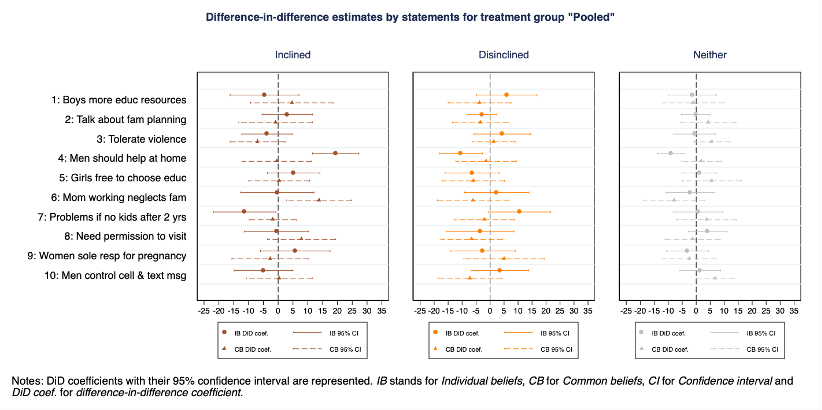
We believe these results are important because they show promise that even a small and short-term dose of digital gender awareness interventions can shift normative beliefs towards gender equity and empowerment. /8
We also add evidence about misperceived gender norms. Bursztyn et al. (2020) find this among men in Saudi Arabia. We find evidence among women in Paraguay. This suggests a further policy lever for encouraging gender transformative change – correcting misperceived norms. /9
3⃣ We find modest evidence that even a small dose exposure to IgualdApp can influence beliefs in the domain of gender roles: it is associated with an⬆️in individual beliefs that men should take on more responsibilities at home (inclined towards gender equity and empowerment). /7
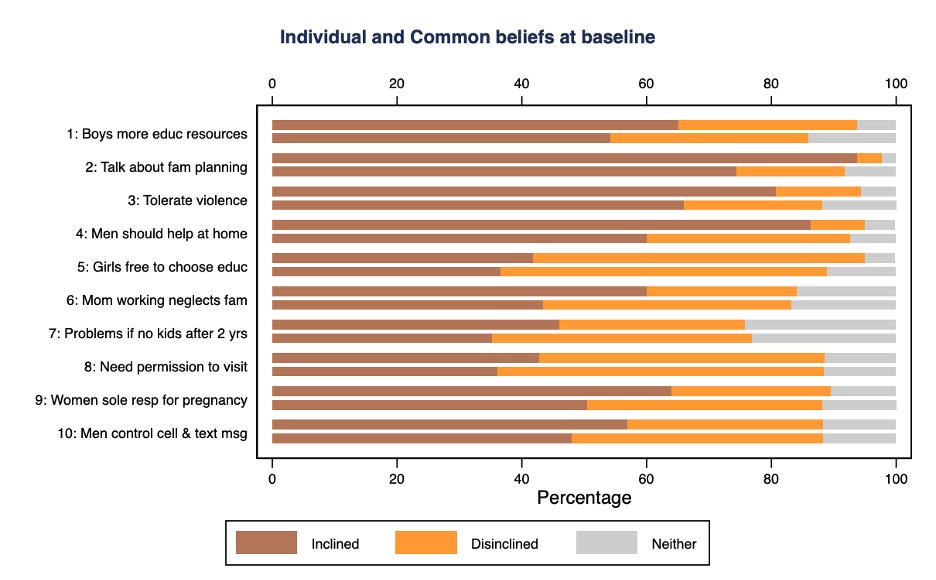
2⃣ We find evidence of norm misperception: participants think their peers are more disinclined towards equity and empowerment than they actually are. /6
1⃣ Participants tend to be more inclined towards gender equity and empowerment than not, but there is heterogeneity, suggesting that some norms might be less well established than others. /5
We elicited individual beliefs about gender norms using Likert Agreement responses to a set of normative statements related to three domains (gender roles, SRHR and IPV). Common beliefs are measured by then converting this instrument into an incentivized coordination game. /2