Anthropic engineer:
"You don't need better prompts. You need graph engineering that makes agents remember everything."
In 25 minutes he shows how engineers at Anthropic wire agents into a graph where each has a job, they run in parallel, verify each other, and share a memory that never resets.
This beats any paid course on building agents I've seen.
Watch it, then read the full guide on graph engineering below.
It is a must watch playlist for LLM beginners.
This playlist "Understanding Large Language Models" covers
1️⃣ What is temperature in LLM?
2️⃣ Pretraining Large Language Models: Everything You Need to Know!
3️⃣ How Attention Mechanism Works in Transformer Architecture
4️⃣ What Are Word Embeddings?
5️⃣ LLM Training Starts Here: Dataset Preparation & Tokenization Explained!
6️⃣ LLMs Like ChatGPT, Explained Visually – How Do They Really Work?
Refer to the comments for the playlist link.
Google DeepMind introduced "GenAI Processors" Library
GenAI Processors is a lightweight Python library that enables efficient, parallel content processing.
GenAI Processors library helps to build Modular, Asynchronous, and Composable AI Pipelines for Generative AI.
✨ Key Features
Modular: Breaks down complex tasks into reusable Processor and PartProcessor units
Integrated with GenAI API: Includes ready-to-use processors like GenaiModel for turn-based API calls and LiveProcessor for real-time streaming interactions.
Extensible: Lets you create custom processors by inheriting from base classes or using simple function decorators.
Rich Content Handling: Supports various content types (text, images, audio, custom JSON).
Asynchronous & Concurrent: Built on Python's familiar asyncio framework to orchestrate concurrent tasks (including network I/O and communication with compute-heavy subthreads).
Stream Management: Has utilities for splitting, concatenating, and merging asynchronous streams of ProcessorParts.
Library - https://t.co/AUoDVfHkuS
Enhance customer engagement and boost sales with Kothok, the AI chatbot designed for retail. Provide instant support, personalized recommendations, and seamless shopping experiences.
#AIchatbot#RetailTech#CustomerService#visieaitech
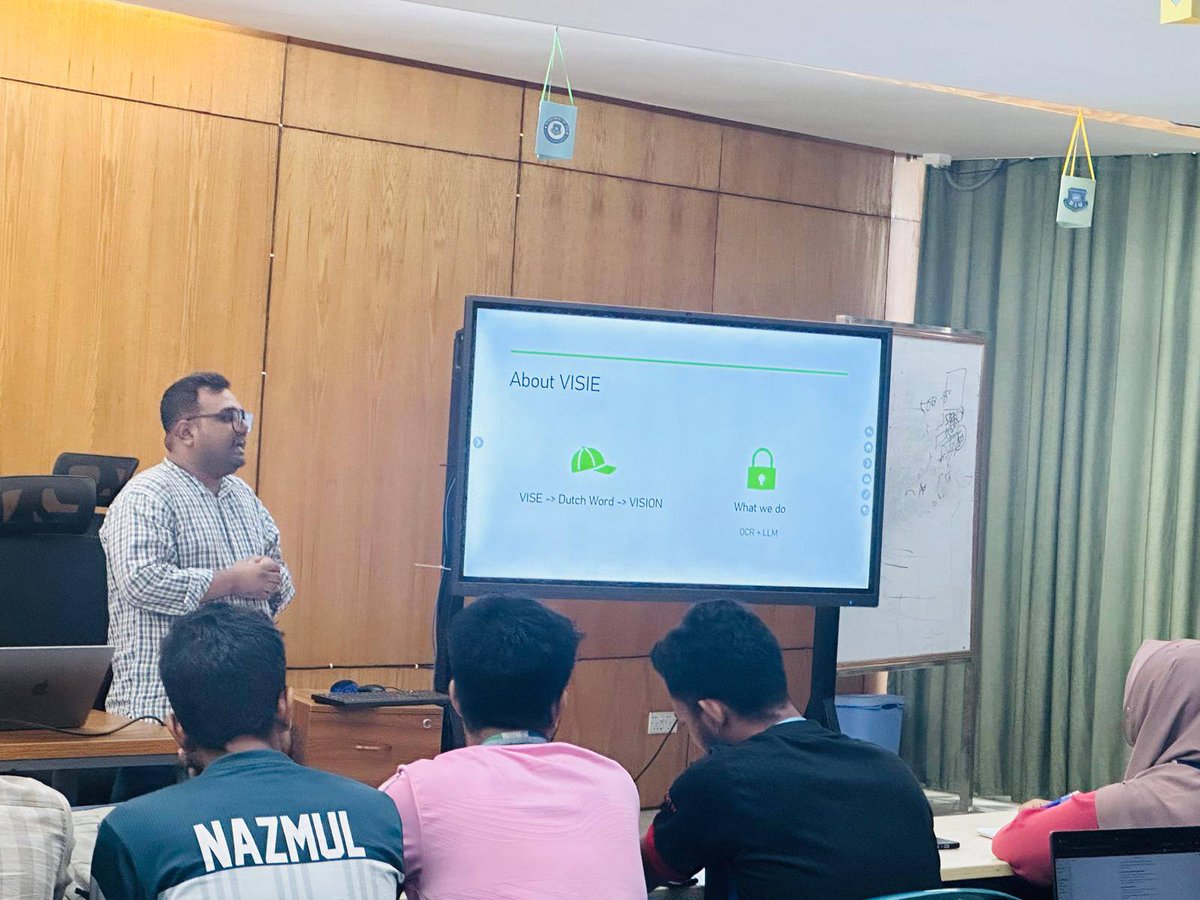
"Had an amazing time conducting the seminar 'Empowering Future Data Scientists' at Daffodil International University! 🌟 The participants were curious, energetic, and asked such insightful questions—truly inspiring. 👏💡
#DataScience#FutureLeaders#DIU#Mentorship#visie
came across a gem of a channel for learning gpu programming, covers
> kernel basics
> code simple neural network by just using cuda
> cuda memory
> performance factors in GPU
wonder why these type channels and videos are so underappreciated
This is Peter Thiel.
He's worth $7.1 billion after founding & investing in $1B startups.
From creating the "PayPal mafia" to hiring Sam Altman, Reid Hoffman, and partnered with Elon Musk...
He is also the greatest recruiter ever!
His 4 questions to spot future billionaire:
Nowadays, it's alarming to try to solve every problem with machine learning/AI. But I think we need to about when not to use ml/AI as well...
What's your thought?
#ml#ai#randomthought#mlmisuse#whennottouseml
So previously I had made a video explaining transformers from the atom up that had some technical inaccuracies. So I fixed them.
Here's the new video and longer thoughts below:
https://t.co/IHCIotGneb
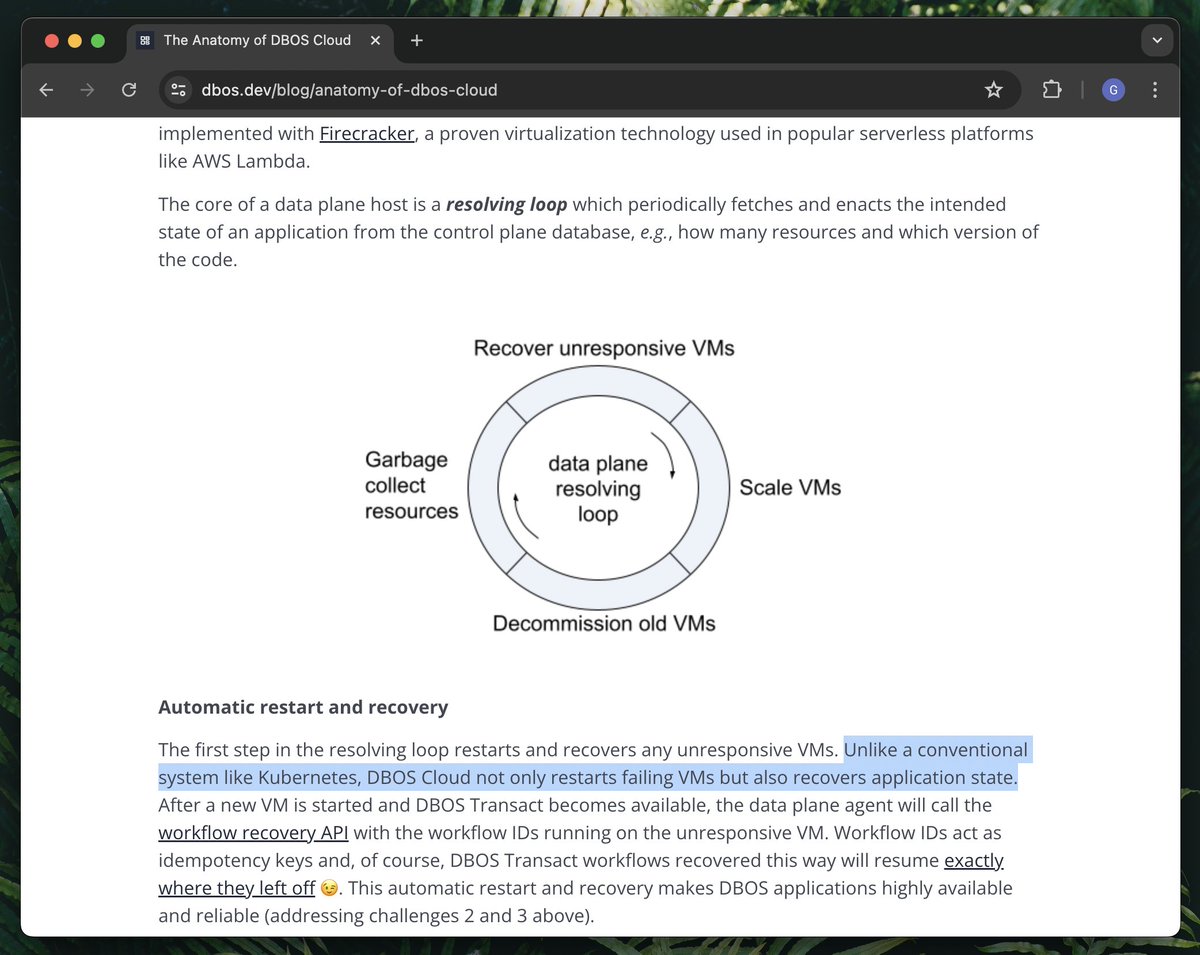
Reading recommendation for this week - A blog detailing an architecture that uses Firecracker VMs for a new type of reconciliation loop. Unlike Kubernetes, this approach recovers not just the application, but also its state.
Four things caught my attention last week.
In no particular order:
1. @AnthropicAI released artifacts
Mostly hate it.
We implemented something similar in our chat app last year. The idea is to use a system prompt to catch specific requests to build tiny apps (like in html). It returns the source as part of output stream with a tag that the client UI knows about and can render. It's fun - it's cool - but it's a truly awful way to write even a small application and noobs will do it anyway. It's the perl of LLM scripting.
2. @dharmesh released email agents.
Love it.
The simple idea: call agents by sending an email, and receive the response in a return email. This was a but of a 'duh' moment for me. SMTP acts as a ubiquitous decoupling device and is easy for an LLM to parse.
3. @SierraPlatform released an agent benchmark.
Good Start.
I applaud anyone that releases open benchmarks for assessing the utility of AI / agents. This looks like a good start. Their v1 of the agents is simply tools w/function calling (plain jane), so most of the initial results are really bad. It's all Python and the function signatures were not done w/annotations. Need to think about that.
4. @SullyOmarr released constrained tabular agents.
Love it.
Unlike many other agent companies, Sully released a UX model that is tabular (spreadsheet-ish) and offers a set of Tools (or agents) that run across the data. It's a great example of how to ship something useful in a limited amount of time.
I finally looked at the Apple Intelligence architecture today.
Main thing that stands out is the orchestration of multiple models.
Especially between on-device and server models.
1 • Small LM (SLM) that is 3B param and runs on your device. Vocab size of 49K.
2 • Large LM (LLM) that runs on the server and handles complex tasks. 100K vocab.
3 • Diffusion models for all image generation needs.
4 • Adapter layer to route multimodal user requests to server model.
For evaluation, Apple used human graders to compare performance.
The 3B param on-device SLM outperformed 7B mistral.
The server LLM beat gpt-3.5 and mixtral 8x22B, but fell short of gpt-4.
Excited to see a push for smaller, on-device LMs from the big players.
Video lectures, Caltech CS 159 Advanced Topics in Machine Learning Spring 2021 by Yisong Yue, Ugo Rosolia & Jeremy Bernstein
https://t.co/f80OoFVfsG