Managing Partner @Bholden will be speaking at @AgenticZero during @Techweek_. If you're an early-stage founders building with cryptographic and decentralized systems, go find Brad. 🤝
t54's trust layer has processed 20M+ agentic transactions without per-transaction human approval.
@awscloud details how our risk engine Trustline scores endpoints before settlement, while AgentCore payments enforces limits and isolates credentials.
More: https://t.co/nCSQoa7GiW
Applications Closing Soon!
25 spots and we’re closing applications very soon. If you’re serious about building your startup, don’t wait until it’s too late.
Apply before the deadline here: https://t.co/tVvwZlEPGM
#LastCall#StartupOpportunity
New episode with @AdamMarblestone, CEO and co-founder of @Convergent_FROs. Adam is an extraordinary catalyst and accelerant for science: he has influenced or routed billions in funding, he helped start significant companies and scientific subfields, and he is the world’s go-to person for neuroscience roadmapping. This year, the NSF launched a $1.5B X-Labs initiative inspired by the FRO model Adam pioneered. Though he started with neuroscience, today he helps organize scientific endeavors across many fields, including AI, math, biology, climate, astrophysics, and more.
Adam proposes that fields like neurotech, whole-brain emulation, cryo, and nanotech are severely limited by capital and coordination — not ideas. Connectomics is a clear case. He argues that mapping the brain's full wiring diagram is the approach most poised-to-scale and still extremely neglected. Costs for a molecularly annotated mouse connectome have come down orders of magnitude, from an estimated $10B to $100M–200M, Adam suggests, with a human connectome perhaps costing around $1B–2B. The cost curve of connectomes is similar to transistors and gene sequencing: once it is low enough, we get extraordinary outcomes for humanity. Near-term applications could pay for it: new drug targets for brain disease, insights for AI development, emulations, and even “control knobs” for mood and focus we haven’t identified yet.
In this episode, we go deep on many topics in neurotech and beyond: what the brain can do that computers still can't; what neuroscience could teach AI; how you'd actually map a whole mammal brain; how far today's fly-brain simulations really get toward an upload; what it would take to move mind uploading beyond the fringe or science; where brain-computer interfaces go next; nanotech, reversible cryonics, AI doing its own ML research, and even predictive, agent-based economics. I'm very excited to have Adam on the podcast. Hope you enjoy!
Other links to this episode and references below.
Chapters
00:00:00 Introduction
00:01:40 What are the grand challenges of neurotech?
00:04:50 What the brain does that computers still can't (on a few bananas a day)
00:14:43 The neuroscience overhang: why brains learn from so little data
00:26:29 How to record and map the brain: DNA "ticker tape," ultrasound, and the unexplored map
00:40:29 Why connectomics is the area most poised to scale
00:47:54 How whole-brain connectomics works, end to end
00:55:27 Simulating the fly brain: how far does it actually get us?
00:57:51 What would it cost to map a mammal's brain?
00:59:55 What will be connectomics' ChatGPT moment?
01:04:35 What a connectome unlocks: disease, drug targets, and the brain's control knobs
01:14:20 Scaling up to the human brain — a faster timeline than expected
01:17:34 Mapping activity, and what the fly connectome has revealed
01:27:55 What you could build with today's connectome
01:35:29 Why uploading may be one of civilization's great cornerstones and transitions
01:42:43 Optimistic visions of a future with uploading
01:49:12 Beyond neurotech: virtual cells, nanotech, and AI-driven science
02:15:29 BCIs today: semi-invasive devices, ultrasound, and what's on the horizon
02:22:44 Why science is capital-and coordination-limited, not idea-limited
The Open Robotics Lab is live. Apply now for your Access ID
Level up your credentials, earn Bolts, and collect Badges when you:
> contribute robotics work
> participate in special subnet campaigns
> refer new users
Submit your application: https://t.co/xTunhxpAdW
Two days ago I was in a debate with a researcher at Protocol Labs about how soon AI will generate genuine new breakthroughs, not just remix known results, but solve problems humans haven't cracked.
The Riemann Hypothesis came up as our go-to example of "this is still safely human territory."
TWO days later...
Welcome to Ratan Rajasthan.
Your chance to power the change you want to see in the world and earn GLW tokens for the impact you drive.
Join us in building a brighter future for humanity today at https://t.co/zFf5ZuRWRL.
Everyone sees Demo Day.
Few see what it takes to earn it.
The Founders Forge documentary drops February 27th ✨
From hackathon project to real companies. This is the journey.
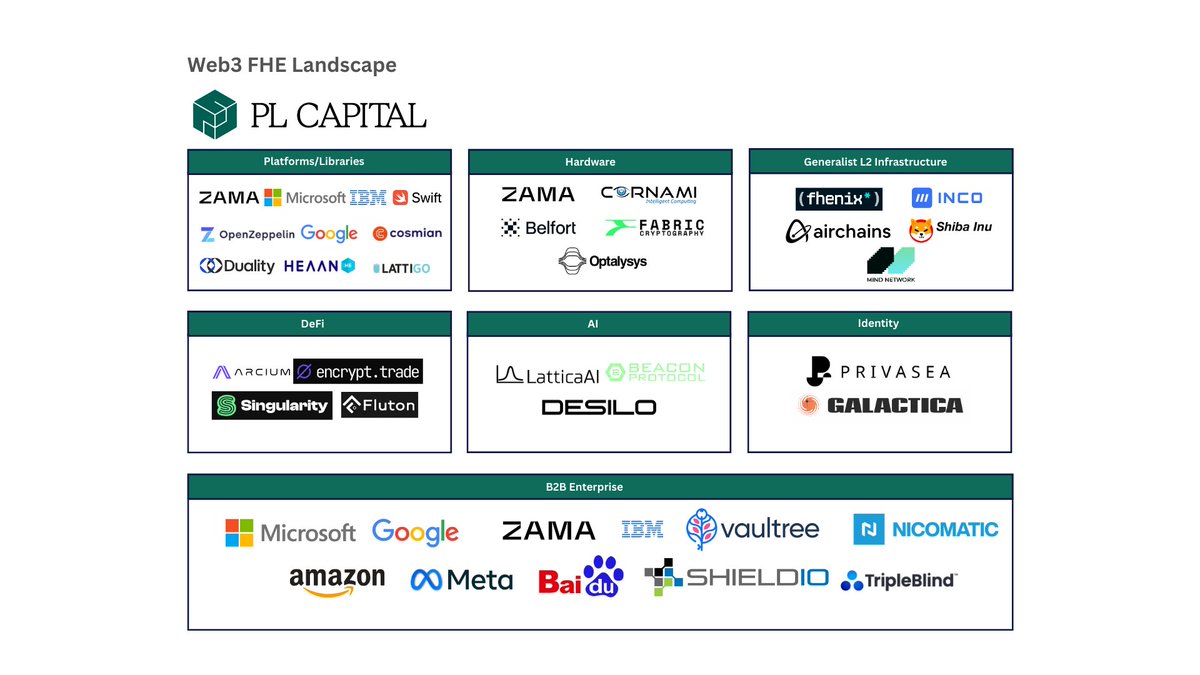
Crypto holds the key to quantum resilience, yet this is often overlooked. At @plcapital we've made several bets in the space (denoted by an *) particularly around FHE. We consider FHE a bet on quantum resilience 🧵
We're launching a $100K match fund with @Artizen to back the builders of public goods infrastructure. 🏗️
Funding protocols, coordination tools, governance frameworks, autonomous funding agents—if you're building it, we want to support it.
More info 👇
Today, Payy becomes a network, and privacy becomes native to onchain money.
For the past three years, we’ve held an unwavering focus on perfecting onchain privacy. You’ve seen it take shape through Payy Wallet and Payy Card, with 100k organic users and $130M/year in unincentivized stablecoin volume.
But while we were building the product, something unexpected happened: dozens of crypto and fintech teams began asking how they could add Payy-level privacy to their own products. These conversations revealed a growing institutional problem. Nearly every bank, fintech, and enterprise is telling us the same thing:
They cannot move real capital flows onchain if their financial data is exposed to the world.
That’s when it became clear: the infra powering Payy wasn’t just an internal advantage, it was the only battle tested, compliant privacy infrastructure in the market that others could actually use. So we quietly expanded it. And slowly, it became a network.
Today we’re announcing Payy Network: Ethereum’s first and only privacy-native EVM L2.
How does it work?
Every ERC-20 lives in a chain-native privacy pool by default. Direct transfers happen inside the pool, while smart contract interactions automatically pull funds out of the pool to a fresh EVM address. Users and developers don't have to think about privacy, it's magically added to every transaction.
- Send an ERC-20 on MetaMask? Private.
- Swap on a DEX? Uses a new address every time.
- Deposit to liquidity pool? Unlinkable to your other transactions.
I firmly believe privacy is the final barrier to critical mass adoption. By removing it, we’re unblocking the path for the $2 quadrillion global payments economy to move onchain, without turning every transaction into a data leak.
Finally, privacy isn’t a tradeoff, it’s a default.
Welcome to the era of invisible privacy.
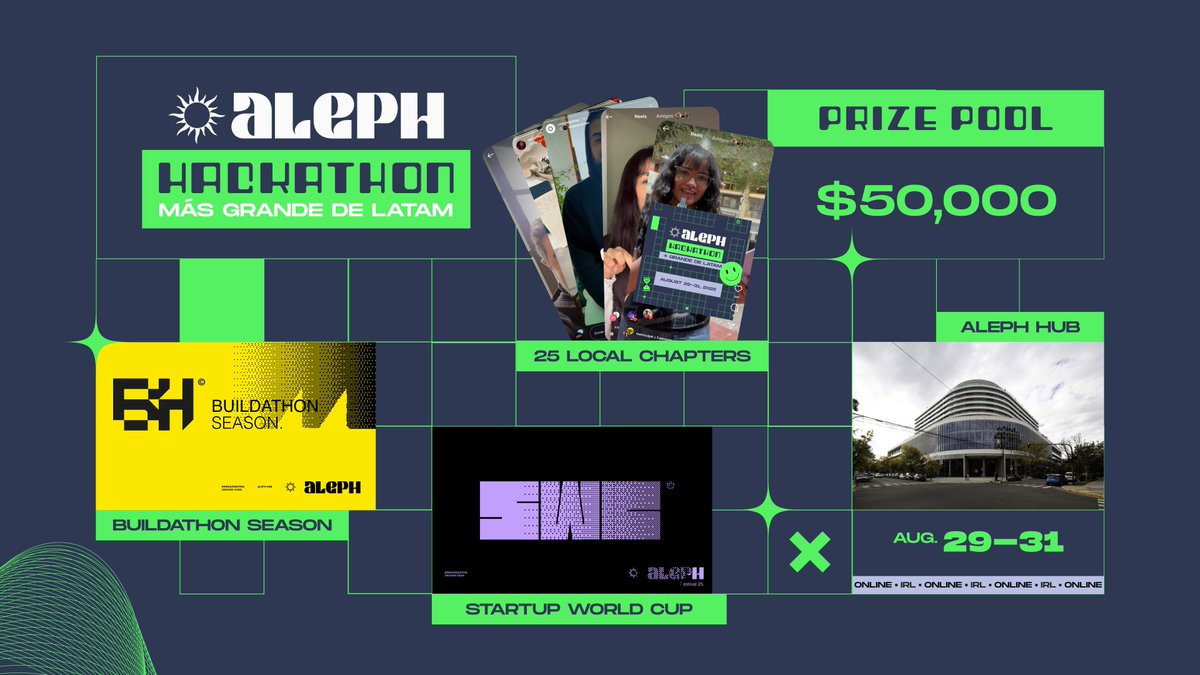
LAST 24 HOURS TO JOIN THE ALEPH HACKATHON
- $50,000+ in prices
- 3 scholarships to come to Buenos Aires for @EFDevcon
- a ticket to pitch the Startup World Cup at DevConnect
- access to +5 builder programs
You can hack online or join any of the 25 Local Chapters all around the world.
Don't miss out on Latam's biggest hackathon ever
Link below👇
🧵 PL_Genesis: Modular Worlds Hackathon: Official Winners Thread 🌍💥
1,900+ builders.
350+ projects.
$250,000+ in prizes.
Here are your champions across sponsor bounties, wildcard tracks, Fresh & Existing Code prizes and the teams joining Founders Forge where the strongest Genesis and PL network teams level up. 👇
🧵The Modular Internet Starts Here.
The @PL__Genesis & @protocollabs Hackathon is officially LIVE.
$260K+ in prizes, cutting-edge bounty challenges, wild card challenges, and a fast track to Founders Forge.
👉 https://t.co/NBqmB3zJjS
@PL__Genesis Also check out https://t.co/4pJsKfILzf and the Harvard Dataverse project - they’re both part of the hackathon too and can offer primitives and datasets you could use as part of your project.
@PL__Genesis Also check out https://t.co/4pJsKfILzf and the Harvard Dataverse project - they’re both part of the hackathon too and can offer primitives and datasets you could use as part of your project.