Chinese Dunhuang dance resurrects the breathtaking "flying apsaras" and whirling figures from the 1,000-year-old Buddhist murals found in the UNESCO World Heritage Mogao Caves.
The James Webb Space Telescope has done it again: revealing a breathtaking structure now dubbed the “Cosmic Vine”: a string of 20 galaxies stretching across a staggering 13 million light-years!
What makes this discovery so shocking? This colossal formation dates back nearly 11 billion years, forming just 3 billion years after the Big Bang, a time when galaxies were thought to still be forming in isolated clumps. Instead, JWST captured a massive, organized structure linking galaxies together much earlier than expected.
[image: artist's impression]
How success breeds ecosystems.
👀The NEW @wef report highlights how VC-backed breakout companies like @ripple become “founder factories” that spawn thriving ecosystems. What makes XRP special (IMO) is that ✨North Star Vision is combined with serious capital that actually provides real support at various levels. There aren’t many teams in this space on the same explosive path that encourage the next powerful generation of XRP ecosystems (e.g., @FlareNetworks, @evernorthxrp, @Girin_Labs, etc.). Ripple support is not a free ride to success (we’ve seen plenty of blowups), but I’d rather be on the investment side of a united front that keeps an XRP win front and center.
🙏@bgarlinghouse.
Link to the report in the comments.
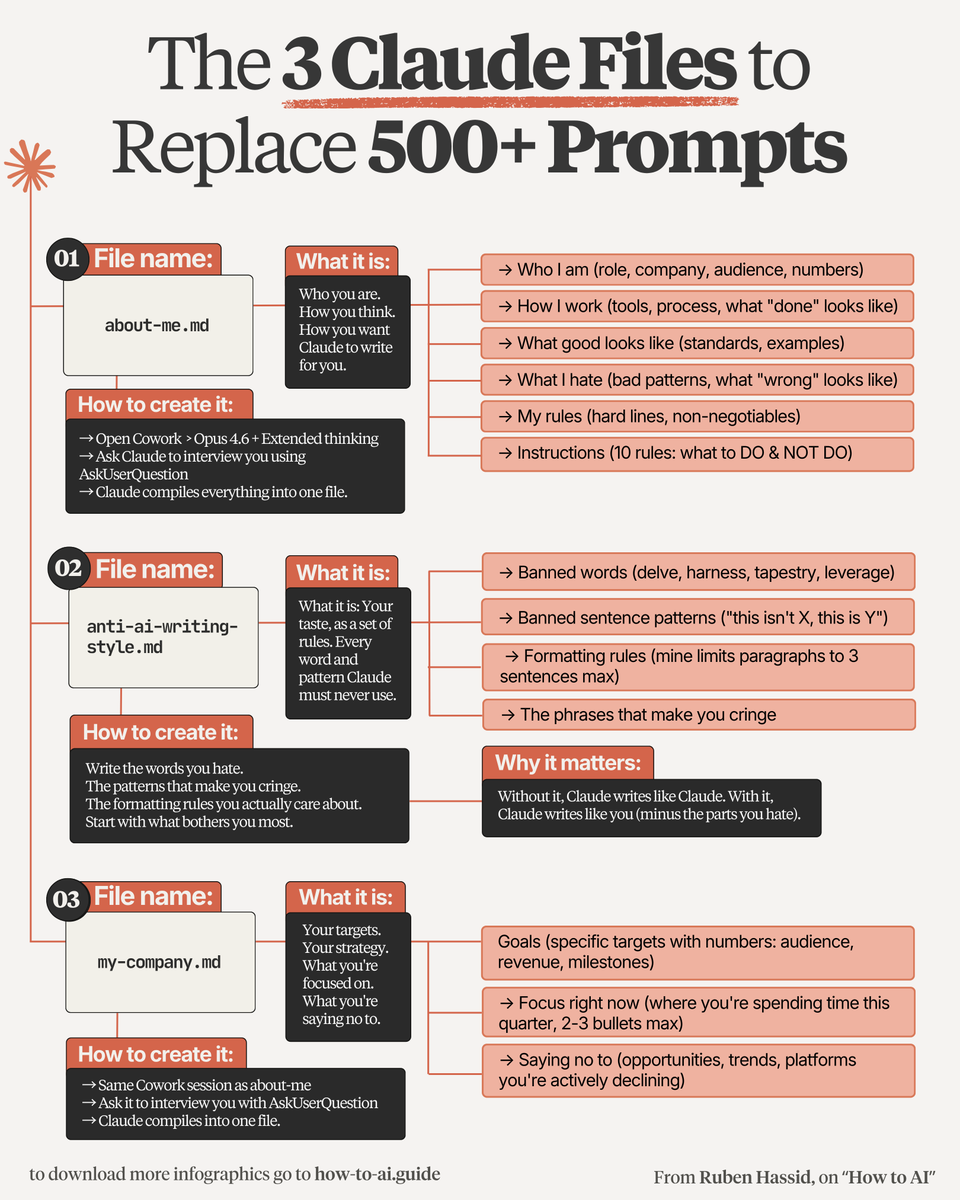
Delete every prompt template you ever saved.
You only need these 3 files:
1. Folder
☑ A folder on your computer called "Cowork":
This is where your 3 files live, forever.
↳ Claude reads them before every single task.
2. about-me .md
☑ Who you are. How you think. How you write:
Open Claude. Run a 100-question interview.
Then compress the answers into one .md file.
↳ Now Claude sounds exactly like you.
3. anti-ai-writing-style .md
☑ Every word, pattern, and tone you HATE:
"Delve." "Tapestry." "This isn't X, this is Y."
80% of this file is what you REJECT.
↳ Without it, Claude writes like AI. With it, like you.
4. my-company .md
☑ Your targets. Your focus. Your hard No's:
Specific numbers (audience, revenue, milestones).
2-3 bullets on where you spend time this quarter.
↳ Claude stops giving you generic advice.
5. Dictate, don't type
☑ Use Wispr . ai (free). Voice is faster:
You answer 100 questions in 90 minutes.
Voice is also more honest than typing.
↳ Vagueness won't survive Claude's follow-ups.
6. Edit it (Obsidian)
☑ You change. Your taste changes. So must the file:
Download Obsidian (free). Open your Cowork folder.
Now editing your .md feels like a Google Doc.
I teach you how Claude works at https://t.co/uWTpOI3Woc.
Copy my folder & download my 3 personal .md files:
Step 1: Subscribe for free at https://t.co/psB7XxB2Y4
Step 2: You will have two choices: free or paid.
Step 3: Choose the free tier. Don't pay for anything.
Step 4: Open your welcoming email. Reply to it.
Step 5: Trace the Notion link. Open '.md files' folder.
Step 6: Access my entire folder + 3 files template.
Step 7: Send this image to your team's channel.
Step 8: Read 2x newsletter per week (for free).
Step 9: Become the "AI guy" at work, forever.
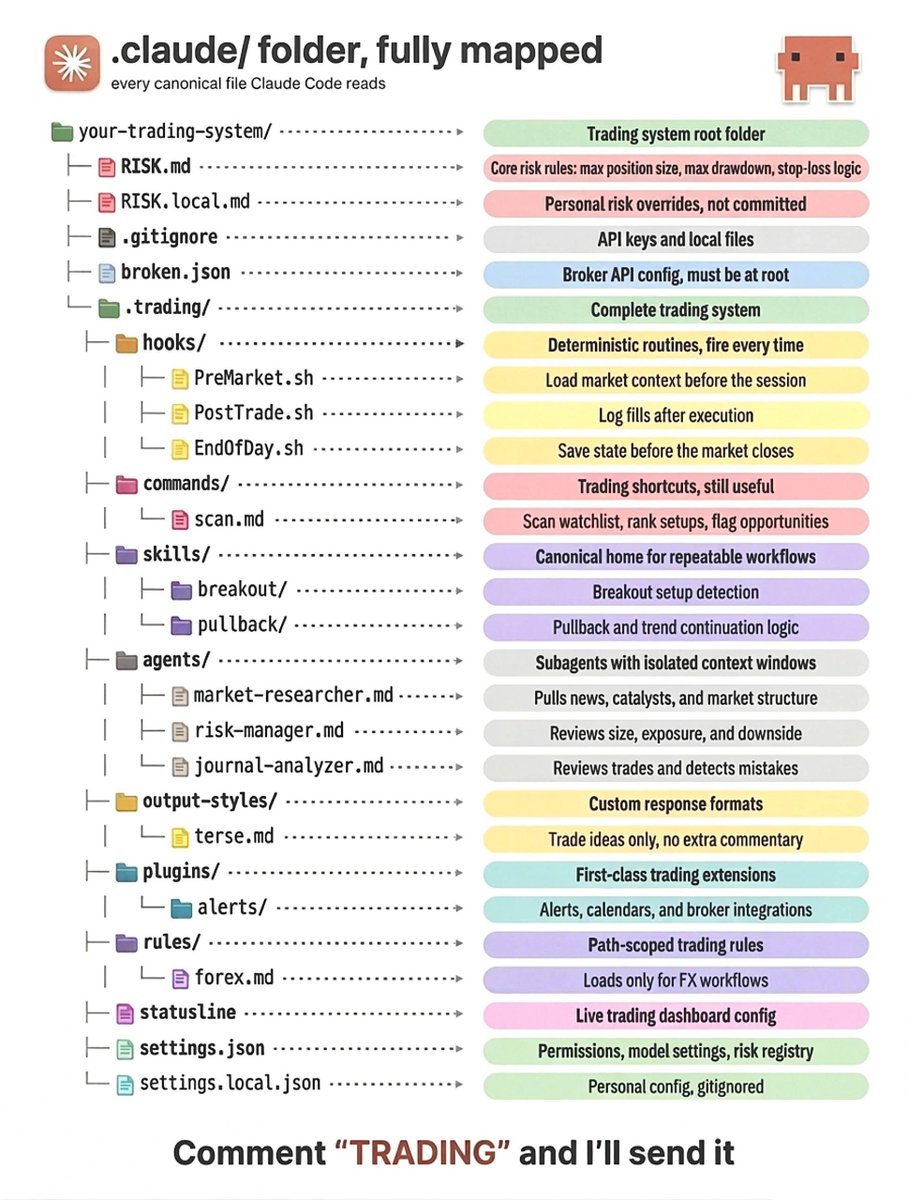
Claude Trading Folder
I’ve compressed the best trading prompts into one PDF
Get it for FREE:
• Like + Repost + Comment “TRADING”
• Follow me so I can DM you
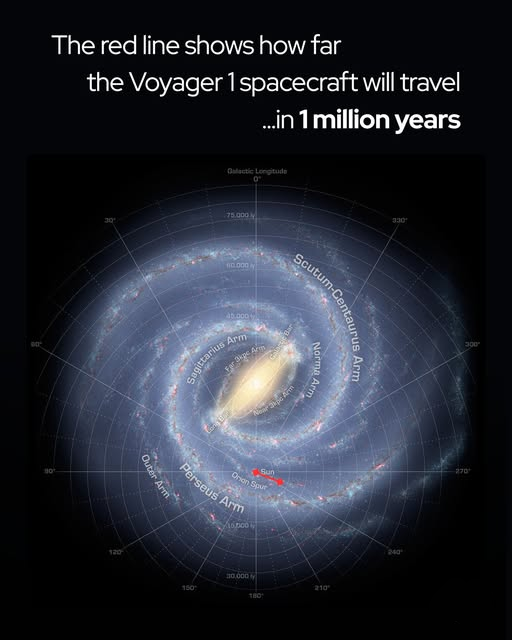
Voyager 1 is humanity’s most distant spacecraft.
But even after a million years, it will barely have scratched the surface of the galaxy.
Launched in 1977, Voyager 1 has been speeding away from Earth for 48 years. It now travels through interstellar space at about 38,000 miles per hour (61,000 km/h) – fast enough to circle the Earth in 40 minutes. Yet, space is so vast that this blistering speed barely makes a dent.
In one million years, Voyager 1 will cover about 330 trillion miles (530 trillion km). That sounds enormous – until you realize it’s only about 56 light-years. For comparison, the Milky Way is roughly 100,000 light-years across. After a million years, Voyager 1 won’t even have crossed one-tenth of one percent of our galaxy.
It will pass its first star encounter, a faint red dwarf called Gliese 445, in about 40,000 years – and then keep drifting silently onward. By then, its instruments will have long since gone dark, but the spacecraft itself, along with its golden record carrying sounds and images of Earth, will continue its lonely journey.


![Rainmaker1973's tweet photo. The James Webb Space Telescope has done it again: revealing a breathtaking structure now dubbed the “Cosmic Vine”: a string of 20 galaxies stretching across a staggering 13 million light-years!
What makes this discovery so shocking? This colossal formation dates back nearly 11 billion years, forming just 3 billion years after the Big Bang, a time when galaxies were thought to still be forming in isolated clumps. Instead, JWST captured a massive, organized structure linking galaxies together much earlier than expected.
[image: artist's impression]](https://pbs.twimg.com/media/HI2nEAJXkAAeFcl.jpg)