It's that time again: no, I do not run any Telegram group, some criminals are impersonating me.
Please don't add pain to injury by sending me angry emails. There's nothing I can do about these scammers. Block and report and be done with it.
@Afinetheorem Maybe you’re missing a step?: prima facie this could mean that European companies are great at adopting to innovation whereas US companies are terrible and thus die. But if you add size and it seems that US companies are just better. No?
Interesting. For applied economic theory, I'm not convinced though. Because there, details matter, beauty matters. I can't speak about macro and asset pricing where, to my solidly mid eye, the same themes come up a lot. But in applied theory, you try to explain much with little (although that seems a bit of a lost art, too, even pre-AI). A sigh.
After highschool, I did an internship at a machine producer and my task was to build a stair to a platform. I am quite sure that in the process of building the stair, I needed to solve a quadratic equation.
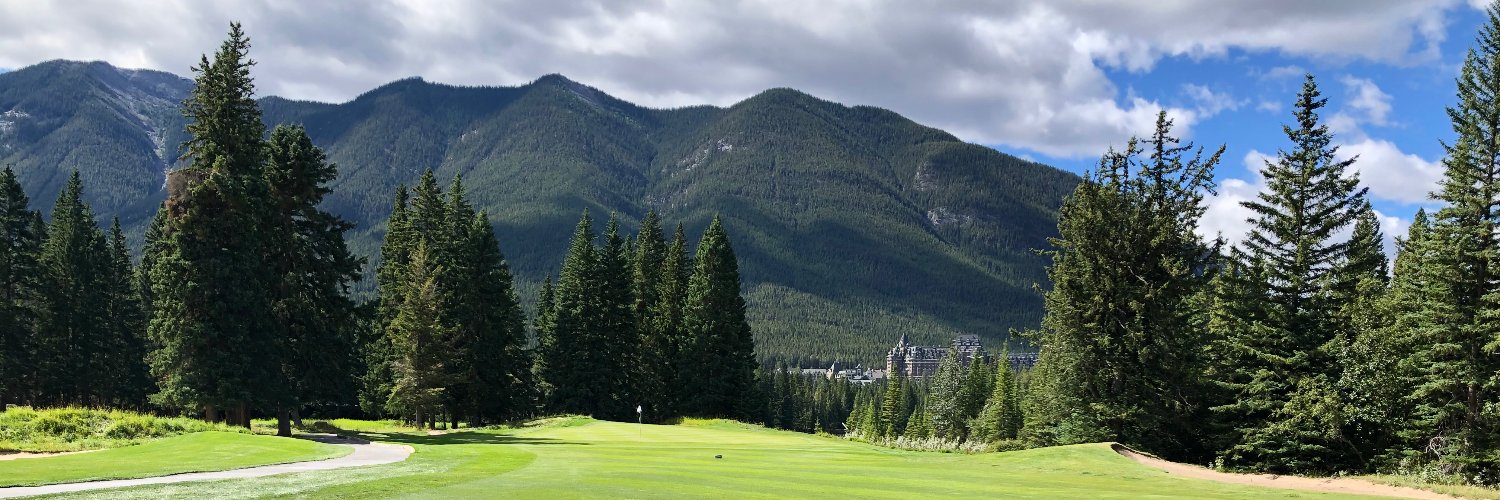
I also regularly use Pythagoras, thanks for asking, when playing golf... 'cos trees and such...
@TourSwingsTommy Why should anyone care about people going for a vanity hcp? The sandbaggers are the problem, those that miraculously play -7 net any time there's a net comp coming up.
Gemessen am 2025 output? CC kam Ende 2025, das war der Watershed Moment. Ich weiss schon, dass das jetzt anecdotal und subjektiv ist, aber auf Konferenzen hoere ich in meinem Gebiet immer das gleiche: man kann viel mehr machen (und tut es auch). Generell ist mein Eindruck auch, dass die Job satisfaction nach oben gegangen ist.
Also denke ich denke, dass in den naechsten 1-2 Jahren die meisten von uns rausfinden werden, wie man am effektivsten mit AI arbeitet, und das wird sich dann durch's Teaching verbreiten.
So schnell, wie's AI Firmen gerne haetten, wird's nicht gehen. Firmen (und Uni admins!) brauchen noch, denn die sind ja oft "stuck in their ways" und interne Policies machen AI adoption echt schwer. Aber das wird sich eben aendern, wenn's genug Leute gibt, die gelernt haben, produktiver zu arbeiten.
Denn wenn man eben hoert, wie die Kollegen die Gains in der eigenen Arbeit sehen, dann wird da schon massiv was kommen. Auf Momentaufnahmen gebe ich eben wenig: dass man da jetzt noch nichts sieht, heisst nicht, dass da nix ist oder dass da nix mehr kommt. Oder?
Fun fact: @ProjectLincoln 's latest ad on crumbling infrastructure features ... the Gardiner Expressway in Toronto, CANADA. Not wrong to say that it's falling apart, but that's maybe pushing the MAGA blame a bit too far... 🤣😂🤣
Today: California billionaire wealth tax prop 40.
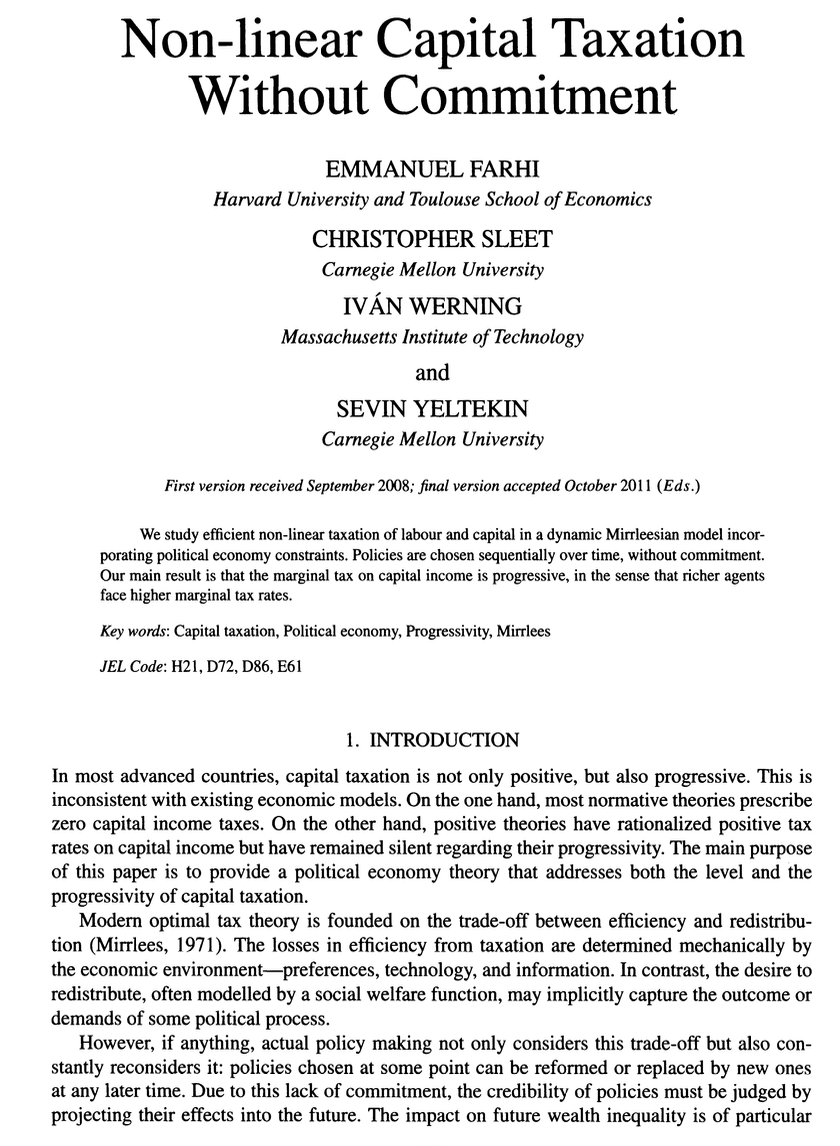
Throwback: One of the papers I most enjoyed writing some 15 years ago (with Farhi and later Sleet, Yeltekin) was on Wealth taxation, nonlinear in a political economy with no commitment.
Let me explain what we did. I am not trying to take political sides really or advocate one thing or another. Enough of that and it is good to think of the economic logic in a basic way. As you see, the paper is more subtle.
The paper modeled a situation where you (e.g., voters, on average) want to do a "one time" wealth tax and promise never to do it again. The incentive to do so is increasing in the amount of wealth inequality. You have nonlinear taxes on wealth and income, so you have rich tools. However, you can't bind future politics or policies. Every now and then you reevaluate (vote).
Sounds familiar? Indeed, various basics of the real world tradeoffs are present.
Obvious: this is a time-consistency problem that leads to a 3rd best (third world?) outcome (not your standard optimal tax one, where you assume you can commit). Well known and studied. At its most basic, the temptation is confiscation (slogans: robin hood, socialism), but the expectation of this happening in future is of course a problem (slogans: capitalism, property rights).
Less obvious: what it is the best you can do today if you with your tax tools, given the situation and constraints. AGAIN: you are not allowed to say "I promise never to tax again". ALSO NOTE: the options are also not necessarily just a choice between taxing wealth now or never doing so. (As the debate on this oversimplify.) Logically: taxing never may just not be feasible/credible. Equally important: you may come up with a different more intermediate plan. Let's see...
Indeed, the model spits out something subtle. You actually declare a more moderate but progressive nonlinear tax on wealth that will be in place permanently. It is progressive with rising marginal tax rates: indeed, you subsidize savings for the poor (!) but tax the rich. In fact, you want to promise this tax today for the future, even if inequality is zero today. Why?
The credibility problem depends on the amount of wealth inequality. That is what affects the incentive to renege on promises and tax away wealth. The solution tries to deal with this by creating an environment that will lower or keep inequality in check, to avoid a temptation to fall into the time inconsistency revision. A progressive tax goes in that direction both mechanically and in terms of saving incentives.
(BTW, the fact that the tax comes out progressive is very clean and surprising, given that the optimal tax literature rarely obtains such results.)
Insight: By keeping inequality in check, it makes policy more credible, avoiding falling into a much worse 3rd best.
At the time, we called it a "compassionate conservative" solution: even if you want zero taxes, you compromise and do some progressive taxation, to avoid more radical taxes later. Metaphorically, the best way to deal with a tide is not by ignoring it, denying it or swimming frantically, you may have to float with it, adapt and swim moderately finding the right moves.
Links: (older ungated): https://t.co/iTqEhlc9qs
published: https://t.co/7ZHJ3zxlhr
Footnote: We titled it capital taxation, but in reality it is more exactly about wealth taxation, e.g. it holds even in a world without capital, where people hold assets against each other etc.
Since Toronto progressives are so keen on following the science, here is what the economic sciences have to say about Toronto's LTT (TL;DR: yes, really stupid and harmful tax, better to raise funds through property tax):
Problem 1: LTT lowers sales of single family homes, aka people stay in their house longer. Dachis, Duranton, and Turner, “The effects of land transfer taxes on real estate markets: evidence from a natural experiment in Toronto,” *Journal of Economic Geography* 12, no. 2 (2012): 327–354. Toronto’s LTT cut single-family sales by about 15 percent and lowered prices by roughly the amount of the tax. Relative to raising the same money with property tax, they put the welfare loss at about $1 for every $8 of revenue.
Problem 2: LTT lower economic welfare, possibly by than what the tax raises. Han, Ngai, and Sheedy, “To Own or to Rent? The Effects of Transaction Taxes on Housing Markets,” Review of Economic Studies 93, no. 4 (2026): 2605–. The moving hazard for existing owners fell 13 percent, about 14 months longer in the house, and time on the market rose about 27 percent. Buy-to-own purchases fell while buy-to-rent purchases rose. The deadweight loss is 111 percent of the extra revenue: about 60 percent from distorting the rent-versus-own choice, 38 percent inside the ownership market, 13 percent inside the rental market.
💯 The LTT is a moving tax, and it's a really stupid idea to making moving more expensive. Because it prevents older people from leaving big houses in favour of smaller ones.
At first order, it is also a tax on the young that massively raises the cost of young families buying a home. Because you need to raise the cash for the LTT in addition to your downpayment.
But it's a great tax for politicians because you take money from someone before they are constituents.