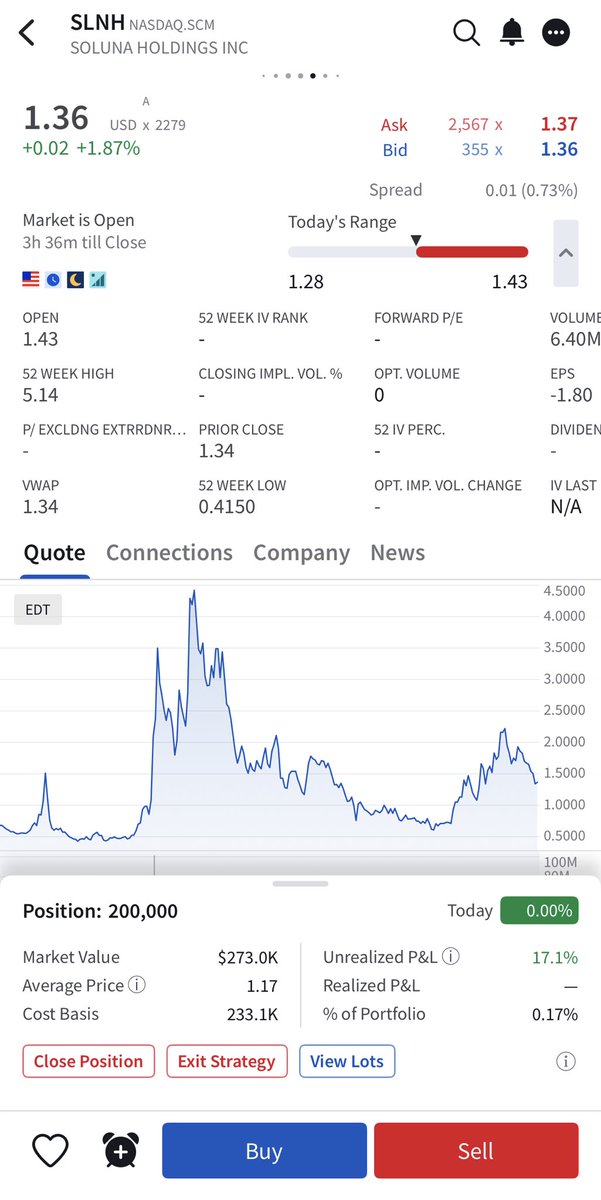
$SLNH This is where the valuation disconnect becomes interesting.
Soluna is still valued around ~$200M, while the company is moving into an AI/HPC infrastructure market where contracted capacity can be worth billions over time.
$APDL Applied Digital is a good example of what the sector is starting to price once MW move from “pipeline” to contracted AI/HPC capacity. Their 210MW hyperscaler lease represents around $5.2B in base-term contracted revenue over 15 years. That equals roughly $24.8M of contracted base revenue per MW.
If Soluna lands the first 100MW phase at Kati 2, that same revenue intensity would imply around $2.48B of potential base-term contracted revenue over the lease period.
100MW × ~$24.8M/MW = ~$2.48B.
That alone shows why the first Kati 2 lease matters so much. At a ~$200M market cap, one serious 100MW AI/HPC lease could completely change how the market views Soluna.
But Kati 2 is not only 100MW. The first phase is the proof point. The broader campus plan is 350MW, and management has discussed a longer-term 1GW+ roadmap.
Using the same rough framework, 350MW would represent about $8.7B of potential base-term contracted revenue.
350MW × ~$24.8M/MW = ~$8.68B.
A 1GW+ roadmap would obviously be much larger.
Then comes Dorothy 3.
Dorothy 3 is important because it can be the follow-on proof that Soluna’s model is repeatable, especially where Soluna owns the power layer through Briscoe. John has discussed a first AI footprint around 100MW, with the broader Dorothy 3 opportunity at 300MW+.
If Dorothy 3 starts with 100MW, the same rough framework would imply another ~$2.48B of potential base-term contracted revenue.
100MW × ~$24.8M/MW = ~$2.48B.
If Dorothy 3 scales toward 300MW+, that framework would imply roughly $7.4B+.
300MW × ~$24.8M/MW = ~$7.44B.
So the real roadmap is not just “Kati 2 first 100MW.”
It could be:
Kati 2 first 100MW as the commercial proof point.
Kati 2 350MW as the campus expansion case.
Kati 2 1GW+ as the long-term roadmap.
Dorothy 3 first 100MW as the repeatability proof point.
Dorothy 3 300MW+ as the owned-power AI campus opportunity.
This is why I think the market is missing the scale of the setup.
Soluna is still being priced like a small BTC-linked company, but the assets they are convertingare power-backed AI infrastructure assets.
Wait $CIFR did a 75MW deal with AWS for $2 billion and $SLNH is currently advertising for 100 MW available now at Kati 2 and is trading at a $200 million market cap ?
good to see @RoboStrategy $BOT now up 90% in a bit over a week, was told countless times that its trading over mnav and it will dump but the reality is that there is literally no other way for retail to get access to the best companies in the robotics space.
this is the only option and if developments like anthropic and openai are anything to go by companies like figure probs wont IPO til like $1trn anyway.
if you believe like i do that figures livestream was the chatgpt moment of robotics the upside from here is enormous, we literally already have the equivalent roadmap thanks to LLMs (highlighted in yellow)
the entire robotics industry sitting at 200b right now and were looking at 5T within 5-10 yrs imo
My favorite setups into the rest of the week
Massive daily bases in the optics sector & incredible relative strength
SK Hynix aims to double wafer capacity over the next five years because AI demand is driving unprecedented growth in memory:
$AAOI
$CRDO
$VECO
$COHR
These look ready to move.
Did you listen? $LASE
Connecting $LASE, $ONDS, and $LPTH
The recent LinkedIn interaction between Laser Photonics Corporation and Ondas Inc. highlights a highly strategic connection within the U.S. defense technology ecosystem. At the center of this relationship sits LightPath Technologies, acting as a crucial technological bridge.
1. The Supply Chain Link $LPTH
The strongest operational tie between these companies comes down to advanced optics and thermal imaging:
Ondas has a strategic multi-million dollar partnership with LightPath Technologies to secure proprietary, U.S.-made infrared cameras for its autonomous drone systems.
Laser Photonics, as a specialist in tactical laser systems, relies heavily on the exact same high-precision optical lenses and coatings that LightPath manufactures.
2. Perfect Market Synergy
Ondas and Laser Photonics effectively tackle opposite sides of the modern battlefield:
Ondas is experiencing rapid backlog growth in autonomous military drones, loitering munitions, and air defense tracking.
Laser Photonics focuses on the counter-drone (C-UAS) market with its flagship Laser Shield Anti-Drone System (LSAD), designed to neutralize hostile drones.
When a laser-defense firm actively tracks a high-performing drone manufacturer, it points to strategic alignment. Modern defense contracts increasingly favor complete ecosystem solutions. By aligning through a shared supplier like LightPath, these companies are well-positioned for technology integration, shared supply chain cost reductions, or joint bids on comprehensive Pentagon contracts.
Everyone’s talking $AAOI. So I filtered the flow: buy-side, $250k+
Every print is a call. Zero puts.💡
And the size reaches into July and Sept ($200s, $220s, a $250/$350 spread) -> dated months out, not same-day.
Flow isn’t a thesis and big prints can be hedges. But a one-directional buy-side >$250k call tape dated into the fall? Worth watching. 👀
go poor if you have to buy this
$ampg
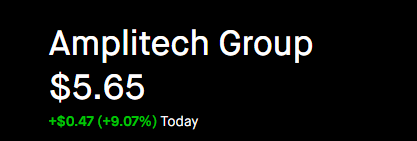
AmpliTech is a small cap RF/microwave amplifier specialist (low-noise amps, cryogenic tech, subsystems) serving high-growth markets: 5G O-RAN, satellite comms, defense, space, and quantum computing
Explosive near term catalyst: Strong Q1 2026 revenue (+48% YoY) and gross margin expansion to ~48%. Recent full FCC/ISED approval for its 5G Native DAS solution + AI-RAN trials unlock U.S. carrier and private network deployments.
Secular tailwinds: 5G rollout, satellite mega constellations, defense modernization, and quantum infrastructure all need ultra low noise, high frequency RF components areas where AMPG has deep expertise and U.S.-made products.
Pipeline: ~$100M+ in non-binding LOIs and Tier-1 interest. If even a fraction converts, revenue could scale rapidly from current ~$20–30M run-rate
Valuation: Micro-cap (~$130M market cap) trading at a discount to growth potential. Successful execution could drive multi bagger upside as margins improve and revenue scales.
Not to mention they just announced $NVDA X $AMZN as customers on there website without releasing contracts of what there buying.
this is a 1B stock larping at 130m.
Just a random thought: $JBL seems highkey compelling long idea at $38B.
Don’t really think markets have priced in their 1.6T LRO pluggable transceiver business yet.
Especially if it’s “how much can you make” with $SIVE as the bottleneck H1 2027. Not really is there enough demand.
They already have the massive supply chains setup… and took over $INTC pluggable lines.
Seems more scalable than $AAOI capex ATMs for laser fabs, if you have $SIVE + tons of different fabs like Win Semi + others mass producing lasers and $JBL doing the rest.
So you’re getting that Innolight style setup for free (with US premiums), with an already validated hyperscaler supply chain.
Don’t currently have positions, just throwing out a thought for others to do research on.
Prob H1 2027 is when everyone starts realizing. Maybe 40% rereating seems plausible?
(dont have any open positions, just a thought)
The optical transceiver market triples to $36 billion this decade and $AAOI is the smallest cap name with arguably the most explosive upside in the entire space. Here is the math nobody is showing you.
Start with where we are. 800G is the workhorse today and it is exploding. Shipments doubled in 2025 to around 24 million units.
TrendForce sees 63 million units in 2026, a 2.6x jump in a single year. Zero demand softening.
Now the 1.6T ramp, which is the real story. Shipments crossed 1 million units in 2025 and are forecast to hit 5 plus million in 2026.
NVIDIA’s GB300 platform requires 162 of these 1.6T modules per server cabinet, so demand scales directly with every rack that ships.
Microsoft alone is deploying 2 million 1.6T transceivers, roughly $3 billion in procurement.
And 3.2T is absolutely coming. By 2027 most switch ports transition to 1.6T, and by 2030 most are expected to run 3.2T.
Every generation means more dollars per port, more modules per cabinet, and a brand new upgrade cycle. This is a staircase that climbs for the rest of the decade.
Now here is why $AAOI specifically.
It is the smallest cap of the major players, which means it has the most room to run if it executes. And it has one structural advantage almost nobody else has.
They make their own lasers in house. In a market where lasers are the single biggest supply bottleneck, while competitors wait in line for allocation, AAOI controls its own input.
That is exactly why two to three hyperscalers told them they would buy every transceiver they can produce.
Revenue already grew 83% to a record $456 million with guidance over $1.1 billion for 2026.
A confirmed order book stretching through 2027. And a market cap a fraction of $COHR, $LITE, or $CRDO
When you own the bottleneck input in a market tripling this decade, and you are the smallest name in the room, that is where the asymmetric upside lives.
A $39 million purchase a decade ago might turn out to be one of the smartest acquisitions in semiconductor history.
Almost nobody is talking about it. $ADEA owns the foundational patents on hybrid bonding and the entire AI chip industry is being forced to adopt it.
Here is what is happening.
For decades chips got faster by shrinking transistors. That era is ending. Physics caught up. The way forward now is stacking silicon instead of shrinking it, and the technology that makes that work is hybrid bonding.
Thousands of microscopic connections joining chips face to face. Smaller, faster, far more power efficient. For AI processors choking on heat and power limits, it is becoming the only path forward.
$ADEA holds over 1,100 patents on it. They bought the core IP for $39 million back in 2015 when nobody cared. Now everybody needs it.
AMD is already shipping hybrid bonded chips and just signed as a licensee. Intel, Broadcom, and Marvell have all laid out roadmaps that use it.
SK Hynix, Samsung, and Micron are pouring billions into the memory that depends on it. The CEO flat out said NVIDIA adopting it is a matter of when, not if.
Every single one of those names is a current or future licensee. And $ADEA collects without manufacturing a thing. 60% EBITDA margins. Pure royalty flow that scales as adoption spreads.
The kicker is that the market still prices this like a dying media patent company. The semiconductor side is the fastest growing piece and it is barely reflected in the valuation.
As hybrid bonding goes from emerging to standard, the revenue inflects and the multiple snaps higher.
They own the toll booth on the one road the entire AI chip industry has to drive down.
When the market figures that out, this moves.
We just discussed something similar on stream last week.
I got alpha for you guys. Research and locate companies focusing on high tech actuators and/or ones with major contracts with robotic companies.
Those are the ones to long via spot and dated leaps.
WOW now they have BRAND NEW a PURE photonics ETF. Seems like an insane opportunity $FOTO
How is NOBODY talking about this? Shoutout @seer_xyz for showing me
You don't wanna miss out on this.
The same guy who called these stocks
$ASTS at ~$35
$RKLB at ~$35
$FLY at ~$20
$SATL at ~$3
$SIDU at ~$2
Just told us where the money is heading next.
This is a run you don't wanna miss out on.