"When advising people how to make sense of the world, I emphasise three C’s: calm, context and curiosity. Calm, because our emotional reactions to the numbers we see in the news are often stronger than rational thought; we should notice those reactions and try not to let them overwhelm us.
Context, because numbers are meaningless without it; we need to understand whether they are large or small, rising or falling and the methods behind them.
And curiosity, because the most important step in understanding the world around us is to want to understand. All too often we seize on factual claims to win an argument or signal loyalty to a viewpoint, rather than because we are eager to know more."
https://t.co/2BPHwFUl8F
Our forecasts are showing tight margins on the electricity system for tomorrow evening. This is due to the impact of extremely high temperatures affecting Great Britain and the continent and low wind.
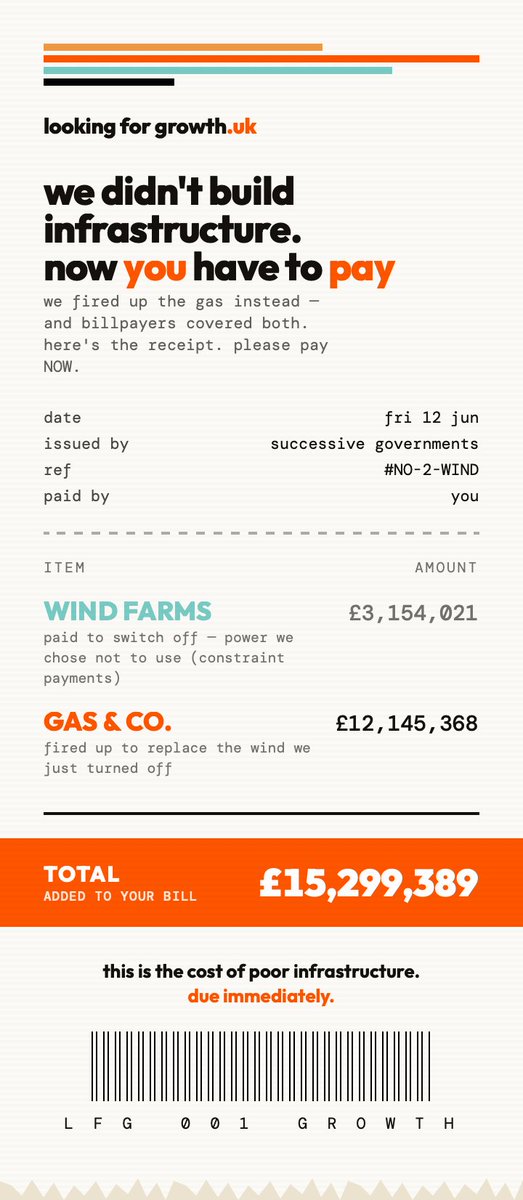
This line "we didn't build infrastructure. now you have to pay" misses the point quite badly
We *did* build a bunch of infrastructure (offshore windfarms and huge transmission lines for them). Last year we spent £4.2bn, this year £7.6bn and next year we
https://t.co/dntwXF4hhL
but only when we build that generation in sensible places. It's obviously not great that we're paying wind farms to *not* generate electricity, but it's not because we've under-invested in infrastructure generally - it's because we've invested in the wrong infrastructure
This line "we didn't build infrastructure. now you have to pay" misses the point quite badly
We *did* build a bunch of infrastructure (offshore windfarms and huge transmission lines for them). Last year we spent £4.2bn, this year £7.6bn and next year we
https://t.co/dntwXF4hhL
On the 12th June you paid £15,299,389 because of Ed Miliband's failed energy policies.
We have some of the highest energy bills in the WORLD.
And we are sending MILLIONS to big renewable to turn off wind farms.
Why are we doing this to ourselves?
will spend £9.1bn funding just the transmission build-out in order to accomodate offshore wind. This is despite the fact the UK uses less elecricity now than it did 20 years ago! Maintaining the network would be more than sufficient for connecting consumers to generators,
The prospect of variolation being a normalised practice again seems more promising than most vaccine R&D advancements IMO
(Full article is worth reading!)
Some takes about RSI from discussions with many smart researchers & thinkers:
1. Many RSI (or automated AI R&D) debates converge to similar cruxes: is a 1000x sample efficiency improvement possible, can you just simulate reality and train on it with no sim2real gap, can we easily make models good at "fuzzy" tasks? People like to assume that automated research agents will find such breakthroughs specifically *because* without them, progress could be heavily bottlenecked on data or continued compute scale-ups.
2. The Yudkowsky "genius brain in a box" framing of ASI has latent influence on many researcher views even though people may not be aware of it. A common move is to "flip" predictions, as they go further out, from assuming LLM or deep learning-specific properties of future AI to assuming "von Neumann x1000", human brain-like properties. I'd like to see more thought-out reasoning of why this flip should occur at any particular point (eg pre or post automated AI R&D)—this question is a crux behind many predictions like AI 2027.
3. There are some cracks in this worldview beginning to show: predictions from a few years ago that models would be less jagged now than they are, or that they would be more deceptive, synthetic data would work better, etc. Many of these seem like prediction errors from imagining future models as a "human brain in a box", but LLMs are empirically a different kind of intelligence. Most models of software-only intelligence explosion are also coarse enough to mostly ignore properties of LLMs.
4. Views about fast RSI progress seem to be correlated with (a) belief that synthetic data is all you need (b) belief in very high GDP growth and an industrial explosion because of automated firms (c) having worked only in AI research or in small organizations.
5. Key technical things to track over the next 1-2 years: does RL increase in its generalization, AI lab data spend, can we automate synthetic RL env construction, best practices for FDEs deploying AI into large enterprises, coherency of AI personas, how powerful will multi-agent scaling of test-time compute be, and continual learning.
6. Overall I think the "RSI leading to *fast* takeoff" frame had huge alpha in 2022, moderate in 2024, and potentially is of neutral usefulness in 2026 for predicting the future.
New Syn Post: The capital stock for manufacturing has withered on the vine. For electricity generation, it has exploded, but to no real benefit.
Link below.
@evcricket@flexibledragnet@AndyMasley It's an interesting question that I have thoughts on, but if you're going to continue selectively and uncharitably responding to my answers then I don't really see the point in talking with you
Yeah that was far from ideal! Despite that very bad situation in 2022, France still managed to deliver more electricity to consumers than the UK, at a lower per-unit cost than the UK, and with fewer emissions than the UK
I agree you don't require much extra backup to incorporate wind and solar into a diverse grid mix, but that necessitates keeping their share of supply low (otherwise it's no longer diverse). Once it becomes a larger share, you really do need redundant generation capacity to make the output shortfalls manageable (which is when they become uneconomical)
If countries want to go further with decarbonising their power sectors, it seems much better to scale up dispatchable generation (hydro, geothermal, nuclear)
Thanks for engaging thoughtfully!
@flexibledragnet@evcricket@AndyMasley To answer more directly - usually gas would cover it in the UK, but if you have rolled out nuclear at scale (eg in France) then outages will mostly be covered by other nuclear plants
Planned outages will usually happen outside of peak-risk periods so that the rest of the system will cover demand - Sizewell B is normally taken offline every 18 months and takes about six weeks to undergo refuelling and maintenance
Unplanned trips in the UK are covered by other dispatchable generators, storage, interconnectors, demand response and balancing services
Residual firm capacity needed elsewhere might be 0.15–0.25GW for every 1GW of nuclear in order to account for outages. Since outages will tend to be uncorrelated with the rest of the grid, it's especially manageable
Since renewable output is variable and weather-dependent, you need substantially more backup generation to secure supply. Their output drops to ~0 frequently (daily for solar) and these drops occur at essentially the same time across all renewable sources of the same type. (They'll be less correlated if you build vast cross-continent transmission lines, but even then they're still highly correlated)
To clarify, I'm not talking about peaking capacity but gas turbines existing to support renewables (when it counterfactually wouldn't for firm power such as nuclear). And I'm mostly thinking about my country's actual energy system, not a thought experiment
Anyway I had a look at the 2026 draft and it says NEM currently has 4 GW mid-merit gas plus 8 GW peaking gas. They say as 9 GW retires, the fleet would be replaced/expanded to 14 GW of flexible gas by 2050. It also says typical flexible gas may generate only about 7% of annual potential - ie it will play a backup role
AEMO explicitly says gas, storage and hydro are needed to back up/firm VRE
The counterfactual is no-transmission scenario, not a fossil-based one, and is still largely based on renewables. It looks at achieving the same policy goals without any transmission buildout, meaning:
- the renewables that are built have lower resource quality (as their locations are restricted)
- there is thus more reliance on flexible gas, and CCS is required to stay under emissions targets
- coal retires earlier, not later, than in the proposed scenario (to allow for more gas to be burned while staying under emissions limits)
- more storage needed in constrained locations
So the no-transmission counterfactual costs more because the generator, storage and fuel costs are higher than the transmission buildout
I do agree that it's worth modelling the grid under different scenarios to see the difference - just know which scenarios you're comparing