$CrvUSD might be the game changer ever for both stablecoin and DeFi universe.
How will $CrvUSD reshape the @CurveFinance’s internal ecosystem and the whole DeFi world?
Let’s break it down 👇(15/15)
It’s happening! 🔥 Ugly Cash is now live on the App Store and Google Play:
https://t.co/DqNx0Gf7sZ
Our goal for this Early Access stage is to closely monitor the correct functioning of all U.S. banking services as we gradually roll out all the features of Ugly Cash.
We're starting with a few functionalities and limited new sign-ups per week. A LOT of polishing still needs to be done, but don't worry: the experience will improve, and more features will become available as we get closer to full access. Expect quick iterations and updates for @verygoodbanking over the next few weeks.
What can users expect in this Early Access release?
🇺🇸 For Members in the U.S.
🏦U.S. Bank Account in your name (through Bangor Savings Bank, Member FDIC).
- $0 opening fee, $0 maintenance fee, no minimum balance.
- Sign up with a government-issued ID, such as an international passport, SSN or ITIN.
- Use your account and routing number to pay bills online, receive wires, or set up direct deposits.
(T&C https://t.co/XF58lbjJKK)
💳 Mastercard Debit Card (issued by Bangor Savings Bank pursuant to license by Mastercard International Incorporated).
- Use virtual and physical cards.
- Connect it to your payment apps (Zelle, Venmo, Cash App).
- Withdraw cash from authorized ATMs.
- Add it to your Apple Pay and Google Pay wallets.
🌎 For Members in Latin America
- USD balance (top-ups and withdrawals in stablecoins).
- Mexican users can operate from their bank accounts in the local currency.
- Send and receive money within Latin America at no cost among Ugly Cash members.
- Access to Bitcoin and Ethereum.
Stay Ugly, Stay Hot, Stay Latino…!
A bootstrapping origin story of popular stablecoins + rounding out with the latest stablecoin safety ratings from @bluechip_org
A story on differentiation, timing, resilience and flywheels… and safety ratings!
Lets go… 🏃♀️
Tether (USDT) $83B mkt cap, the founding team 2014 had the creativity, differentiation and timing – but could not turn it into a sustainable business. Value prop was safe-haven from crypto trading, mostly Bitcoin at the time. Enter Bitfinex a top 5 crypto exchange with large network effects. Coupled with Bitfinex’s banking relationships 2015 + the rise of ERC20 and ICOs in 2017 helped, $USDT built the deepest liquidity and trading pairs across crypto. While Tether got a D from @bluechip_org, my observation is they keep trending toward increased transparency. The invisible hand of the market is at play.
Circle (USDC) $25B mkt cap, founded by serial entrepreneur jeremy allaire in 2018. On differentiation, the team prioritized transparency and regulatory friendliness, so like Tether but more transparent. Makes sense! Taking a page from USDT/Bitfinex, the team integrated Coinbase as a shareholder, and Circle bought a top 5 exchange Poloniex. Smart way to get a stablecoin to critical mass quickly. USDC got a B+ from @bluechip_org!
Maker (DAI) $5.3B mkt cap. What if you could have the stability of USDT and USDC, but accessible to anyone without an account or wanted to keep your ETH but access some tax-free spending money? Or what if you just believed in decentralization? DAI brought entirely new differentiation. An explosive flywheel was born from the March 2020 Covid Black Thursday, coupled with the expansion of new collaterals to mint DAI and diversify backing, and a perfect storm of Defi Summer thanks to the bear market investments of 2018-2019. DAI has a B+ from @bluechip_org.
<intermission>
🎬 By now you are getting the drift so pardon occasional brevity as I look to focus on the more innovative levers…
Techteryx (TUSD) $3.4B mkt cap – followed the USDC-ish playbook with a regulated custodian under NYDFS, with early/ongoing commitment to Binance ecosystem, then partnerships Silvergate, Signature Bank, FTX, Bittrex, Kucoin, Hotbit. Strong flywheels but deserves pause given lots of questions on transparency, with TUSD receiving the grade of D in the @bluechip_org review.
Binance (BUSD) $2.2B mkt cap – one of the world’s largest and best UX centralized exchanges coupled with what many consider to be a solid transparency and regulatory compliance at Paxos as a custodian. Unfortunately regulators, were no longer having it in early 2023 (google it). If @bluechip_org, only existed earlier (score of A for BUSD), regulators might have seen a different opportunity.
Tron (USDD) $724M mkt cap – One of crypto’s most controversial entrepreneurs, forking Terra Luna the fastest growing algo stablecoins in early 2022, you know that story , do I need say more? 📉@bluechip_org rigorously scored USDD an F in case you were wondering.
Frax Finance (FRAX) $670M mkt cap – Crisp capital efficiency from fractional backing + mastery of partnerships/integrations (Curve, Tokemak, Convex, etc.) during an explosive Defi Summer combined with an innovative AMO design invention to bring yield on collateral back to the protocol. FRAX scored a D with @bluechip_org but watch this team that keeps innovating.
Why is the Reserve guy talking about 7 other stablecoins?
Four of the seven listed here are utilized in the composable Reserve/RToken ecosystem. 🤝 Each of the seven tell a different story of differentiation, timing, resilience and flywheels, all coming together at a right time, to reach billion dollar TVL thresholds at one time or another in market cycles. The Bluechip ratings bring safety into perspective.
Really interesting to see how adoption values network effects vs transparency and safety, so far.
Sadly Terra Luna was one of the worst of this.
If we are in the midst of a great unbundling of the financial system, with less than 5 million crypto monthly active users on a planet of 8 billion, it is possible the long term winners don’t exist yet.
We have the privilege of learning from the projects mentioned here, and now possess tools of permissionless digital money that help drive the cost of production and the cost of distribution toward zero, with no middleman, setting the stage for a revolution in connecting financial products supply and demand at the edges.
If you are considering launching a currency, stablecoin, flatcoin or index, I invite you to spin up an RToken on the @reserveprotocol – it can be done in less than an hour with no fees except the cost of gas. Lots of support is available in the Discord linked below. 👇
1/
This is an invitation to discuss "compUSD" – a novel, 1:1 asset-backed and revenue-generating stablecoin with enhanced safety mechanisms, designed to drive ecosystem growth for @compoundfinance, powered by @reserveprotocol RTokens
👇
Today Tether shares its attestation for Q2/2023 (2023-06-30).
Another quarter, another massive result.
I'm immensely proud of our team.
Hightlights
1. Q2/2023 Tether's operational profits > $1B.
How?
The main component of the profits are the interests on the T-Bills that Tether holds as part of the reserves (more on this below)
2. Excess reserves at $3.3B
What "company own excess reserves" mean?
It means that Tether, on top of the 100% reserves necessary to back issued tokens, has $3.3B more. This accounts almost for 4% additional value on top of the minimum 100% reserves.
Ok... but why does Tether keep excess reserves in the portfolio?
While these excess reserves are part of Tether own shareholder equity and normally a company would distribute them as dividends, Tether prefers to keep a big portion of these profits on top of the reserves to make its stablecoins products even more resilient.
While many banks have failed their customers recently, with poor risk management, long term maturity products and extensive fractional reserve, Tether believes that its main role, as leader in the stablecoin industry, is to act as a counterbalance, ensuring more protection to its global userbase and avoiding those mistakes.
3. $72.5B overall exposure in US T-Bills, this includes direct ownership, overnight reverse repos and look-through in the money market funds, bringing Tether above UAE in the ranking of the biggest holders of US debt (based on this chart https://t.co/mhKiQ7wQiD).
Average maturity of US T-Bills is less than 90 days.
4. Tether, as disclosed in the past, is investing a portion (relatively small to its profits) in building renewable energy production facilities and #bitcoin mining.
Thanks everyone for the support ♥️
The Stablecoin Trilemma 🔺
Is it possible to achieve decentralization, stability, and scalability all at once? 🤔
A post on some of the approaches taken by both CDP & Decentralized Reserve based stablecoins, and the challenges we've seen 🧵
👇
CDP-based protocols require collateral in order to mint stablecoins - ensuring decentralization and stability even in the toughest of situations.
This ticks off two of the requirements (if taking in only decentralized collateral), however there are still some scalability issues which can arise due to the constraints placed by:
- The need for borrowing demand
- The need for trustless collateral (makes it tougher to retain a hard peg)
- Secondary liquidity being required on external DEXes / AMMs
What's the alternative?
👇
Enter Decentralized Reserve Protocols
Decentralized Reserve Protocols take an alternative route, utilizing a protocol-owned reserve. This reserve is often backed by native assets of that particular chain (eg. ETH)
With this approach, the protocol allows for direct minting and redeeming of the stablecoin, which in turn results in a stronger peg.
This also helps solve the problem of liquidity, as it makes the protocol itself the primary AMM 💡
However, the volatility of reserve assets (such as ETH), pose a significant challenge for these protocols as the protocol takes on all the risks in case of market movements.
This makes having efficient hedging mechanisms a must.
So, what are some hedging mechanisms that we have seen❓
👇
1) Recapitalization via inflation is one - where protocols introduce a third token (in addition to the stablecoin & the reserve token) to supplement the reserves.
These tokens can be inflated in supply so users can deposit more reserve assets in exchange for the inflationary asset, which the protocol can then use as a surplus to back their stablecoin
This mechanism comes with two main issues:
- Protocols require extremely high collateral ratios making it capital inefficient (think 500% + CR )
- Death spirals to inflationary tokens can often happen with market crashes
What's the other mechanism?
2) Delta-neutral hedging
Delta neutral hedging is a method to hedge the reserve's volatile asset (e.g. Ether) against price movements to ensure stability for the stablecoin. In this context, this means using perpetual futures to hedge volatile reserves.
This also comes with some big challenges, namely:
- Excessive hedging costs (especially when demand for leverage is low)
- Often times centralized entities & exchanges are used for hedging = centralization risk❗, which completely makes solving the trilemma moot
Despite the challenges that we have seen when it comes to delta-neutral hedging, we’re confident that solving this particular component is the the best way forward for cracking the trilemma 🫡
How do we plan to do that?
Through a few neat innovations💡
Come back tomorrow to find out!
#StablecoinRevolution
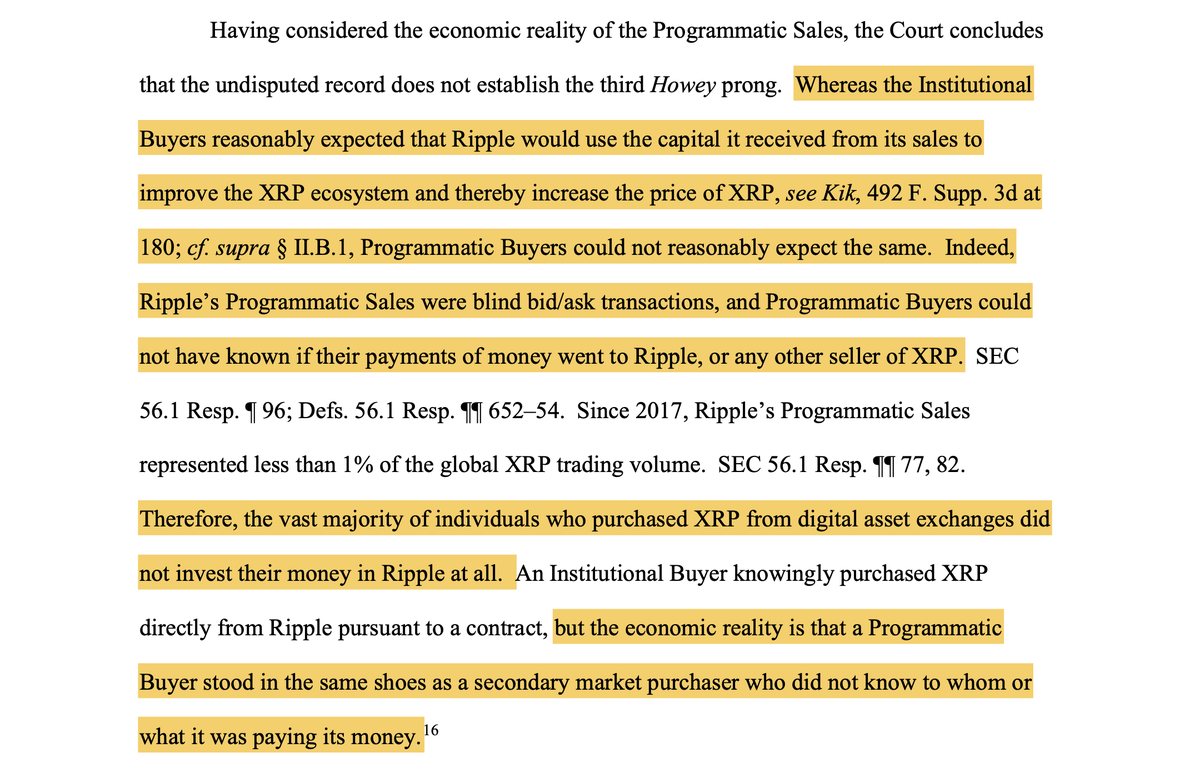
The most important part of this ruling:
“XRP, as a digital token, is not in and of itself a “contract, transaction[,] or scheme” that embodies the Howey requirements of an investment contract.”
This is a now a matter of law (not up for trial.)
The sale of XRP on exchanges is NOT a security. Which means the sales of all cryptos on exchanges are NOT securities and @SECGov and @GaryGensler have NO jurisdiction over them. This is a watershed moment that relegates the SEC to TradFi and makes it a dinosaur regulator. Buh-bye
Thanks @0xgabo for giving us time. It is clear that the tough decisions which were taken are in the best interest of the @reserveprotocol project. We wish you all the very best for your massive efforts to kickoff the US-LATAM remittances power machine 💸 $RSR
Letter to the Rpay community: Embracing Challenges and Adapting for a Global Vision.
https://t.co/y6qNIHwBTv
Given the sensitivity of this update, I'll be available to answer any questions directly at: https://t.co/sNcaVhdqOM
On June 5, @SEC_News files 13 charges against @Binance. Hot on Binance's heels, @coinbase comes under scrutiny next day.
This has brought huge FUD to the whole crypto world. How has this influenced BUSD and how Binance reacted to it?
Let’s break it down. 👇(9/9)