Our work "Fast Voxelization and LoD for Microgeometry Rendering" is now available in The Visual Computer!
https://t.co/IhTOeKTh5l
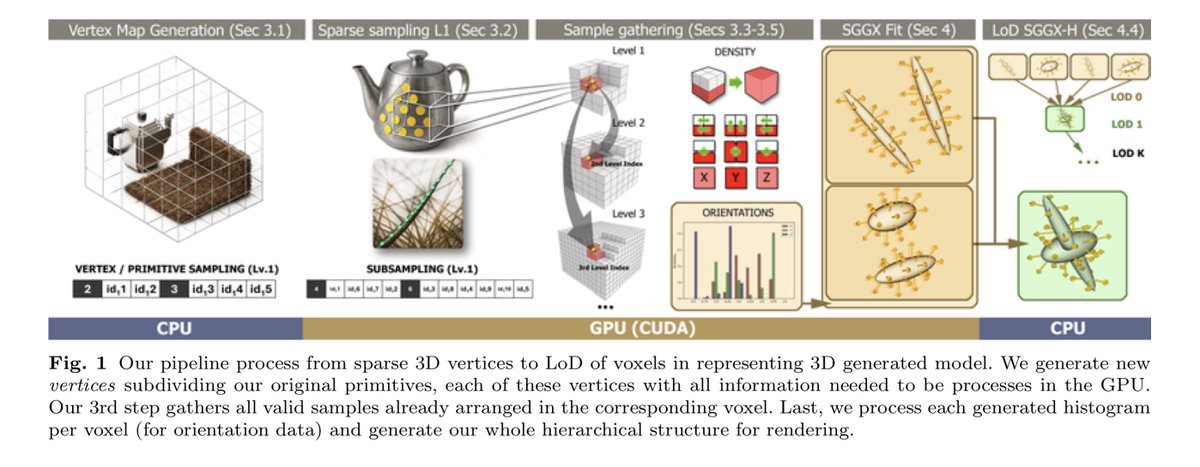
We introduce a fast parallel voxelization method and a novel SGGX LoD model to efficiently render complex microgeometry like fibers, trees or hair.
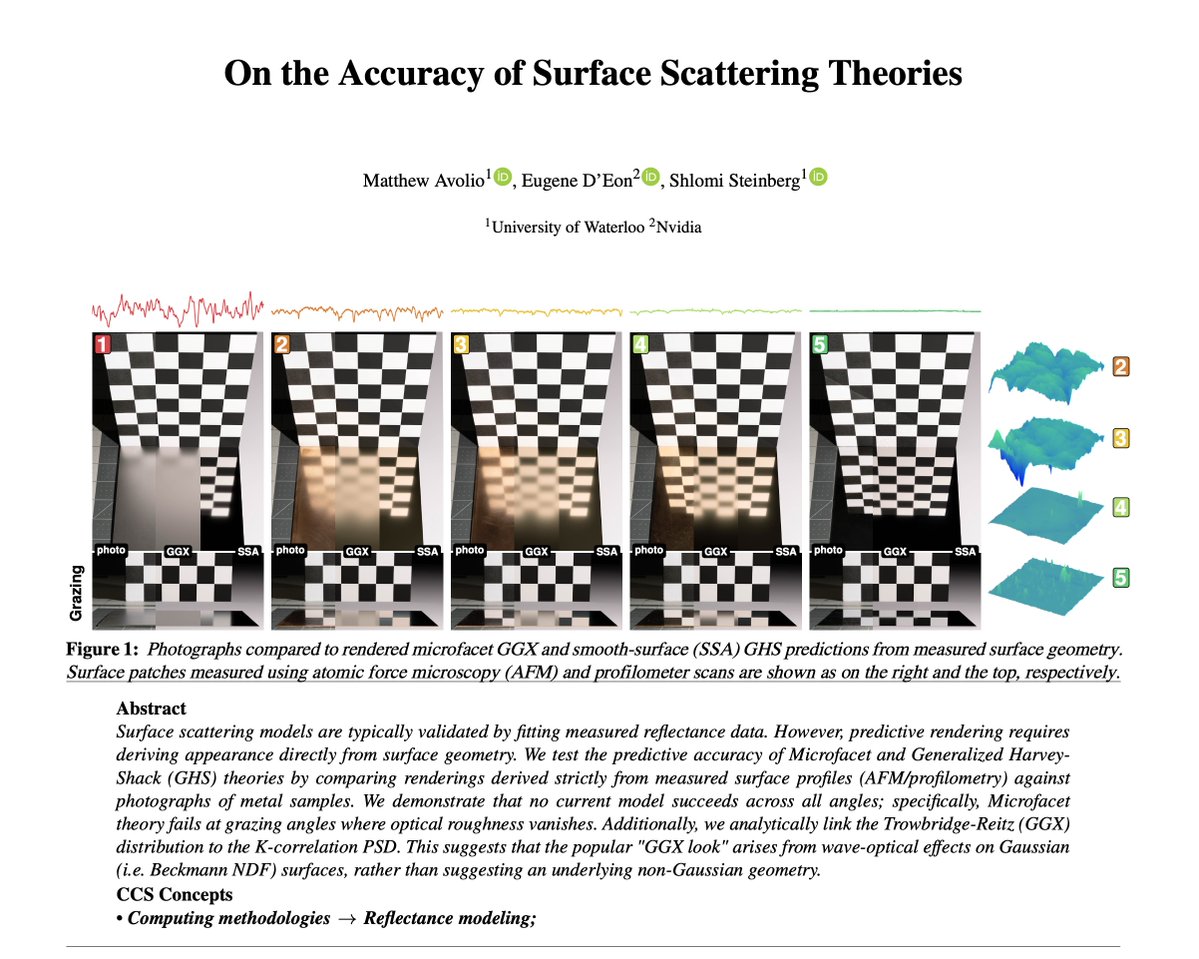
There's a neat short paper from Eurographics this year that evaluates how well microfacet shading models actually predict measured reflectance. The answer is: not nearly as well as one would hope!
(1/3)
https://t.co/GcM5ZxYFvZ
Fast Voxelization and Level of Detail for Microgeometry Rendering
Javier Fabre, Carlos Castillo, Carlos Rodriguez-Pardo, Jorge Lopez-Moreno
Paper: https://t.co/LfIe3egpxA
Supplementary: https://t.co/c7f3QyROdl
Abstract:
Many materials show anisotropic light scattering patterns due to the shape and local alignment of their underlying micro structures: surfaces with small elements such as fibers, or the ridges of a brushed metal, are very sparse and require a high spatial resolution to be properly represented as a volume. The acquisition of voxel data from such objects is a time and memory-intensive task, and most rendering approaches require an additional Level-of-Detail (LoD) data structure to aggregate the visual appearance, as observed from multiple distances, in order to reduce the number of samples computed per pixel (E.g.: MIP mapping). In this work we introduce first, an efficient parallel voxelization method designed to facilitate fast data aggregation at multiple resolution levels, and second, a novel representation based on hierarchical SGGX clustering that provides better accuracy than baseline methods. We validate our approach with a CUDA-based implementation of the voxelizer, tested both on triangle meshes and volumetric fabrics modeled with explicit fibers. Finally, we show the results generated with a path tracer based on the proposed LoD rendering model.
New Paper🙂
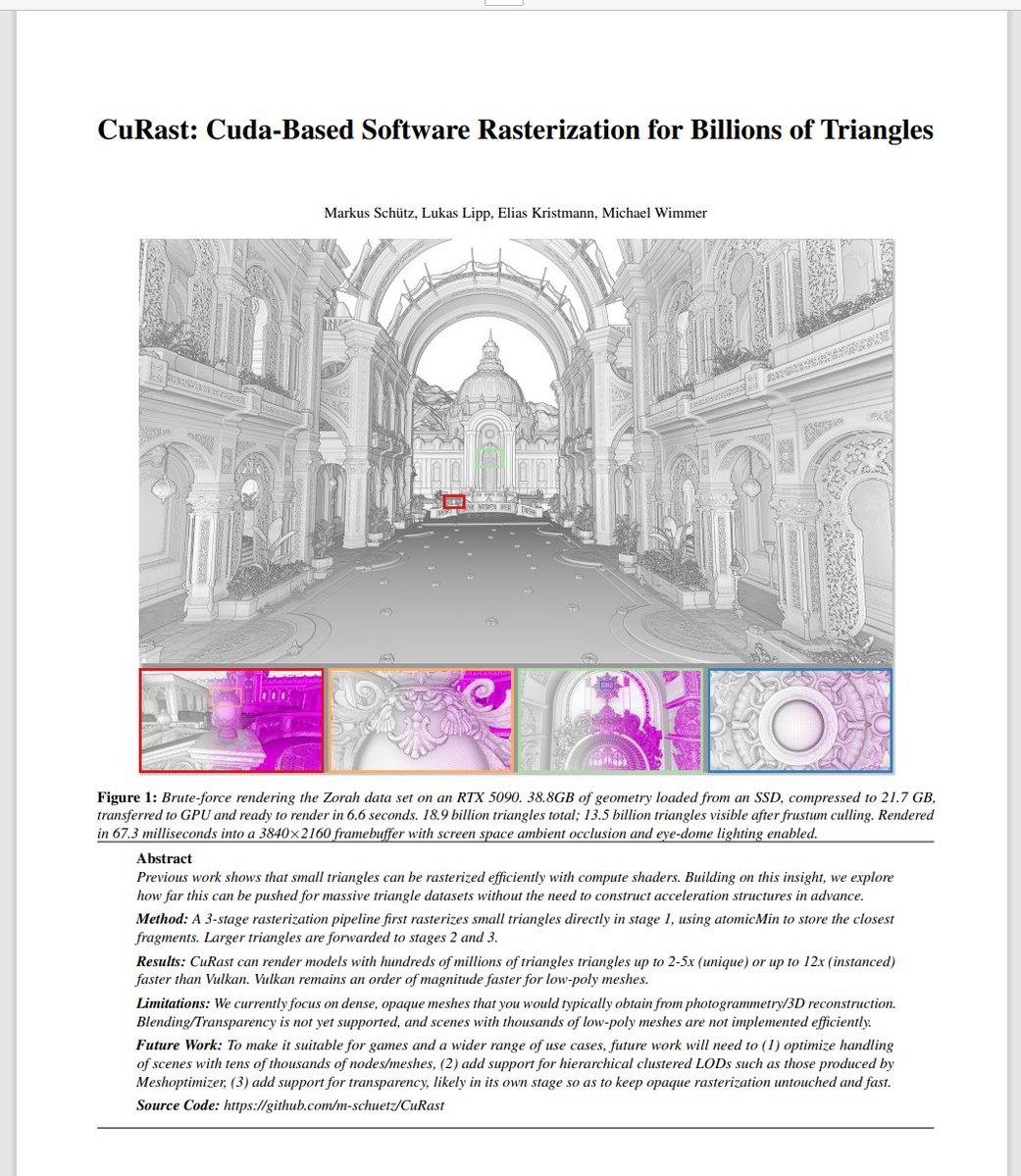
Nanite has shown that small triangles can be rendered fast in compute, we're exploring how fast for large meshes with up to 18.9 billion triangles, without the need to precompute LOD structures.
Paper: https://t.co/F9u4xE6Na3
Source: https://t.co/1LgdSHVi7i
Fast Voxelization and Level of Detail for Microgeometry Rendering
Javier Fabre, Carlos Castillo, Carlos Rodriguez-Pardo, Jorge Lopez-Moreno
Paper: https://t.co/LfIe3egpxA
Supplementary: https://t.co/c7f3QyROdl
Abstract:
Many materials show anisotropic light scattering patterns due to the shape and local alignment of their underlying micro structures: surfaces with small elements such as fibers, or the ridges of a brushed metal, are very sparse and require a high spatial resolution to be properly represented as a volume. The acquisition of voxel data from such objects is a time and memory-intensive task, and most rendering approaches require an additional Level-of-Detail (LoD) data structure to aggregate the visual appearance, as observed from multiple distances, in order to reduce the number of samples computed per pixel (E.g.: MIP mapping). In this work we introduce first, an efficient parallel voxelization method designed to facilitate fast data aggregation at multiple resolution levels, and second, a novel representation based on hierarchical SGGX clustering that provides better accuracy than baseline methods. We validate our approach with a CUDA-based implementation of the voxelizer, tested both on triangle meshes and volumetric fabrics modeled with explicit fibers. Finally, we show the results generated with a path tracer based on the proposed LoD rendering model.
Heads up to everyone, I'll be in Vancouver (from Saturday) to present our paper on primitive-based, physically-based volume rendering at SIGGRAPH!
If anyone wants to chat feel free to drop a DM :D
Link to the paper: https://t.co/4AKZ5vKPOi
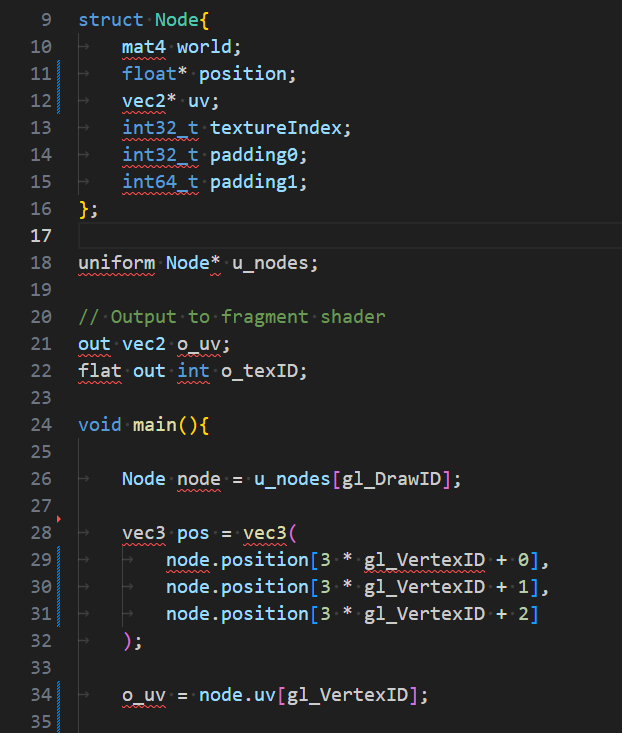
Just tried OpenGL bindless and it's beautiful 🥹
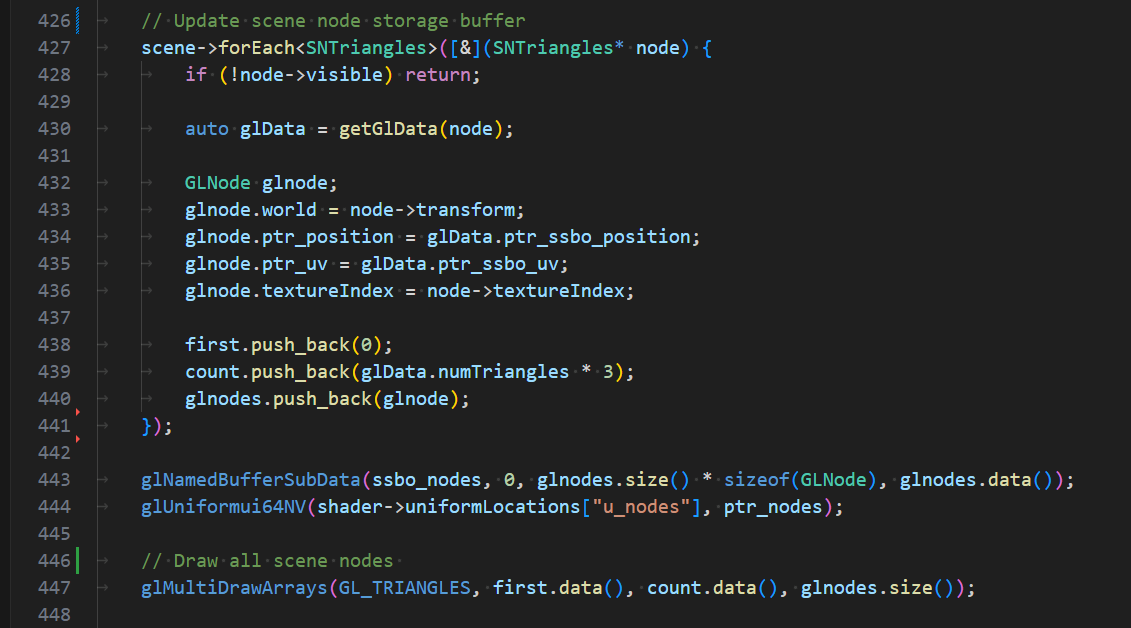
- Easily drawing all scene nodes with geometry in separate storage buffers in a single draw call.
- Vertex shader gets a list of nodes, each node contains pointer to the node's geometry.
No vertex buffers, no bindings. 🥹
Oh, and if you haven't already, you can watch the short film that the Guardian made about my life living with #LongCovid here ⬇️
https://t.co/4bjiNvIkyJ
🎓 We introduce SAMa! A material selection and segmentation model on 3D models in any format (3DGS, NeRF, Mesh).
Given a user click, we propose to select all regions on an objects with the same material. We can also do segmentation in under a minute: https://t.co/cl3KvzBLcw
Blendify -- Python rendering framework for Blender
Vladimir Guzov, Ilya A. Petrov, Gerard Pons-Moll
Paper: https://t.co/dEj4W34FDk
Code (GPL3.0): https://t.co/3xhswjwvQu
Abstract:
With the rapid growth of the volume of research fields like computer vision and computer graphics, researchers require effective and user-friendly rendering tools to visualize results. While advanced tools like Blender offer powerful capabilities, they also require a significant effort to master. This technical report introduces Blendify, a lightweight Python-based framework that seamlessly integrates with Blender, providing a high-level API for scene creation and rendering. Blendify reduces the complexity of working with Blender's native API by automating object creation, handling the colors and material linking, and implementing features such as shadow-catcher objects while maintaining support for high-quality ray-tracing rendering output. With a focus on usability Blendify enables efficient and flexible rendering workflow for rendering in common computer vision and computer graphics use cases.
#cv #blender #b3d #python
New curated SMPL texture batch just dropped! Now including sports outfits 🏀🏈.
Get them for free at https://t.co/Pja0tF9Do6 or sample SMPLitex to generate new ones!
Really cool!
I remember programming 10+ times some sampling techniques in a quick python program just to view the way samples look in a 2D / 3D plot.
Plus it runs in your browser!!
I'm calling it. Samplin' Safari version 2 is out! This is my small research-oriented tool to visualize and interactively inspect high-dimensional random points (as used for e.g. Monte Carlo #rendering).
Many changes and new features (a thread).
https://t.co/LSKedXNFoh
Pregunta a los investigadores de las universidades españolas: Meta quiere investigar temas de VR conmigo, para lo cual hay que firmar un NDA bastante corriente. El problema es que mi universidad quiere meter una cláusula con la que no estoy de acuerdo: 👇
Our work to be presented at #sigAsia2023: a fully-differentiable end-to-end NLOS inverse rendering pipeline that self-calibrates the imaging parameters! We optimally reconstruct geometry and albedo of hidden scenes. Joint work with KAIST and @GILabUZ@julio_marco
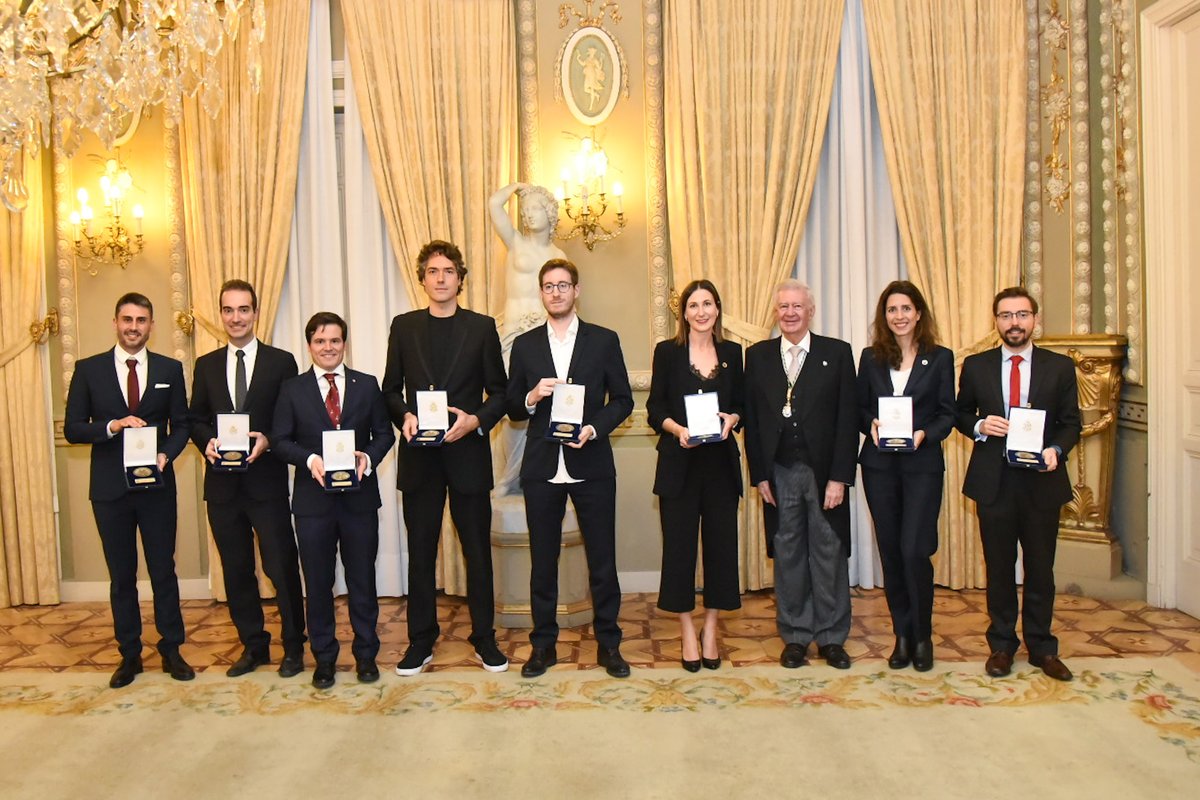
Yesterday, I had the honor of receiving the medal from the Royal Academy of Engineering of Spain (@RAI_Ingenieria) as a runner-up for the Young Researcher Award 2023.
Thanks students and collaborators for the great work, and family for all the support!
I3D 2024 ACM Symposium on Interactive 3D Graphics and Games Call for Papers is open!
https://t.co/g5xGd8mZ0i
Consider submitting any innovative 3D work - academic research or the industry.
I am the conference's Paper Co-Chair this year, so if you have any questions - contact me!