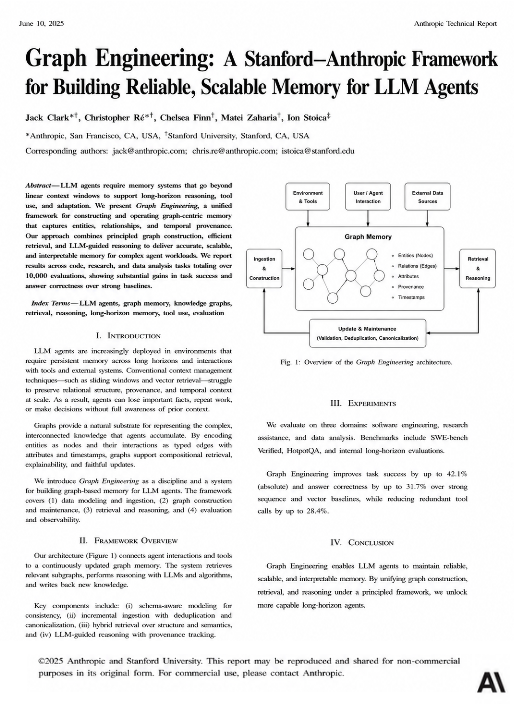
STANFORD AND ANTHROPIC SPENT $3.1M TO PROVE YOUR AGENT PERFORMS 42% WORSE THAN IT SHOULD - AND FOUND THE FIX
most agents have the memory of a goldfish - 30 seconds and everything is forgotten - a graph is elephant memory that never loses connections
Graph Engineering transforms memory from a notebook into a living network that grows with every task
13,000 tasks - code accuracy up 36%, research up 45%, unnecessary actions down 39%
without a graph the agent starts from zero every time - with a graph every task builds on everything it already knows
bookmark this and paste the file into Claude Code - the difference between an agent that forgets and an agent that learns
Andrew Ng just released a 1-hour course on building agentic knowledge Graphs from scratch:
• 00:00 - Introduction to agentic knowledge Graphs
• 03:07 - Construction of agentic Graphs
• 14:00 - Architecture of multi-agent systems
• 23:00 - Building agentic graphs with Google ADK
• 01:06:03 - Why Graphsare the future of agentic AI
Worth more than 10 articles on loop engineering.
Watch it today, then read how to become a graph engineer in the article below.
Andrew Ng:
“AI agents are doing almost 100% of my tasks now - the hype has exceeded my expectations.
in 4-6 months, we’ll all be building graphs to orchestrate self-improving agents. No more prompting.”
In a 20-minute talk, Andrew Ng explains how to build self-improving agentic systems from scratch.
Worth more than a $500 agentic course.
Watch this video, then read the article below on how to become a graph architect.
90% of your KV cache never gets reused.
(prompt caching was never meant to fix it)
if your system prompt and tool definitions are stable, prompt caching is the single highest-leverage optimization available today. cached input tokens get up to 90% cheaper, and hit rates of 60 to 85% are realistic.
but it comes with one rigid rule. the cached portion must be an exact, byte-for-byte prefix of the new request. change a single character in that region and you get a full cache miss.
that rule breaks in three situations you hit constantly:
→ RAG with multiple documents. you cached document A alone and document B alone. a query now needs both. document B's cached state was computed without any awareness of A, so it's invalid and gets recomputed from scratch.
→ document order changes. the same three documents appear in a different order across requests. every permutation is a cache miss, even though the content is identical.
→ growing conversation history. each new turn changes everything after the stable prefix, so earlier cached states beyond it become useless.
Alibaba Cloud's production data shows how bad this gets: 10% of KV cache blocks serve 77% of all hits. the rest sits in storage and never gets reused, because prefix matching won't allow it.
CacheBlend, a research paper from the LMCache team (EuroSys 2025 Best Paper Award), attacks exactly this. the insight is that in modern transformers, tokens overwhelmingly attend to their own local context. only a small fraction of tokens carry real connections across document boundaries.
so instead of recomputing everything after the first cached document, CacheBlend reuses every document's cache as-is and selectively recomputes just those few boundary tokens. those are the small orange fixes between documents in the diagram, and they are the entire cost. the result is 2 to 4x faster processing on multi-document queries with no quality loss.
the order problem disappears with it. shuffle the same documents however you like, and every permutation stays cached, where prefix caching recomputes all of them every time. the bottom of the diagram shows that side by side.
that's the real shift: from caching prefixes to caching knowledge. every document in your knowledge base becomes a reusable cached asset, regardless of what order it appears in or what sits next to it.
CacheBlend ships inside LMCache, the open-source cache management layer that runs outside the inference engine and integrates with vLLM, SGLang, and TensorRT-LLM, on both NVIDIA and AMD GPUs.
check it out on GitHub: https://t.co/TXlaLLu04a
(don't forget to star 🌟)
i wrote the full breakdown of the architecture, including why cache management should never live inside your inference engine. the article is quoted below.
stay tuned for more on this!
Elon Musk explains his 5-step algorithm for solving any problem:
"The most common mistake of smart engineers is to optimize a thing that should not exist."
"I have this very basic first principles algorithm that I run as a mantra."
Elon breaks it down:
Step 1: Question the requirements.
"Make the requirements less dumb. The requirements are always dumb to some degree, no matter how smart the person who gave you those requirements. You have to start there, because otherwise you could get the perfect answer to the wrong question."
Step 2: Try to delete it.
"Try to delete the part or the process step entirely. If you're not forced to put back at least 10% of what you delete, you're not deleting enough. Most people feel like they've succeeded if they haven't been forced to put things back in. But actually they haven't, they've been overly conservative and left things in that shouldn't be there."
Step 3: Optimize or simplify.
"The most common mistake of smart engineers is to optimize a thing that should not exist. So you don't optimize until after you've tried to delete."
Step 4: Speed it up.
"Any given thing can be done faster than you think. But you shouldn't speed things up until you've tried to delete it and optimize it otherwise, you're speeding up something that shouldn't exist."
Step 5: Automate.
"And then the fifth thing is to automate it."
Elon explains why the order matters:
"I've gone backwards so many times where I've automated something, sped it up, simplified it, and then deleted it. I got tired of doing that. So that's why I have this mantra."
a prompt I've been using a lot recently:
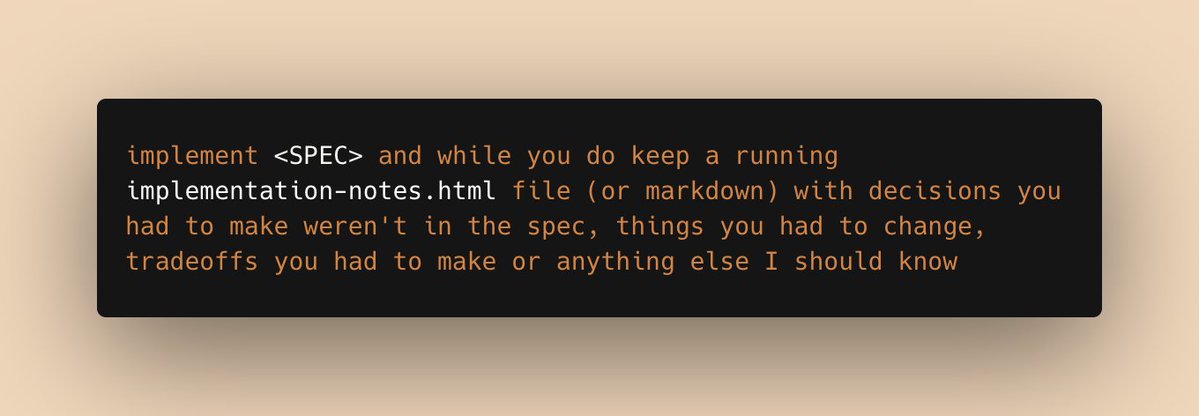
implement <SPEC> and while you do, keep a running implementation-notes.html file (or markdown) with decisions you had to make weren't in the spec, things you had to change, tradeoffs you had to make or anything else I should know
In the next version of Claude Code: run /usage to see a breakdown of which Skills, Agents, MCPs, and Plugins are using your tokens
CLI today, coming to Desktop next
The creator of Claude Code teaches more about vibe-coding in 30 minutes than most tutorials do in hours.
Save this — it'll change how you build forever.
New course: Spec-Driven Development with Coding Agents, built in partnership with @jetbrains, and taught by @paulweveritt.
Vibe coding is fast, but often produces code that doesn't match what you asked for. This short course teaches you spec-driven development: write a detailed spec defining what to build, and work with your coding agent to implement it. Many of the best developers already build this way.
A spec lets you control large code changes with a few words, preserve context across agent sessions, and stay in control as your project grows in complexity.
Skills you'll gain:
- Write a detailed specification to define your mission, tech stack, and roadmap, giving your agent the context it needs from the start
- Plan, implement, and validate features in iterative loops using a spec as your agent's guide
- Apply the same repeatable workflow to both new and legacy codebases
- Package your workflow into a portable agent skill that works across agents and IDEs
Join and write specs that keep your coding agent on track!
https://t.co/hI4GwuvhtN
🚨 BREAKING: Someone just made OpenAI's Whisper transcribe 2.5 hours of audio in 98 seconds. 100% OPEN SOURCE.
It runs entirely on your GPU. No API keys. No cloud. No subscription.
It's called Insanely Fast Whisper.
You drop in an audio file. One command. You come back and there's a clean, timestamped transcript waiting. Not a rough draft. Not a partial output. The entire thing. Done.
Not a wrapper.
Not a web app.
A CLI that turns your local machine into a transcription engine that makes paid services look embarrassing.
Here's what it does on its own:
→ Transcribes 150 minutes of audio in under 98 seconds using Flash Attention 2, same model, 19x faster, zero quality loss
→ Auto-detects language across dozens of languages, or translates directly into English with a single flag
→ Speaker diarization built in, knows who said what, not just what was said
→ Word-level and chunk-level timestamps so you can jump to any exact moment in any recording
→ Runs on NVIDIA GPUs and Apple Silicon Macs with zero code changes between them
→ Works on Google Colab free tier if you don't own a GPU at all
Here's how fast it actually is:
Standard Whisper large-v3 out of the box: 31 minutes to process 2.5 hours of audio. The same exact model with Flash Attention 2 and batching: 1 minute 38 seconds. Same weights. Same accuracy. One flag difference.
Here's the wildest part:
This never started as a product. It was a benchmark demo to show what Hugging Face Transformers could do. Then the community started using it for real work. Podcast transcription. Legal recordings. Research interviews. Meeting notes at scale. The team kept adding what people actually needed until a benchmark became a full CLI that nobody planned to build.
8.8K GitHub stars. 100% Open Source.
In 2019, MIT professor Patrick Winston gave a legendary 1-hour lecture called “How to Speak.”
It has 18M+ views for a reason.
His frameworks:
• Your ideas are like your children
• The 5-minute rule for job talks
• Why jokes fail at the start
15 lessons on communication: