Today we are releasing the best open-weights model you can run on a single device reaching 1339 Elo on LMsys for Gemma 3 27B (aka zizou-10)!
Very strong capabilities on math, multilingual, coding, instruction following, function calling !
Very excited about this tutorial at #AAAI2025 on inducing privacy, fairness or robustness to distribution shifts when data is imperfect (e.g. unlabeled, noisy)! You can check out the slides at https://t.co/8oivNIpnRn
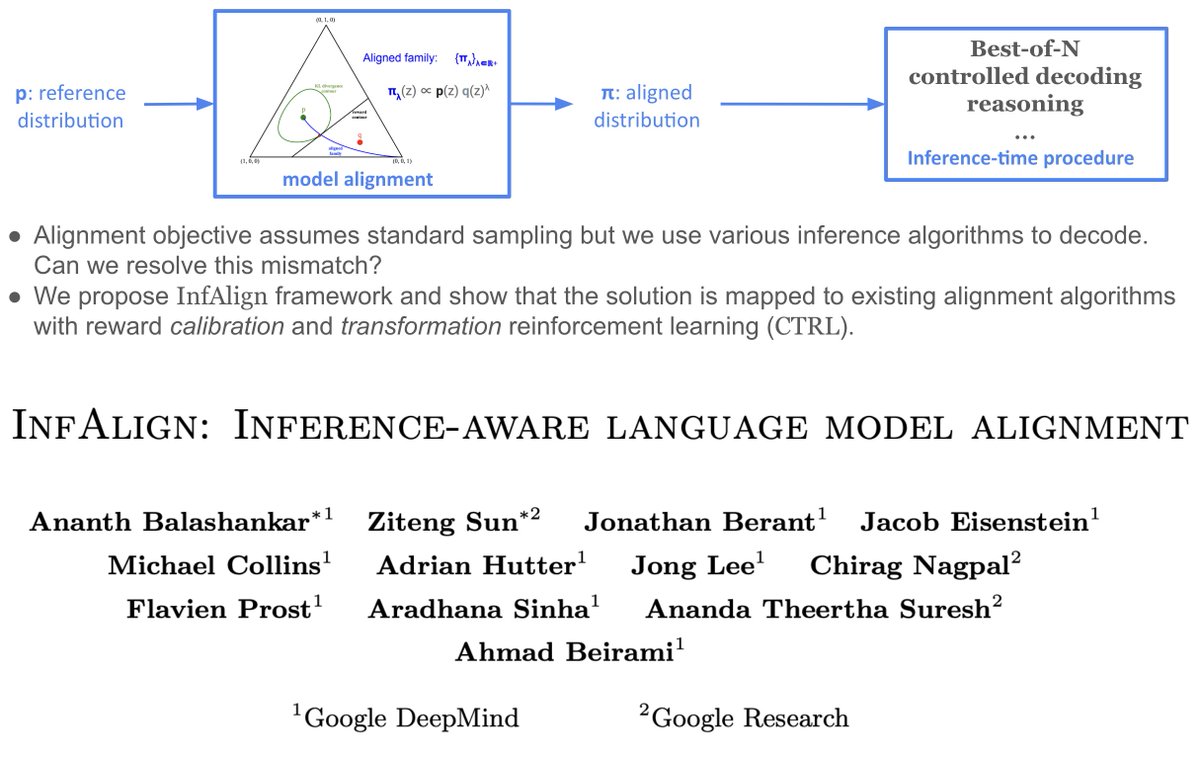
Inference-time procedures (e.g. Best-of-N, CoT) have been instrumental to recent development of LLMs. The standard RLHF framework focuses only on improving the trained model. This creates a train/inference mismatch.
Can we align our model to better suit a given inference-time procedure?
We answer this affirmatively, check out the thread below.
Excited to share 𝐈𝐧𝐟𝐀𝐥𝐢𝐠𝐧!
Alignment optimization objective implicitly assumes 𝘴𝘢𝘮𝘱𝘭𝘪𝘯𝘨 from the resulting aligned model. But we are increasingly using different and sometimes sophisticated inference-time compute algorithms.
How to resolve this discrepancy?🧵
My team at @GoogleDeepMind in Zurich is hiring. If you are passionate about safety, and the opportunity to actually do pre-training on Gemini scale models (!!) excites you then this is for you!
@FannyYangETH Finally, we've just published on arXiv my work during an internship in the Responsible AI team@Google Research (joint work with @PreethiLahoti, @packer_ben, Yoni Halpern, @abeirami, @FlavienProst). Let's chat, if you're interested in (post-proc) mitigations for group fairness!
[Call for papers]
#NeurIPS2023 R0-FoMo Workshop
Robustness of Zero/Few-shot Learning in Foundation Models We solicit novel contributions that relate broadly to zero/few-shot learning in foundation models, with both empirical and theoretical nature.
Please R/T
Announcing the release of MinDiff, a new regularization technique available in the @TensorFlow Model Remediation library for effectively and efficiently mitigating unfair biases when training #MachineLearning models. Learn more below: https://t.co/xnhoOrUUYK
Super happy to share that our paper “Fairness without Demographics through Adversarially Reweighted Learning" has been accepted at #NeurIPS2020.
A big thanks to all my co-authors, reviewers, and colleagues at @GoogleAI, #MPI-INF and #MPI-SWS for their valuable feedback!
This work focuses on improving the model performance on worst case groups when no demographic information are available! It is achieved via an adversarial re-weighting learner which identifies computationally identifiable subgroups that underperform.
How can we train ML models to achieve fairness when we do not know protected group memberships? Excited to share a new paper on this (https://t.co/Ja4jSPSgi4) from my internship @GoogleAI. Joint work with @alexbeutel@edchi@chenjilin@Nithum@FlavienProst and others. 1/n
Check out our poster at #neurIPS19 in the workshop "ML with Guarantees".
We will describe how Maximum Mean Discrepancy can improve the trade-off between performance and fairness in production systems (https://t.co/VOHoC7qfwG).