Jeff Currie on the next oil price spike:
"Demand is above supply. We're drawing inventories, borrowing oil from the future until we hit tank bottoms... We're going to be out of oil going into the summer."
I'm Italian, living in Portugal. From Lisbon, the Spanish border is two hours east.
I'm in Extremadura more than I'm in Porto.
Almost every foreigner who comes to Spain does the same trip:
Madrid, Barcelona, maybe Sevilla, Granada or Valencia.
The Spaniards I know don't spend their weekends there. They drive inland. To Castile, Extremadura, Aragón, Galicia. The interior that emptied out since 1950, what they call la "España Vaciada".
That's where the country still lives.
10 places I've stayed in. Some many times.
🧵
@Invest20003@Claes_Hemberg Det går åt ungefär 10 kalorier fossil energi (främst olja och naturgas) för att producera och leverera 1 kalori mat på tallriken i moderna, industrialiserade jordbrukssystem (särskilt i USA och Västeuropa).
Renewables are the key to preventing resource scarcity, argue European leaders, California Governor Gavin Newsom, and Ezra Klein and Derek Thompson, whose bestselling book Abundance became one of Barack Obama’s favorite books of 2025 and launched a political movement dedicated to what Klein calls “a politics of plenty.” The logic is straightforward and appealing. Solar panel costs have fallen more than 90% since 2010. Wind power costs have dropped by 70%. Battery storage prices have collapsed.
If governments would simply clear the regulatory obstacles to building solar farms, wind turbines, and transmission lines, the abundance argument goes, clean energy would flow so abundantly that fossil fuel dependence would become a choice rather than a necessity. “The miracles of solar and wind and battery power,” Klein told the Long Now Foundation, “have given us the only shot we have to avoid catastrophic climate change.”
But if renewables could prevent resource scarcity, then the world would not be in the midst of what the International Energy Agency’s Executive Director Fatih Birol called “the greatest global energy security challenge in history,” with global supply losses now totaling 12 million barrels per day, compared to about 5 million during each of the 1973 and 1979 crises. The United Kingdom is receiving its last shipment of jet fuel from the Middle East with nothing behind it. Australia saw over 500 gas stations run dry. And South Korea is considering driving restrictions for the first time since 1991. “In April,” warned Birol, “there is nothing.”
It is true that solar and batteries have made enormous progress. Solar electricity costs roughly 3 to 5 cents per kilowatt-hour at the point of generation, cheaper than any fossil fuel in most locations. Battery costs have fallen below $115 per kilowatt-hour. China produces more solar panels than the rest of the world combined.
But the world has installed more than 1,600 gigawatts of solar capacity and over 1,000 gigawatts of wind, and still we are in crisis. Global green energy investment was $2.3 trillion in 2025 alone. And yet when Iran closed the Strait of Hormuz, none of that capacity mattered, because solar panels do not produce jet fuel, diesel, ammonia, or the petrochemical feedstocks that underpin modern civilization.
Electricity accounts for roughly 20% of final energy consumption worldwide. The other 80%, the part that moves ships, flies planes, heats buildings, and makes fertilizer, runs overwhelmingly on oil and gas. Solar and wind cannot substitute for these fuels at any price, because the energy density of liquid hydrocarbons exceeds batteries by a factor of 40 to 80 by weight.
Klein and Thompson, to their credit, also support some forms of nuclear power. Abundance opens with a vision of cities powered by “clean (nuclear) and renewable (wind and solar) energy sources.” They lament America’s nuclear stagnation compared to France’s successful buildout. Klein has said that he supports advancing nuclear power alongside renewables.
But, the new nuclear power plants that Klein and Thompson support do not exist. The “small modular reactors” that populate the abundance fantasy have not produced a single commercial kilowatt-hour of electricity. NuScale, the most advanced American SMR developer, canceled its flagship project in 2023 after costs doubled. No SMR has received a commercial operating license anywhere in the world. The first commercially operating SMR, if all goes well, may produce power in the early 2030s, but SMR developers have for years said that their reactors are just a few years away. Scaling to a meaningful share of global energy supply would take decades, as opposed to building conventional nuclear plants, which Japan and China have shown they can build in just two years, so long as they are standardized and the same construction crews are used.
Democrats, progressives, environmental groups, and left-wing parties across Europe diverted hundreds of billions of dollars over the last two decades from developing the new oil and gas production, pipelines, refineries, and LNG terminals needed to make energy cheap and abundant. California’s aggressive climate mandates drove residential electricity prices to 34 cents per kilowatt-hour, nearly double the national average, while the state simultaneously blocked new natural gas infrastructure. And global investment in oil and gas exploration and production peaked at roughly $780 billion in 2014 and fell to approximately $350 billion by 2020, a decline driven by deliberate policy choices to restrict fossil fuel development.
The European Union’s Green Deal, America’s Inflation Reduction Act, and climate policies across the developed world channeled subsidies toward solar and wind while imposing carbon taxes, windfall levies, and permitting restrictions on fossil fuel projects. The UK’s Energy Profits Levy, introduced in 2022, discouraged investment in the North Sea at precisely the moment when more domestic production was needed.
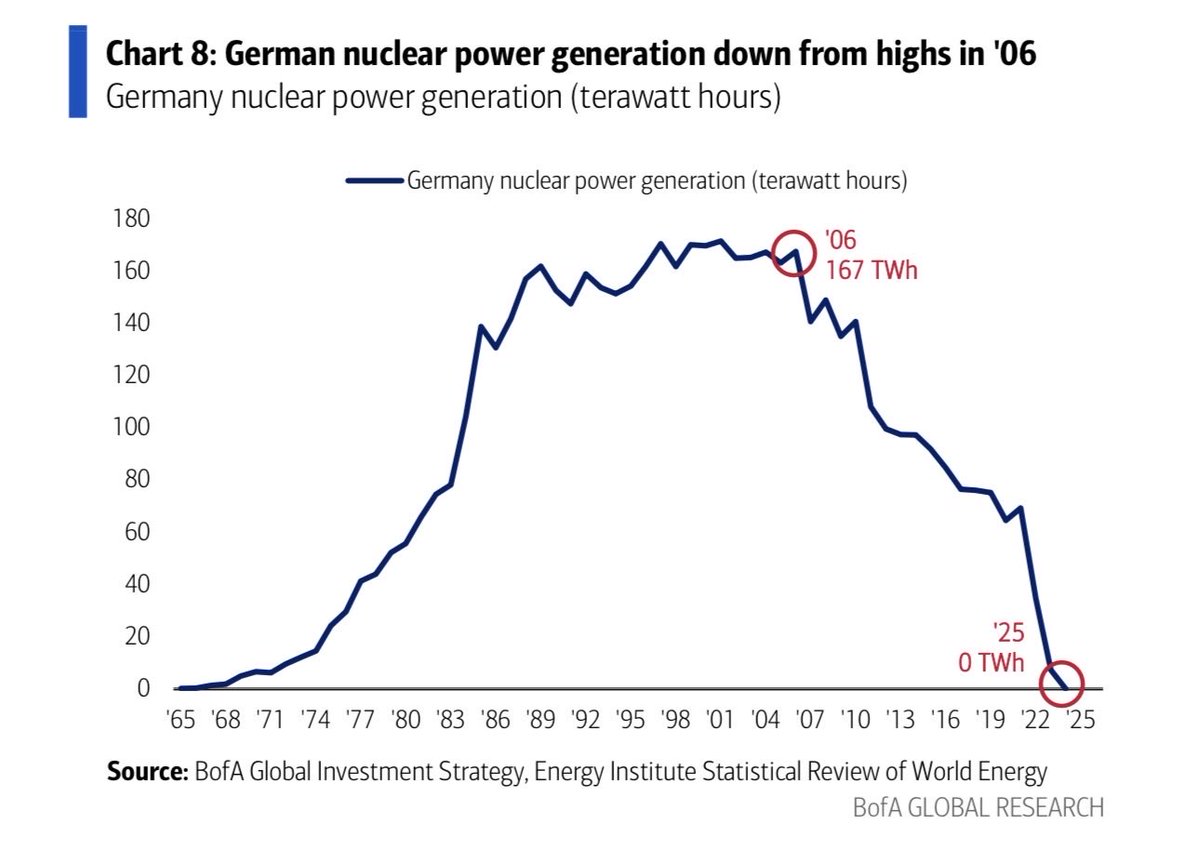
The UK Labor government then banned new exploration licenses in November 2025. Germany’s Energiewende spent over €500 billion on renewables while shutting down its nuclear plants, leaving the country dependent on Russian gas and then, after the Ukraine war, on LNG that must now compete with Asian buyers for cargoes that can no longer transit Hormuz. And the UK has lost a third of its refineries in the last 18 months, meaning that even if crude oil arrived tomorrow, the country lacks the capacity to refine it into the jet fuel, diesel, and heating oil its citizens need.
The only energy abundance solution that works at the scale of civilization right now is piped natural gas and oil. A pipeline delivers energy continuously, at near-zero marginal cost per unit delivered, with no exposure to shipping chokepoints, insurance markets, or geopolitical disruption. A ton of natural gas moved through a pipeline costs a fraction of what the same gas costs when liquefied, shipped by tanker across an ocean, and regasified at a terminal. The logical endpoint is a world powered by natural gas delivered through continental pipeline networks, eventually transitioning to hydrogen produced from natural gas and nuclear power.
America built pipelines while Europe and Asia built LNG dependency. Saudi Arabia’s East-West pipeline, which has ramped from 770,000 barrels per day to 2.9 million since the war began, is the emergency proof of concept. If the Gulf states had built sufficient pipeline capacity to bypass Hormuz before the war, the crisis would be a fraction of its current severity.
So why do so many on the Left continue to preach renewables as the solution to a crisis that renewables manifestly cannot solve?...
https://t.co/VsWofJGE1J
Please subscribe now to support Public's award-winning investigative reporting, read the rest of the article, and watch the rest of the video!
https://t.co/VsWofJGE1J
🔴Thoughts on the Future of Energy Markets🔴
The most severe long-term consequence of escalating trade wars, tariffs, sanctions, disruptions involving Venezuela, Iran, the Strait of Hormuz, and even moves like the Greenland interest isn't just higher prices or short-term supply shocks. It's the irreversible shift where energy becomes fully classified as a core national security issue for every major power and country.
Once that mindset takes hold, global energy markets will never return to the old model of open, price-driven, largely commercial trade. Instead, capitalist economies—historically reliant on market efficiency, global supply chains, and comparative advantage—will increasingly mirror the Chinese approach: heavy state direction, strategic stockpiling, vertical integration, subsidies for domestic champions, and prioritization of self-reliance/control over pure cost minimization.
The irony? They'll adopt this state-capitalist framework without China's advantages—its unmatched scale in manufacturing, technological edge in key supply chains (batteries, solar, rare earths), massive infrastructure buildout, or centralized political ability to force rapid pivots.
The result: higher costs, slower innovation in some areas, fragmented markets, and reduced overall efficiency for Western-style economies, all in the name of "security."
Energy stops being just another commodity; it becomes a geopolitical weapon and a domestic fortress.
>90% of sulphur imported into Africa is from the Middle East… and therefore passes through the Strait of Hormuz
Let that sink in.
I have heard that traders are already struggling to source any. Sulphuric acid prices will therefore significantly increase across Africa… and if the disruption lasts longer than ~3 weeks, copper oxide operations will have to close as they’ve run out of acid.
Oxide copper is the dominant ore source of copper produced in DRC… and the DRC is the world’s 2nd largest copper producer.
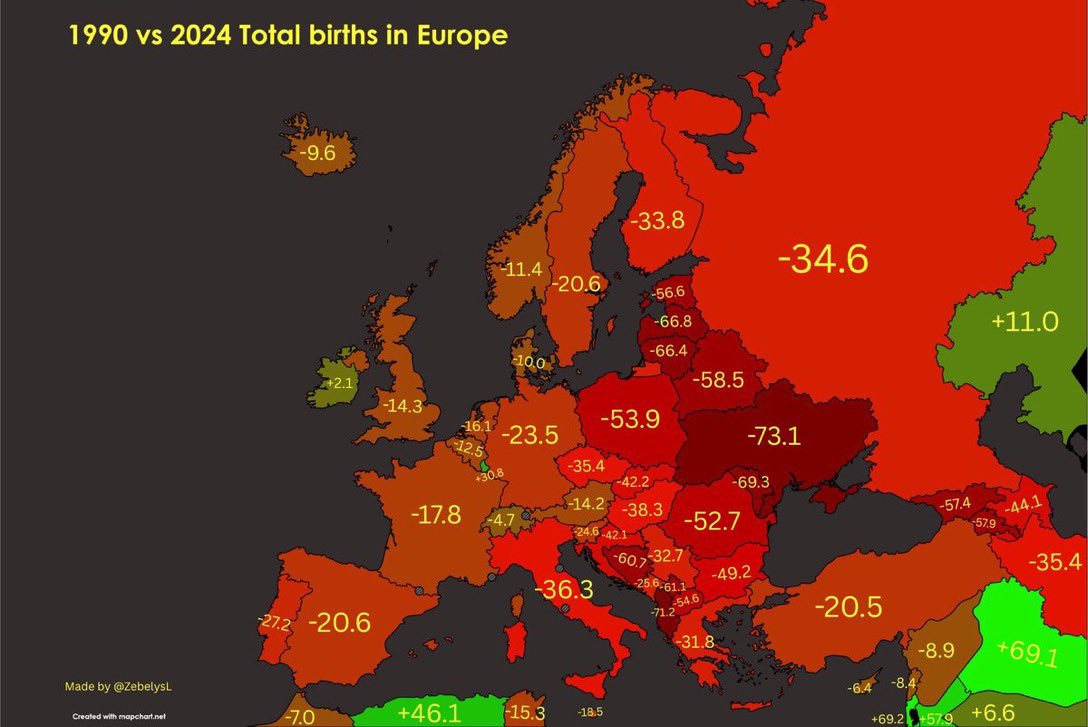
This is probably the scariest chart you’ll see today: births in 2024 vs. 1990.
Many European societies will cease to exist as we know them today. The problem is that it’s a slow process, and people still don’t realize the coming disaster. Good luck with real estate and pensions.
@DVSignals The MMs have managed to convince a lot of people that BTC is leading equities into a bear market. Retail has been destroyed. Everybody thinks BTC has peaked.
@DVSignals You might be surprised to see it turnaround. Gold and silver lead, BTC catches up once it's clear the economy is going to get hot and liquidity keeps increasing from US, Japan, China.
Model tokens are heavily subsidized.
When the subsidies disappear, so will easy "intelligence". Those who outsourced their thinking won't know how to function.
Intelligence withdrawal will be brutal.