Excited to share that our paper "Orbital Transformers for Predicting Wavefunctions in Time-Dependent Density Functional Theory" is accepted to #ICLR26! Huge thanks to collaborators, advisors, reviewers, ACs, PCs and organizers!
Excited to share that our paper "Orbital Transformers for Predicting Wavefunctions in Time-Dependent Density Functional Theory" is accepted to #ICLR26! Huge thanks to collaborators, advisors, reviewers, ACs, PCs and organizers!
Our 500+ page AI4Science paper is finally published:
Artificial Intelligence for Science in Quantum, Atomistic, and Continuum Systems. Foundations and Trends® in Machine Learning, Vol. 18, No. 4, 385–912, 2025
https://t.co/RzxYTDOJwx
(2/2) I'll be presenting GeoMPNN at the competition workshop this Saturday, 12/13, at 3:40 PM PST in West Meeting Room 208.
GeoMPNN Team: @floatlazer@haiyangyu14@ShuiwangJi
We recently developed GeoMPNN (https://t.co/ClsKI6sBb6), a machine-learned simulator for airfoil flows. GeoMPNN is designed to generalize across different airfoil shapes and flow conditions and won best student solution at the NeurIPS 2024 ML4CFD Competition. (1/2)
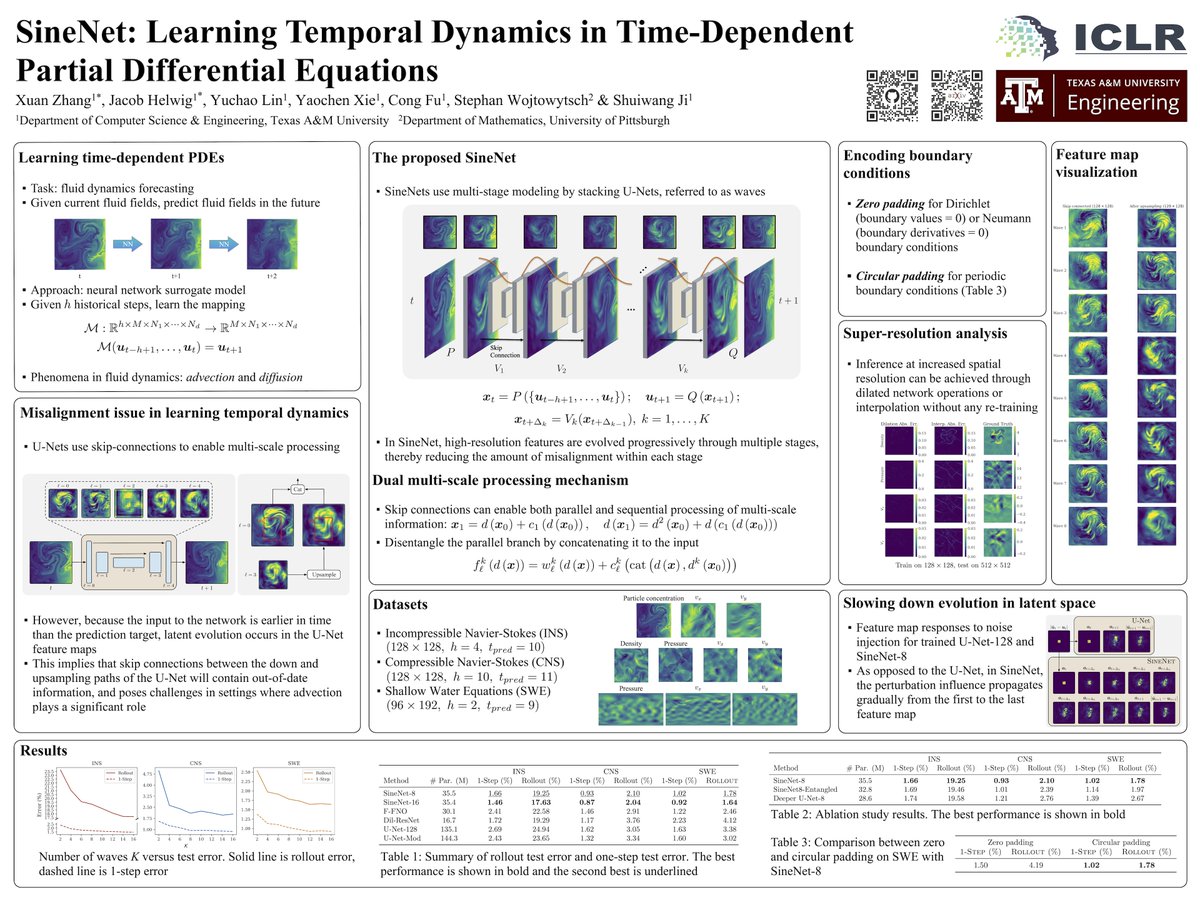
Jacob @JacobHelwig and I will present our paper "SineNet: Learning Temporal Dynamics in Time-Dependent Partial Differential Equations" tomorrow (May 13) from 09:00 to 10:15 EDT in the AI4ScienceTalk series @AI4scienceTalks. Come and join us!.
Details: https://t.co/WBx6SgsDN6
Looking forward to presenting our work on temporal dynamics modeling at #ICLR2024! We will be poster #30 on Friday morning from 10:45 to 12:45PM Vienna time.
This is a super interesting paper, proving once more how important residual connections are. In this case residuals are interpreted as small transformations over time, strongly improving the UNet idea for spatio-temporal problems! I learned a lot when reading this :)
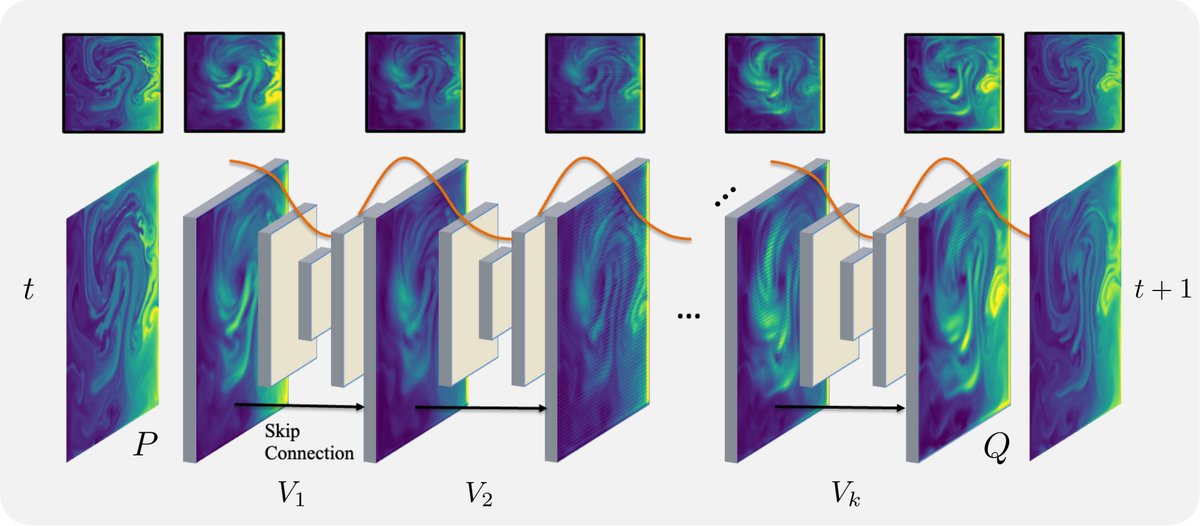
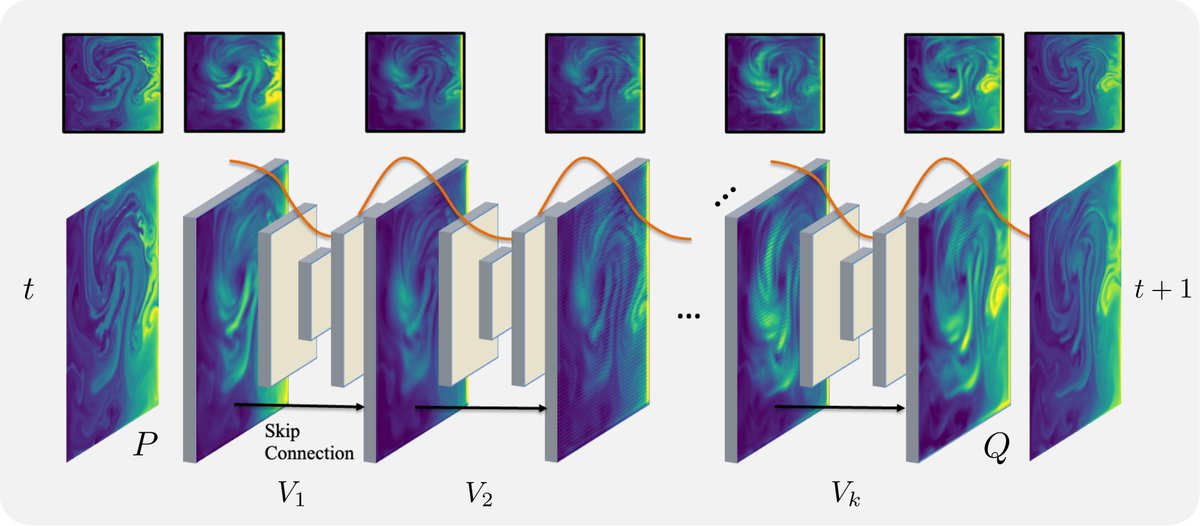
Check out our #ICLR2024 paper, “SineNet: Learning Temporal Dynamics in Time-Dependent Partial Differential Equations” (https://t.co/mVEUeRiOyu).
U-Nets are widely used for static image segmentation tasks in computer vision. [1/N]
Check out our #ICLR2024 paper, “SineNet: Learning Temporal Dynamics in Time-Dependent Partial Differential Equations” (https://t.co/bgismSzI7W), where we improve the U-Net architecture for modeling time-evolving PDEs. (1/4)
We proudly present our 524 page book on equivariant convolutional networks.
Coauthored by Patrick Forré, @erikverlinde and @wellingmax.
https://t.co/y9YBpqhyLG
[1/N]







![maurice_weiler's tweet photo. We proudly present our 524 page book on equivariant convolutional networks.
Coauthored by Patrick Forré, @erikverlinde and @wellingmax.
https://t.co/y9YBpqhyLG
[1/N] https://t.co/Xf7DzkZx4I](https://pbs.twimg.com/media/F8tveafWoAANtjt.jpg)


