Carlos Whittaker did a 7.5-week no-screen experiment and the results are wild.
No phone. No TV. No laptop. No watch. Nothing. He even got his brain scanned before and after by a neuroscientist.
The outcome? His cerebellum healed years worth of damage in just seven weeks. His cognitive memory score jumped from the 50th percentile to the 99th percentile of adult men in America. He said he felt like a completely different human, sharper, clearer, more alive.
This one stopped me in my tracks. I’ve been feeling the scroll fatigue hard lately, and hearing someone actually measure the difference with real brain scans is next-level motivating.
Our constant screen exposure might be doing more quiet damage to our brains than we realize. Sometimes the simplest reset (doing less) creates the biggest upgrade.
Have you ever done a serious digital detox? Would you try one this extreme?
1/ On How Short Life Is
A few years ago, I was walking around in a blizzard in SoHo (New York). It was late, midnight, and it was beautiful.
Some friends, about 15 blocks away, called: "come over?"
It was late, it was cold, was tired, thought "maybe not worth it" but then...
Dolphin Inference Network node operation is now live for anyone who would like to beta test before we go into production
$POD rewards live for testers
Repurposing idle GPUs to run Qwen 3.5 35B MoE
Adobe charges $250 a year for Illustrator.
Someone built the same thing for free. It runs in your browser. And it's architecturally better.
It's called Graphite.
Most vector editors work by storing a flat list of shapes. Change something early and you're manually fixing everything downstream.
Graphite stores your entire design as a computation graph. Every shape, every filter, every effect is a node. Change one node and everything that depends on it recalculates automatically.
This is how game engines and VFX pipelines work. Nobody had built a design app this way until now.
→ Procedural patterns that regenerate when you change any parameter
→ Nondestructive boolean operations that stay editable forever
→ Photo editing baked in alongside the vector tools
→ Motion graphics and VFX compositing on the roadmap
→ 188 contributors building it right now
The people charging $250/year for destructive editing are going to have a problem.
https://t.co/7Jw992BLXm
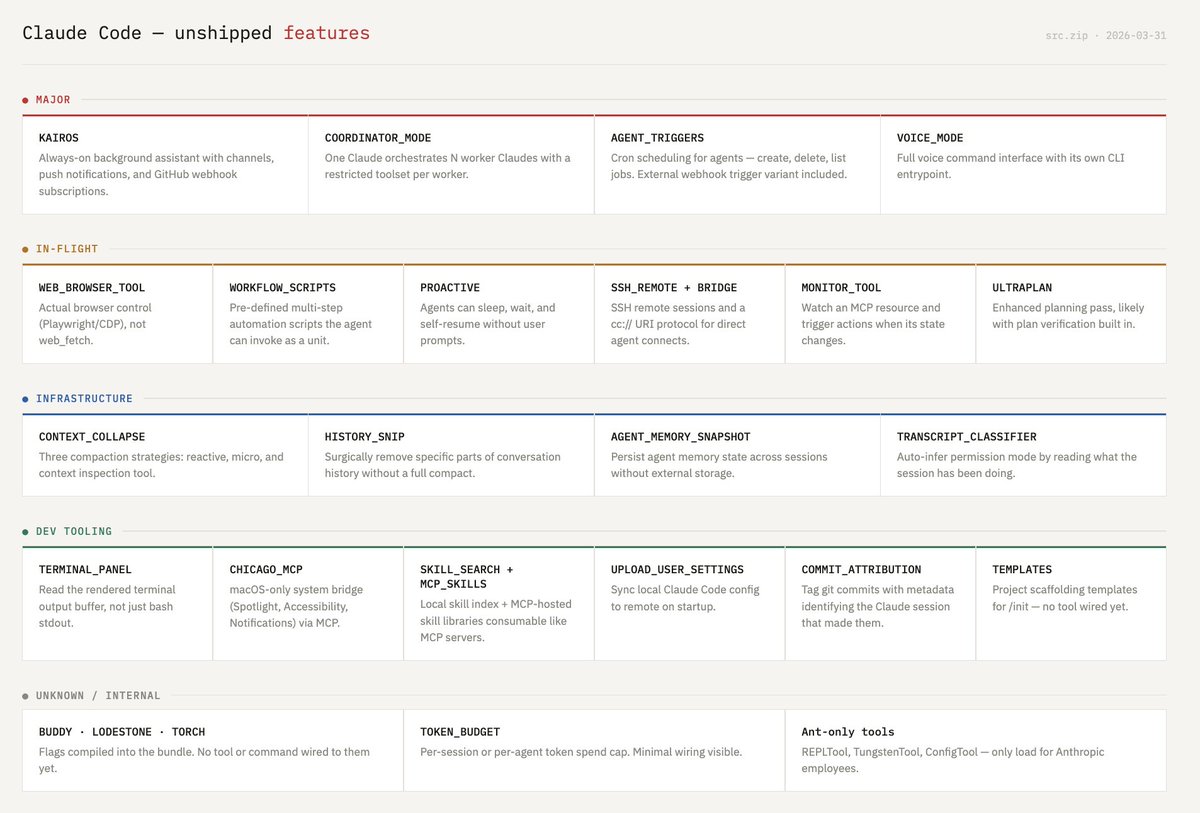
dug through the leaked claude code source.
44 hidden feature flags. 20+ unshipped features...
background agents, multi-agent orchestration, cron scheduling, voice mode, browser control.
it's all built.. no wonder they releasing a new feature every 2 days.. everything already done..
My dear front-end developers (and anyone who’s interested in the future of interfaces):
I have crawled through depths of hell to bring you, for the foreseeable years, one of the more important foundational pieces of UI engineering (if not in implementation then certainly at least in concept):
Fast, accurate and comprehensive userland text measurement algorithm in pure TypeScript, usable for laying out entire web pages without CSS, bypassing DOM measurements and reflow
🚨 Someone just turned your WiFi router into a full-body surveillance system.
No cameras. No wearables. No video. Just radio waves.
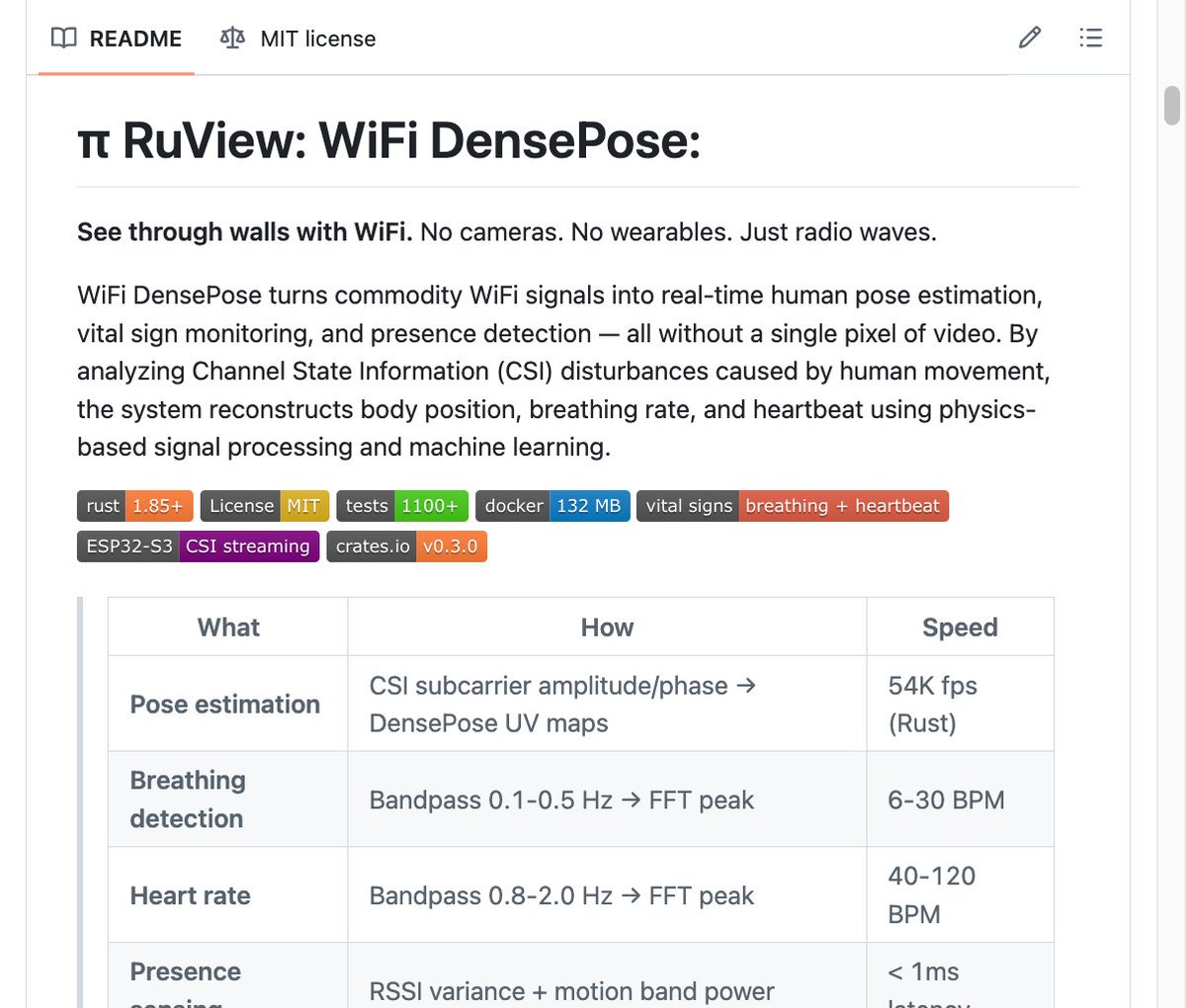
It's called RuView. It uses the WiFi signals already in your room to detect human poses, track breathing, measure heart rate, and see through walls.
Not a concept. Not a research paper. Working code you can run right now.
Here's what this thing actually does:
→ Tracks full 17-point body pose using only WiFi signals
→ Detects breathing rate (6-30 BPM) without touching anyone
→ Measures heart rate (40-120 BPM) from across the room
→ Sees through walls, furniture, and debris up to 5 meters deep
→ Tracks multiple people simultaneously with zero identity swaps
→ Self-learns from raw WiFi data. No labeled datasets needed
Here's how it works:
WiFi signals pass through your room and hit the human body. The body scatters those signals differently based on position, breathing, even heartbeat. RuView reads that scattering pattern and reconstructs everything.
A mesh of 4 ESP32 nodes ($48 total) gives you 360-degree coverage with 12 measurement links, 20 Hz updates, and sub-30mm precision.
Here's the wildest part:
It has a disaster response mode called WiFi-Mat. It detects survivors trapped under rubble through concrete walls, classifies injury severity using START triage protocol, and estimates 3D position. The kind of tool that saves lives after earthquakes.
The Rust implementation processes 54,000 frames per second. That's 810x faster than the Python version. The entire Docker image is 132 MB.
The AI model fits in 55 KB of memory. Runs on an $8 ESP32 chip.
Train once, deploy in any room. No retraining. No recalibration.
1,100+ tests. SHA-256 verified capability audit.
22.4K GitHub stars. 2.7K forks. MIT License.
100% Open Source.
Most people will read this and think optimists live longer because they eat better and exercise more. The study says something wilder.
Lee et al. controlled for smoking, diet, exercise, alcohol, depression, BMI, and socioeconomic status. The longevity effect still held. The most optimistic quartile lived 11 to 15% longer and had 1.5 to 1.7x odds of reaching 85 even after removing every behavioral difference.
Which means something is happening at the level of biology, not just habits.
Rozanski’s meta-analysis across 229,391 participants found optimists carry 35% lower cardiovascular event risk. Blackburn’s Nobel Prize-winning lab at UCSF found pessimistic attitudes are associated with accelerated telomere shortening. Cortisol suppresses telomerase, the enzyme that rebuilds the protective caps on your chromosomes. So chronic negative expectation literally erodes the structures that keep your cells from aging.
The loop runs: pessimistic cognitive style → sustained HPA axis activation → elevated cortisol → telomere degradation → accelerated cellular senescence. Optimists interrupt that loop at the top. They show less emotional reactivity to stressors, faster recovery from acute stress, and they default to reframing threats as challenges rather than catastrophizing.
The part nobody talks about from this paper: the authors explicitly state optimism is modifiable. This isn’t a personality trait you’re born with. Cognitive reappraisal training, morning sunlight for cortisol rhythm regulation, deliberate breathing protocols for vagal tone, structured gratitude practices. All of these shift the prefrontal cortex patterns that determine where you sit on the optimism spectrum.
A 35% reduction in cardiac events from a trainable psychological variable is a bigger effect size than most supplements on the market. That’s the real story buried in this abstract.