Senior Scientist @Google. Computer and Hardware Security. Tweets are mine and not my employer's. #downfall
Previously: @UCSD @Qualcomm @WPI @TalosSecurity
Dropping #Downfall, exploiting speculative forwarding of 'Gather' instruction to steal data from hardware registers. #MeltdownSequel
- Practical to exploit (POC/Demo)
- Defeat all isolation boundaries (OS, VM, SGX)
- Bypass all Meltdown/MDS mitigations.
https://t.co/udgnfAWCE2
Curious how we go about security reviews at Google? In this case, we teamed up with Intel to take a closer look at Intel Trust Domain Extensions (TDX) 1.5 and help secure the confidential computing space!
For the details, 👇
https://t.co/6uous1wGQc
Trust matters, especially for technology like Intel TDX. See how Intel worked with our friends at @Google to improve platform security.
https://t.co/1HRK6RLZBk
The new Rowhammer attack paper against SK Hynix DDR5 modules is very impressive! LPE to root in over 100 seconds, or disclosing RSA keys for SSH from adjacent VM, among other vectors. If the SK Hynix brand doesn't ring a bell, some models of ADATA, G.SKILL, Corsair, Dell, Lenovo and even some Cisco OEM modules are based on Hynix chips. Finding exact list of affected OEM vendors and module modules is a bit tricky.
As part of the research effort Google has also partnered with Antmicro to build dedicated Rowhammer testing rig, which is also open-source!
https://t.co/gfZ7YWvjvg
Paper:
https://t.co/noTsqaajD7
Google blog:
https://t.co/SQu3lydVEs
PoC:
https://t.co/uymJNXwoRb
🔥 New hardware hack ALERT:
ETH Zürich + Google just broke SK Hynix DDR5 memory wide open.
➡️ “Phoenix” (CVE-2025-6202) gets ROOT in 109s on SK Hynix chips
➡️ ECC & TRR defenses? ❌ Bypassed
➡️ RSA keys + sudo at risk
Full story → https://t.co/ZoNjST9S32
💡 Only fix: crank DRAM refresh rate 3×.
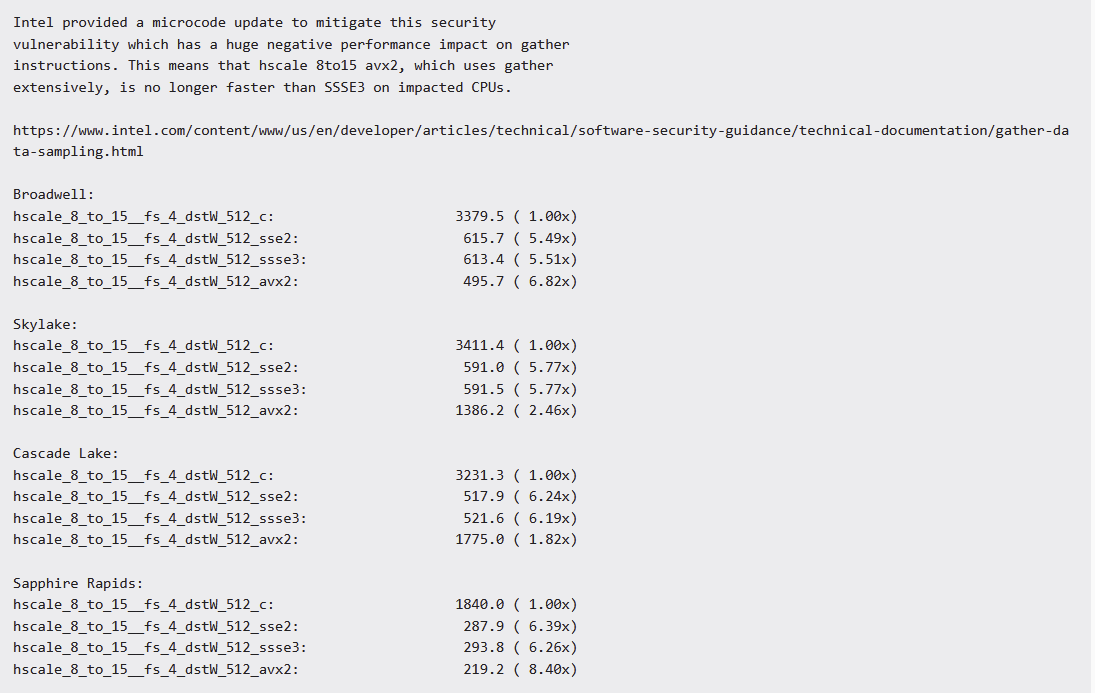
FFmpeg folks are talking about performance degradation due to Downfall (https://t.co/I4Usm1JvzY) vulnerability, and if they can disable it. Short blog post on the issue:
https://t.co/0QH9jBhUq1
Interesting patch from @Google showing the effects of Intel security mitigations on the gather assembly language instruction.
A huge performance decrease as a result.
Deploying mitigations at scale is hard. It has been a couple of years since I discovered https://t.co/I4Usm1K3pw / GDS attack. The performance degradation due to mitigation is bad, which may cause folks to disable them :(
Interesting patch from @Google showing the effects of Intel security mitigations on the gather assembly language instruction.
A huge performance decrease as a result.
@EarlenceF@socrates1024 And your APP1 can easily speculate and leak stuff from APP2 because they share the memory without you knowing about it. And because you have put it in the TEE, it means they hypervisor is malicious so the attack is even easier :-)
@EarlenceF@socrates1024 Because if you are putting wasm in a tee, it means the code is untrusted, and that's against the threat model for what TEEs are designed for. I know well why people want to do that, but it's also very hard to provide real privacy guarantees in that model.
@matthew_d_green@octal Well, commercials pay the bills for musicians to sustain themselves. Not everyone gets big but even the oneswho make it big start from playing bar gigs and commercials. I think music will be dead the way we know it, which is unfortunate.
I wrote a piece on @sigarch blog about the state of hardware and architecture security.
"Secure Computer Architecture in the Post-Meltdown World: A Long Road Ahead" https://t.co/TuJ9jcluOs
[Weekend read] Generalized Power Attacks against Crypto Hardware using Long-Range Deep Learning - https://t.co/cV6TGaxHES
Thrilled to finally publish our GPAM model and high-quality ECC datasets after years of intense R&D. Compared to existing approaches, the GPAM model represents a generational leap because it is able to attack multiple algorithms (AES, ECC) and countermeasures without the need for human intervention and without the need to pre-process the input traces.
Full disclosure each attack requires about automated hyper-tuning: ~700 GPU/h of automated hyper-tuning.
@jmichel_p@invernizzi@flowyroll
#AI #CyberSecurity #cryptography #crypto #ResearchPapers
@ChShersh A library is flexible, you can pick any book you want and read it however you want. A framework tells you what books to read and in which order. The line can be blurry depending on how limiting the library is and how flexible the framework is.
@kaepora I am even more surprised that we are okay with the theory that a supposedly democratic government can arrest someone to send a message to the people.
I didn't attend Usenix Security this year, but looking at the hardware security papers, only a small number solve real problems. This is unfortunate because I know that students put a lot of efforts into these papers. It looks like the gap between academia-industry is quite big.