It’s surprising how little we invest in concentration training these days.
We live in the knowledge economy and do knowledge work. Most people’s ability to concentrate deeply is reportedly very bad already due to mobile phones, social media, etc.
It’s like if we were professional athletes and didn’t go to the gym, ate junk, and barely slept.
Why is it that athletes invest in their bodies and knowledge workers don’t invest in their minds?
How do you know what’s a mistake? If you can’t go back in time, make another decision, and then re-live all possible scenarios of how your life would turn out — and do that for every single decision.
It amuses me that all modern health practices that are getting very popular (things like sauna, fasting, fermented foods like sauerkraut, strength training, cold exposure, etc.) is exactly what my grandfather did about 60 years ago in USSR.
He’s 86 right now and thriving.
Indeed nothing is new under the sun.
@patrickc Spontaneous remission phenomenon (when people with terminal or incurable illnesses recover) - see the book Cured for a taster. Obviously related to the mind-body stuff in health in general.
Nutrition:
1) In relation to mindsets/placebo (Dr Annie Krum’s work, the milkshake study, etc.). What should we believe about the foods we are eating and why.
2) Viewed holistically, in the context of other health-promoting phenomena like socializing - e.g., why it’s better to go to a birthday party and eat a cake at 10pm rather than go to bed at 8 pm feeling lonely e.g., the Mediterranean lifestyle with late dinners.
@worrydream “Our brains haven’t changed in a hundred thousand years. But we’ve built this very complex society around ourselves, and we’ve decided that we want to collectively govern it. We can’t do that if we can’t see or understand how any of this works.”
Some quotes and notes:
“The people here and the people here might be very social people, but the technology is structured in such a way that it’s inherently isolating, that it inherently pulls them apart.”
“When you’re going to the city, what does the city want you to do?”
“You shop and you talk.” - the two things cities (and tech companies) want ppl to do
“People learn best by immersion. If you want to learn a language, you go to the country that speaks that language. You use it for everything, you rub up against it every day, it’s part of your surroundings. You don’t learn a language by studying it for a few hours, every once in a while.” - true for learning everything, AI, design, writing, etc.
@iishaparekh The truth is that both are hard at their corresponding lvls.
It’s not hard to do what you’re told in either; it’s hard to get done in both something that hasn’t been done before.
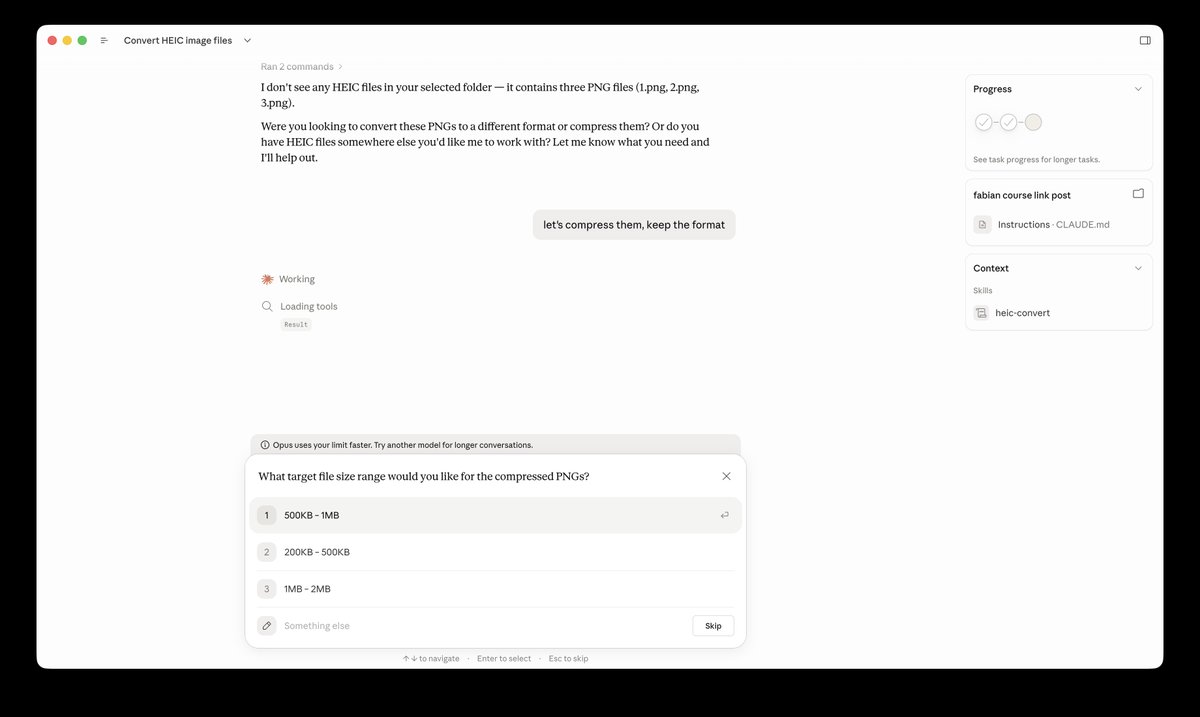
Doing some file compression with Claude Cowork today and noticing.. buttons. Good old buttons, just sittin' there, patiently waiting to be clicked.
I've seen this movie before. In 2015-2016, when Telegram/Facebook/etc. launched their chatbots platform, many people thought "UI is over." Text is the universal interface, blah blah blah.
But guess what - it wasn't. And it won't be this time around either. Humans *love* buttons. (And other UI components too, of course.) They're easy to perceive, process, understand, and act upon. In that sense, they're the exact opposite of text.
Can you imagine a jet fighter pilot controlling his plane through a chat box? Of course no. Our sensorimotor intelligence is very old and very powerful, and will eventually cut through the chat bubble like a hot knife through butter.
My prediction is that we'll still have UI in our models, no matter how intelligent they become. It will prob be dynamic and generated on the fly, like in this case, but it will still be there. Always.
UI > chatbot > UI in chatbot
Buttons for the win!
Launching a “train your own LLM” course next week with @fb_ldn! So excited about this one ☺️
One-liner: deeply understand how LLMs work by training one from scratch based on Karpathy’s nanochat, in a small group of technical founders/engineers, guided by an AI/ML expert — all in 3 weeks!
Basically we realized that Feynman was right and you can’t fully understand something until you create (or recreate) it; hence this course.
We will cover:
* what’s an LLM
* what are tokens, embeddings, activation functions
* what’s a transformer, what is attention, how it works
* what data an LLM is trained on, where this data comes from
* what training means (finding weights for neurons to activate)
* what is loss, why it improves with training
* what is fine-tuning
* what evals mean, how to evaluate an LLM after training
By the end of 3 weeks, you’ll have trained a gpt2-lvl LLM from scratch and acquired an intuitive + first-principles understanding of how these models are built & trained, and what their limitations are
Logistics: 3 live lectures (1hr each) + 3 office hours + async homework, small group of ~10 technical founders, myself and @fb_ldn as instructors (Fabian has an AI & ML background, co-founded Shipamax W17 and exited to WiseTech Global)
DM if interested!
What agents like OpenClaw really sell is a promise of a more productive life once you set them up. Same with many other AI tools, systems like GTD/BAASB, etc.