Esta semana es la última oportunidad para inscribirse en esta conferencia!
Se agradece un RT para llegar a todas las personas que podamos 🌟@lista_redes@WiNS_Society@SocNetAnalysts
Encontrarás toda la información necesaria en la web https://t.co/kaKhv4pvPn
Our recent paper, in ASR: While many sociologists assume that people turn to their “strong ties” when they need a confidant, people are actually as likely to avoid as to talk to their closest friends and family.
https://t.co/0WmIFVGFgL
1/
Confused about how to select control variables in regression analysis? Read "Statistical Control Requires Causal Justification" by @AnnaWysocki3, Katherine M. Lawson and @mijkenijk
https://t.co/ArnXCCRLBU. Solid introduction!
Next week we start again with the WiNS seminar with @anastasiabzv presentation! 🌟
Follow the @WiNS_Society account so you can be updated about all the following speakers.
Old but good (2016):
"we perform a 2,000 user, 250,000 trial online experiment to study the effects of slider appearance [Likert vs VAS]. We find that decorations along the slider considerably bias the distribution of responses"
https://t.co/xUPOrChhXM
Anunciamos nuestra primera Keynote internacional para #LatinR2024: Julia Silge, Data Scientist & Engineering Manager en @posit_pbc✨
Inscripción abierta y gratuita en https://t.co/CjeMyCpTKR
Looking forward to talking about the blessings and curses of AI for clinical prediction modeling later today in Kopenhagen. And finally meeting @jessenleon in real life :)
Slides ICYI: https://t.co/hUeIQLkJA4
⚡️ Excited to share that I am starting an AI+Education company called Eureka Labs.
The announcement:
---
We are Eureka Labs and we are building a new kind of school that is AI native.
How can we approach an ideal experience for learning something new? For example, in the case of physics one could imagine working through very high quality course materials together with Feynman, who is there to guide you every step of the way. Unfortunately, subject matter experts who are deeply passionate, great at teaching, infinitely patient and fluent in all of the world's languages are also very scarce and cannot personally tutor all 8 billion of us on demand.
However, with recent progress in generative AI, this learning experience feels tractable. The teacher still designs the course materials, but they are supported, leveraged and scaled with an AI Teaching Assistant who is optimized to help guide the students through them. This Teacher + AI symbiosis could run an entire curriculum of courses on a common platform. If we are successful, it will be easy for anyone to learn anything, expanding education in both reach (a large number of people learning something) and extent (any one person learning a large amount of subjects, beyond what may be possible today unassisted).
Our first product will be the world's obviously best AI course, LLM101n. This is an undergraduate-level class that guides the student through training their own AI, very similar to a smaller version of the AI Teaching Assistant itself. The course materials will be available online, but we also plan to run both digital and physical cohorts of people going through it together.
Today, we are heads down building LLM101n, but we look forward to a future where AI is a key technology for increasing human potential. What would you like to learn?
---
@EurekaLabsAI is the culmination of my passion in both AI and education over ~2 decades. My interest in education took me from YouTube tutorials on Rubik's cubes to starting CS231n at Stanford, to my more recent Zero-to-Hero AI series. While my work in AI took me from academic research at Stanford to real-world products at Tesla and AGI research at OpenAI. All of my work combining the two so far has only been part-time, as side quests to my "real job", so I am quite excited to dive in and build something great, professionally and full-time.
It's still early days but I wanted to announce the company so that I can build publicly instead of keeping a secret that isn't. Outbound links with a bit more info in the reply!
For clinical prediction models correcting for class imbalance is very often a very bad idea
👉 https://t.co/TKYAqxyOxa
👉 https://t.co/FBMItTawUg
👉 https://t.co/P1EFWRRn3E
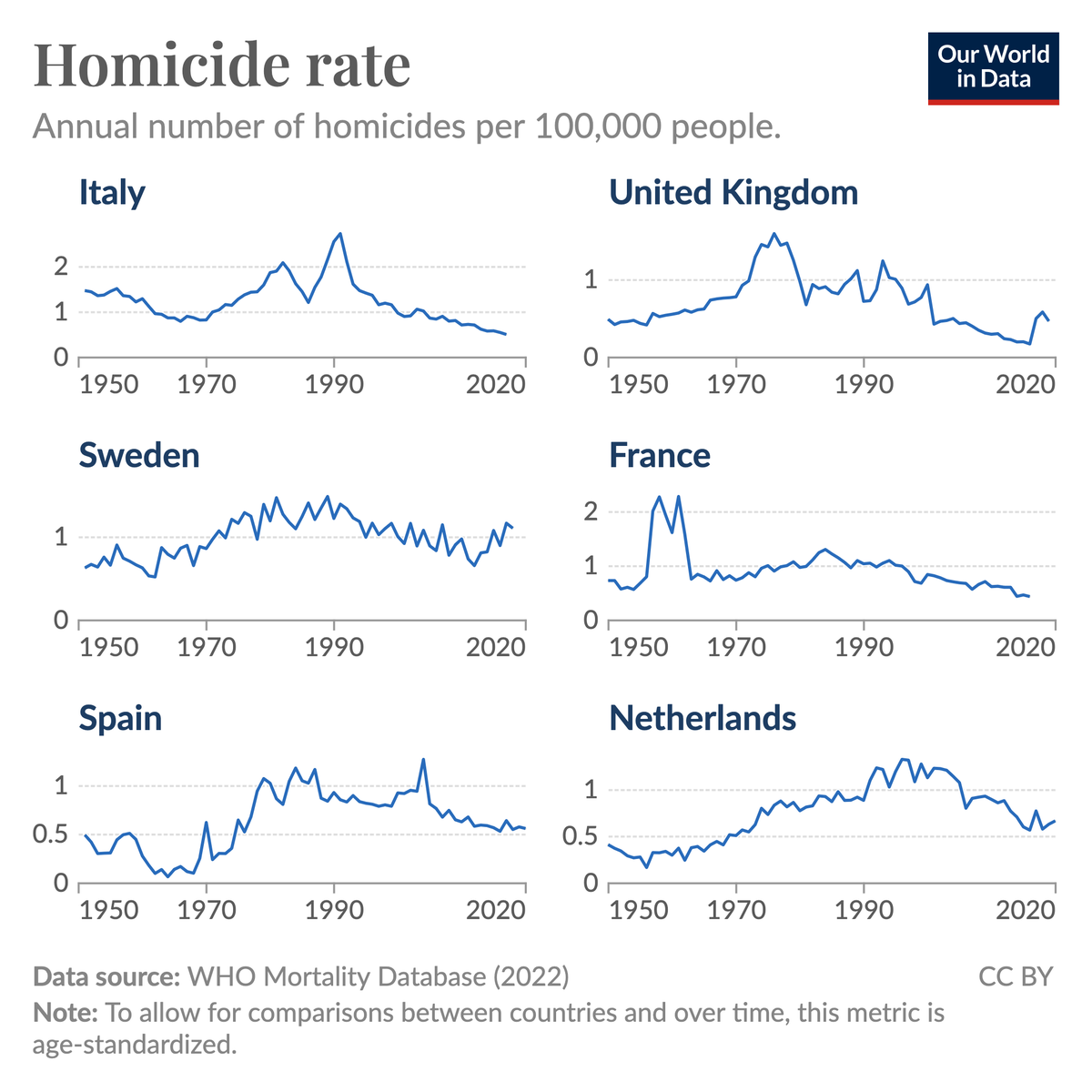
Homicide rates in Europe surged in the second half of the twentieth century but have dropped over the last 30 years.
The chart shows the rates for several European countries based on data from the WHO Mortality Database.
You can see that this trend was most pronounced in Italy. Homicide rates more than doubled from less than 1 per 100,000 people in the late 1960s to more than 2 in the late 1980s and early 1990s. Since then, rates have even fallen below earlier levels.
This rise and fall in homicides is relatively consistent across other European countries, although the timing and magnitude of these changes differ. France, for example, saw a wave of homicides in the late 1950s and early 1960s.
(This Data Insight was written by @bbherre.)
Our latest paper, in PNAS, makes a case for studying what makes people travel to neighborhoods racially different from their own. Maybe some places help counter residential segregation. We found some surprises 1/ https://t.co/21hMMyb9lX
After careful consideration, the FDA advisory comission voted today 9:2 that MDMA has *not* been shown to be effective for treating PTSD, given massive concerns around validity threats in this literature. They also voted 10:1 that MDMA has *not* shown to be safe.
🎓 Exciting PhD opportunity! Join our @rug_gmw project on "Substance Use and Risk Taking among At-Risk Youth." Examine how offline and online social settings influence behavior.
Apply now: https://t.co/m5rccH0EaC
#PhD#Research#Sociology#Education
When teachers were asked to assess whether a given piece of writing was done by a student or an AI, they performed about as well as chance and they tended to classify actually (but not so much assumed) AI-generated works as higher quality.






![EikoFried's tweet photo. Old but good (2016):
"we perform a 2,000 user, 250,000 trial online experiment to study the effects of slider appearance [Likert vs VAS]. We find that decorations along the slider considerably bias the distribution of responses"
https://t.co/xUPOrChhXM https://t.co/w6z3UtTAqw](https://pbs.twimg.com/media/GWjVGa3WkAEnrzS.png)