AI Engineer. Reality Distortion Field.
Jesus said to him, “Go your way; your son lives.” So the man believed the word that Jesus spoke to him, and he went.
🧵A nurse cured a 100% fatal brain disease.
Her cousin had CJD—a prion disease no one has ever survived. Doctors gave him 5 months to live. She gave him IV DMSO (which heals the brain) for 4 weeks.
He recovered
The Yale neurologist who wrote him off wanted to publish the case but refused to mention what she used. He's alive 5-6 years later, no medication, playing scratch golf in Palm Beach.
But CJD is far from the only "incurable" neurological condition DMSO helps. Over 2000 studies support its use for conditions ranging from Alzheimer's and Parkinson's to brain fog, MS, ALS, paralysis, chronic pain, strokes, depression, epilepsy, and Down syndrome, and a physician who began treating his patients with it estimates roughly 80% of what people see neurologists for goes away with DMSO.
6 ideas from Reality Transurfing that rewired my whole life:
- Most of your goals were never yours. School, your parents, the crowd handed them to you. Chase your own and the effort disappears.
- The right door doesn't need breaking down. If you're forcing it, it's not yours. The path meant for you opens quiet, and it only opens for you.
- Stop making it so important. The harder you need something, the harder reality pushes it away.
- Heart first, mind second. Your heart picks the direction, your mind builds the plan. Do it the other way round and you lose.
- You don't experience reality, you experience your version of it. Change the story you're running and the world reshapes to match.
- You don't need permission. Not from your parents, your boss, or the crowd. You can just decide.
Choose your own reality because nobody's coming to hand it to you.
Marc you honestly sound so much like me except a year or two in the future. I am a non-scientist, engineer type that went full force into researching over the last 9 months following my wife's diagnosis (stage 4 diffuse gastric adenocarcinoma w/ signet ring), read hundreds and hundreds of studies and books, used the best AI models you can pay for to synthesize things and try to organize new connections. I haven't gone the route of formulating custom molecules yet... not even sure where to start there... but damn man how did you begin the molecule building phase or get compounding pharmacies on board?? We run into trouble sometimes just trying to get off-labels prescribed from MD's who don't know read the studies. God bless you man, I'm rooting for you.
This little girl is not in the video. She wasn't even born. But she is moved to tears watching her mother and father get married. Why?
Marriage researcher and family therapist Pat Fagan once told me:
"When a child sees their mother loving their father they feel like their mother is loving them. When they see their father loving their mother they feel like their father is loving them. It is the only time in the human experience where you can be loved indirectly. No one's even looking at you or touching you or talking to you, but you feel loved."
That is not the case with a step parent, he said. The child may tolerate the romantic expression. But they do not experience that same circuitous love. More often they feel competition or jealousy.
If every child could order their own world, this is what they would say:
"I want my mom and dad to love me and I want my mom and dad to love each other."
Sometimes that's not possible. Woe to a culture that intentionally denies that to children in the name of adult freedom.
@RussBrookes1981 God bless you man I fear this every day, know that in my heart I am deeply holding the intention that you be given the strength you need to find your way through this.
‼️ Anthropic was hiding a secret internal project to destructively scan every book in the world, irreversibly damaging heritage. The company spent billions of dollars to slice the spines off millions of books, even very rare ones. This means no other AI, and no human, can access this knowledge anymore.
It now markets itself as the responsible lab.
One bookseller told 404 Media his inventory is full of rare, foreign-language and low-circulation books, meaning that if they are destroyed in the process of becoming training data, they will be even harder to obtain.
Second-hand booksellers across Europe are sounding the alarm, because rare books are being destroyed. They have received random lists of thousands of titles. Books too obscure to resell at a profit. Requests arriving overnight from companies nobody in the trade has heard of.
One email came from "Nataly" at 2077AI, a Singapore company. Attached: 3,000 English titles grouped by ISBN. A 1999 geomechanics monograph. A 2018 study of laser shock peening on ceramics. A 2021 academic book on Irish folk tales.
A German dealer watched the orders arrive every night between 3am and 5am. Canadian company Zoom Books, buying systematically, titles with nothing in common. Zoom told Swiss broadcaster SRF that this is a regular recycling and trading model.
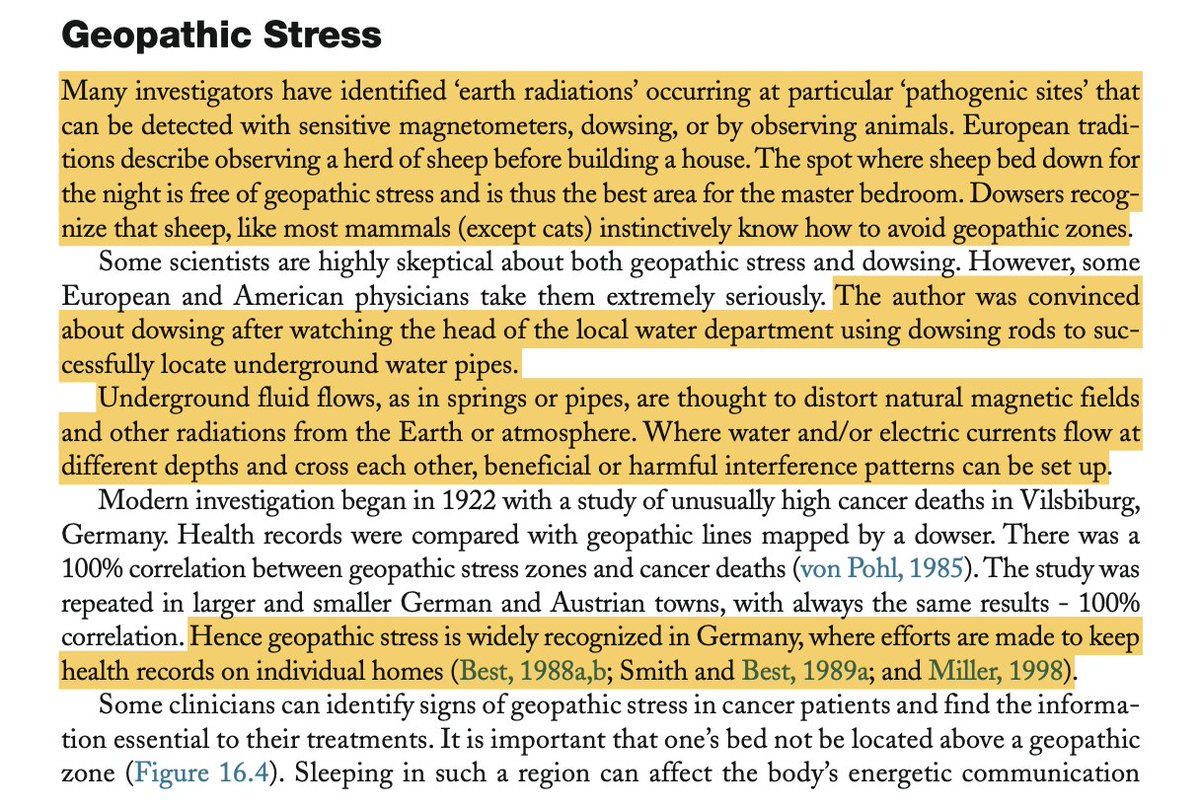
In 1929, a dowser mapped underground currents beneath a German town of 3,300 people, living in 565 houses.
Every recorded cancer death in that town fell on one of his lines.
If that correlation is real, where you sleep — for years at a stretch — is a variable in cancer risk almost nobody has on their radar.
The man behind the survey was Gustav von Pohl, a German aristocrat.
He carried out the mapping himself under the supervision of the town's mayor and local police, who signed an official protocol documenting the investigation.
Because no scientific instrument could detect what he claimed to be sensing — a form of radiation he believed passed straight through concrete and lead — von Pohl relied entirely on his own physiological sensitivity.
Using a solid brass or steel divining rod — the method known as dowsing — he located the hazard zones by tracking where the underground currents reacted so strongly that he could sometimes hardly hold the rod and had to let go of it.
This wasn't a one-time fluke.
Von Pohl repeated the exact same experiment under official supervision in another German town, Grafenau, with the identical result:
A 100% correlation between his mapped lines and the town's cancer cases.
In each case, the bed where the cancer patient slept was situated directly over the dangerous underground current.
Von Pohl documented the original findings in his book, Earth Currents: Causative Factor of Cancer and Other Diseases, published in 1932.
He named these hazard zones "negative electrical earth currents" and measured their intensity on a custom 16-point scale.
Von Pohl didn't believe every underground current was contributing to cancer.
Only currents rated grade 9 or higher, he found, were associated with cancer.
While weaker currents (grade 8 and below) were not linked to cancer, he warned they could still cause milder ailments in sensitive individuals.
The most dangerous configuration was a "cross":
A point where two or more underground streams intersect at different depths, massively amplifying the radiation.
Today these locations are better known as geopathic stress lines.
Fixed points in the ground where distorted natural earth vibrations interfere with the biology of anything living above them.
Long before anyone gave them a name, animal behavior was already pointing to the same places.
Sheep, cows, pigs and dogs instinctively avoid them.
For centuries, one European method of choosing where to build a house required no instrument at all:
Find where a flock of sheep beds down for the night.
Build your bedroom there.
A few species appear to do the opposite.
Cats actively seek out these lines.
Ants build their hills directly above them.
Von Pohl also claimed that bees produced more honey when their hives sat over strong underground currents.
That's the part that's hard to dismiss as coincidence:
Several unrelated species are claimed to respond to the same locations, but in opposite directions.
Georges Lakhovsky, a Belarusian-French engineer and inventor, reached a similar conclusion independently.
He concluded that cancer incidence tracks geology.
His proposed mechanism was different.
Lakhovsky argued that cosmic radiation was the primary force, while underground water acted as a secondary modifier by changing the electrical properties of the ground beneath a building.
Mineral-rich groundwater, he argued, behaves like a conductor.
A hidden underground vein effectively becomes a localized antenna, distorting the surrounding electromagnetic field even where the surrounding soil would otherwise insulate against it.
Different mechanism.
Same underground water detail.
Both arrived at the same hypothesis:
The geology beneath a building influences cancer incidence.
If that mechanism is real, geopathic stress isn't some rare anomaly.
It's simply electromagnetic geology, as common as groundwater itself.
Subsequent investigators reported even more specific correlations.
In Stettin, Dr. Hager, chairman of the local medical association, decided to test von Pohl's theory for himself.
He pulled the town's official cancer records from 1910 to 1931:
5,348 cancer deaths, unevenly distributed across homes.
Some houses had a single death. Others had ten or more.
Working with a professional dowser, Privy Counsellor C. William, Hager examined every address.
Every affected home, he reported, had an underground current running beneath it.
Some lay directly over "crosses," where two currents intersected.
The clearest comparison came from three homes for elderly residents, chosen because the occupants shared a similar age-related vulnerability.
Over 21 years, the home built above a crossing of underground currents recorded 28 cancer deaths.
A second home, built above two weaker currents, recorded 2 deaths during the same period.
In both cases, the victims' beds were positioned directly above the underground lines.
The third home had no underground current beneath it.
Over more than 20 years, it recorded none.
Sixty years after von Pohl first published his findings, the Austrian government funded a study.
In 1987, at the University of Vienna, Otto Bergsmann, a medical doctor & a lecturer, assembled a team of doctors, chemists, physicists and biologists to run a two-year double-blind study.
Neither the 985 participants nor the physicians examining them knew whether a given seat was located in a geopathic stress zone or a neutral one.
Each participant remained in the test location for 15 minutes.
Researchers measured blood pressure, heart rate, circulation, blood sedimentation, breathing, skin resistance and the electrical conductance of specific muscle points.
In total, the study generated 462,421 measurements across 6,943 individual tests.
The researchers concluded that measurable physiological changes appeared in most cases after just 15 minutes of exposure.
That still leaves one obvious question:
What was the mechanism?
Von Pohl never explained why or how the radiation would harm a cell.
He openly admitted in his book that he did not understand the exact biological mechanism.
He simply theorized that the "negative electrical earth currents" caused a "negative electrical overloading of a cell".
Beyond that, he only knew that it generally "weakened the organism" and made organs highly susceptible to disease.
He explicitly wrote that figuring out exactly why the radiation harmed the body was a mystery that "the appropriate sciences should research" in the future.
Decades later, Rolf Gordon proposed an answer.
After losing his son to cancer, Gordon spent decades investigating geopathic stress.
He argued it was not simply associated with cancer, but with many chronic illnesses, including multiple sclerosis, ME, Alzheimer's disease and arthritis.
Not as the direct cause.
But as what he called the "ultimate push button" that weakens the organism and leaves it vulnerable to disease.
His proposed mechanism:
Humans evolved to function within the Earth's natural electromagnetic environment, centered on the 7.83 Hz Schumann resonance.
According to Gordon, underground water and geological faults distort those natural vibrations.
When a person is exposed to geopathic stress, the body's own vibrations rise to abnormally high frequencies, sometimes reaching 266 Hz.
A geopathically stressed environment, in his model, favors pathogens over the immune system meant to control them.
Gordon based these conclusions on more than 24 years of fieldwork involving over 20,000 people and buildings.
Across thousands of cancer cases, he reported that every adult patient he investigated was affected by geopathic stress.
He published these findings in his bok Are You Sleeping in a Safe Place?, first published in 2005.
Gordon also drew on the work of Austrian educator Käthe Bachler, whose investigations became some of the largest conducted on geopathic stress.
Bachler surveyed approximately 3,000 apartments, houses and workplaces across 14 countries, examining the sleeping and working locations of roughly 11,000 people.
In her book, Earth Radiation, 1984, she evaluated 500 cases of cancer and abnormal tissue growth, including benign and malignant tumors.
She reported a 100% correlation, writing that every case of abnormal cell growth was located directly above a geopathic stress zone.
Her primary intervention was simple.
She mapped the room and recommended moving the bed or desk to a radiation-free location.
She reported that many children showed improvements in sleep, behavior and school performance, while chronically ill adults experienced improvements in their health.
Here's what makes this difficult to dismiss as the superstition of a single culture.
Chinese builders were avoiding these locations more than 4,000 years before Gustav von Pohl ever picked up a dowsing rod.
There was no contact between the two traditions.
Yet they arrived at the same practice.
Don't build where the ground is disturbed.
Feng Shui eventually formalized the idea using landform observation and the magnetic compass.
Mainstream medicine has generally not accepted this line of research.
A purely chemical model of health has no place to put it.
None of this requires believing a divining rod detects anything.
It only requires accepting that invisible forms of radiation can influence living organisms.
Once you accept that premise, location stops being irrelevant.
It becomes another environmental variable worth investigating.
Two civilizations, separated by thousands of years and thousands of miles, both believed the ground beneath a house could influence health.
Whether those observations ultimately prove to be correct remains to be seen.
But if location influences biology, then where you spend eight hours every night may be a far more important environmental variable than most people realize.
Sometimes the intervention is simply moving your bed — or your desk — a few feet into a different part of the room.