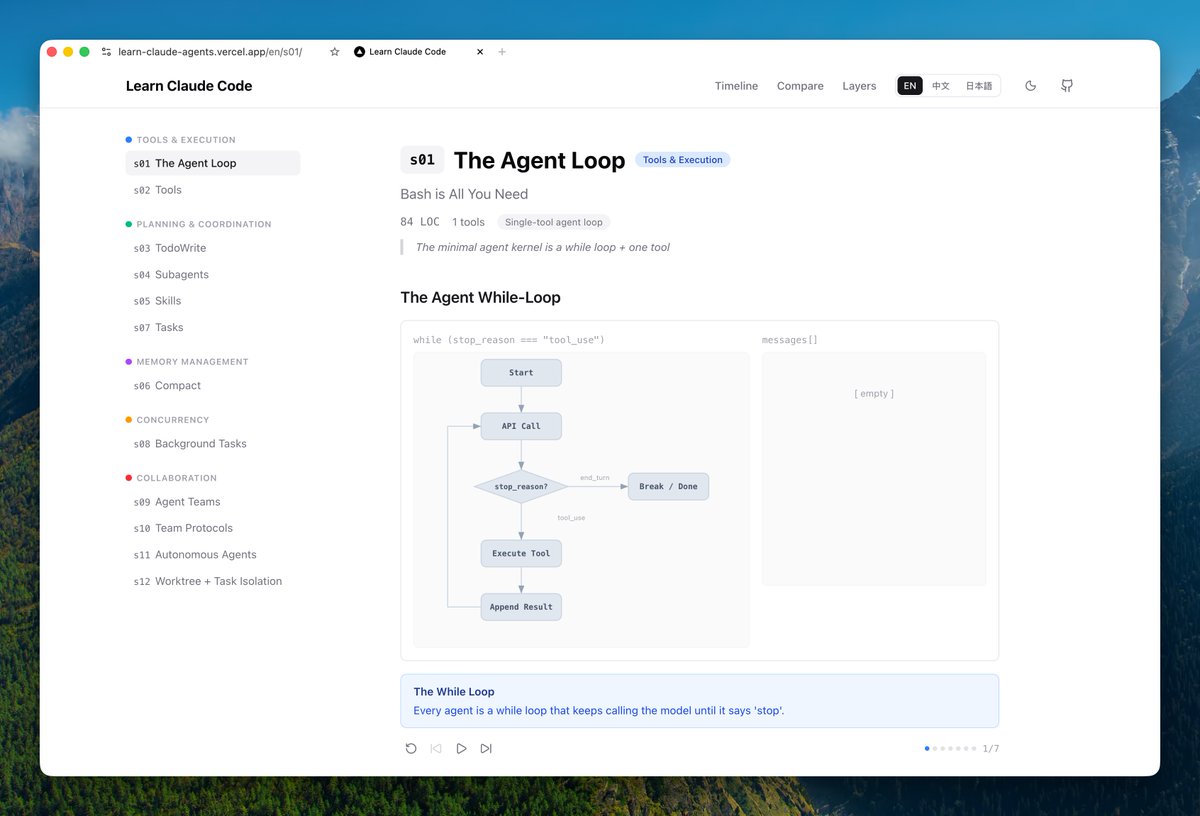
A great resource if you want to understand how AI coding agents work. Learn Claude Code walks through building a minimal Claude Code like agent from scratch, explaining each mechanism step by step.
You’ll see the core loop most coding agents share: call the model, execute tools, feed the results back, and iterate. A clean way to understand how these systems are actually built.
https://t.co/LnIlVFLhiw
10/
We keep asking "will AI replace programmers?"
Wrong question.
The real shift: programmers are becoming the people who design work for AI to execute — and verify that it was done right.
That's a different skill set. Are you building it?
9/
The biggest barrier to non-technical teams adopting agents isn't technical.
It's the belief that it'll actually work.
Show them one demo. Let them see it run. After that, they figure out the rest themselves.
Notion's People team is now one of their highest-adopters internal
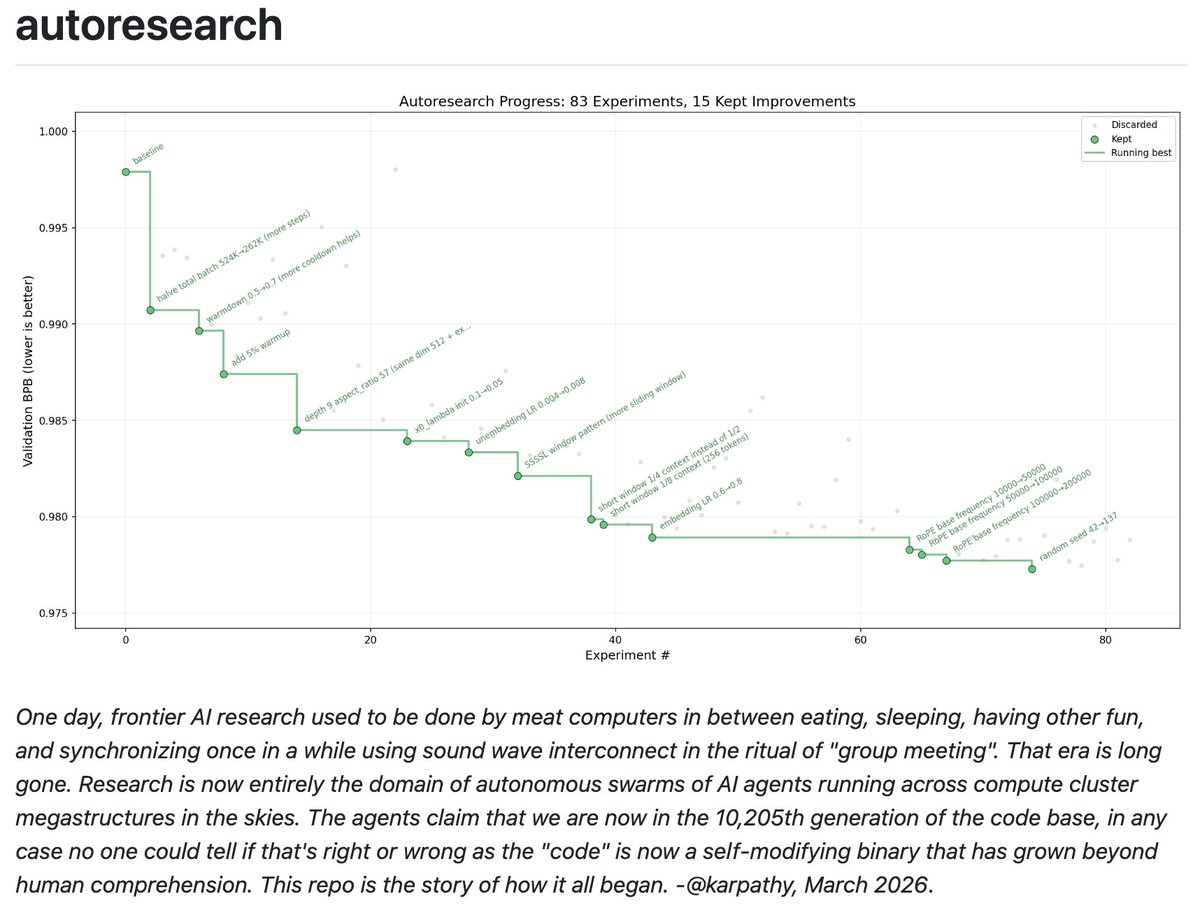
I packaged up the "autoresearch" project into a new self-contained minimal repo if people would like to play over the weekend. It's basically nanochat LLM training core stripped down to a single-GPU, one file version of ~630 lines of code, then:
- the human iterates on the prompt (.md)
- the AI agent iterates on the training code (.py)
The goal is to engineer your agents to make the fastest research progress indefinitely and without any of your own involvement. In the image, every dot is a complete LLM training run that lasts exactly 5 minutes. The agent works in an autonomous loop on a git feature branch and accumulates git commits to the training script as it finds better settings (of lower validation loss by the end) of the neural network architecture, the optimizer, all the hyperparameters, etc. You can imagine comparing the research progress of different prompts, different agents, etc.
https://t.co/YCvOwwjOzF
Part code, part sci-fi, and a pinch of psychosis :)