It has been stunning. And that does not even include multinationals, including ‘Europes companies’ producing in China for the EU market.
Also note that the 2M cars (annualised) China now exports to the EU is 4-5x peak EU car exports to China in the 2010s.
🇺🇦🔥🇷🇺 Nach der Zerstörung des Straßenabschnitts der Krim-Brücke haben sich in der Nähe des Kontrollpunkts bei Tschonhar russische Schwerlastkraftwagen angesammelt – UC
Ukrainische Drohnen haben bereits damit begonnen, diese zu zerstören
Bildbereich folgen
1/ A newly published Ukrainian video reportedly showing one Russian soldier eating another has highlighted the Russian army's repeated problems with starvation and cannibalism – as well as its recruitment of pardoned cannibals. ⬇️
https://t.co/uxAUaAjwol
The fundamental mistake that @jaredkushner makes is not what you think. He doesn't underestimate Putin. Kushner grossly overestimates Putin. Putin is not a smart and organized player Kushner thinks he is. Kushner (and President Trump) keeps offering Putin all kind of deals, but Putin is a narrow-minded, short-sighted thug, who thinks "if they offer me a deal, this means they are losing". Putin will go down, bringing down his regime and the country, still uncapable to understand how good for him the offers were.
I'm sure the CIA will be stunned and delighted to hear from the mouth of Jean-Luc Mélenchon that they have infiltrated France's most prestigious left-wing newspaper Le Monde
To understand what Russia is read what they did with a Ukrainian journalist, a young woman.
Leaked records from Rosstat, Russia’s state statistics agency, say that Ukrainian journalist Viktoriia Roshchyna died of an “illness” while in Russian captivity. Her body was returned to her family with signs of torture and some organs missing.
In November, Belarusian and Ukrainian hackers from Cyber Partisans and Silent Crow shared leaked Rosstat data with independent media outlets. Journalists found an entry for Roshchyna, who died in Russian captivity. The date of death was initially recorded as 16 December 2024 and later changed to 19 September.
Rosstat’s records say the journalist died of an “illness.” The underlying cause of death was listed as “myocardial degeneration,” meaning damage to the heart muscle. The immediate cause was listed as pulmonary oedema.
Roshchyna was first taken captive in 2022 and was subsequently released. She was captured again in 2023 while on a reporting trip. She was gathering material for articles about the aftermath of the destruction of the Kakhovka hydroelectric power plant, the situation at the occupied Zaporizhzhia nuclear power plant, and the “referendums” held in occupied territories.
According to women who shared a cell with her, Roshchyna first spent four months in Melitopol in what abductees call “the garages,” a secret prison beneath a bridge in an industrial area.
She was then transferred to Detention Centre No. 2 in Taganrog. Originally used to hold teenagers and women with children, the facility began receiving Ukrainian captives during Russia’s full-scale war. Prisoners described inhumane conditions. From their first days there, guards hung them upside down, beat them and tortured them.
One of Roshchyna’s cellmates said she arrived in Taganrog with stab wounds. Roshchyna told her that she had been tortured with electric shocks applied to her ears and that afterwards she was “blue all over.” Ukrainian police said she was abused because she demanded decent conditions and refused to sing the Russian national anthem. She was held in an unsanitary cell and given three minutes to eat and wash her dishes. From morning until lights-out, she was forbidden to sit or lie down.
A week before her death, Roshchyna was transferred to another detention centre in Kizel, in Russia’s Perm region. Witnesses said she was by then severely emaciated and could barely stand. In Kizel, she repeatedly lost consciousness. Reporters Without Borders reported that she was beaten there.
The day before her death, Roshchyna asked prison staff for tea. They replied, “You’ve come to the wrong place. You’re in no position to ask for anything here.” Medical staff “gave her something,” one prisoner recalled. On the morning of 19 September 2024, her cellmates told the guards that Roshchyna could not move.
Six months later, her body was returned to Ukraine as part of an exchange of remains. Some organs were missing, and there were numerous signs of torture. Ukraine’s Prosecutor General’s Office reported “haemorrhages in various parts of the body, a broken rib, a neck injury and possible signs of electric shocks on the feet.” A source close to the investigation said her eyes, brain and part of her larynx were missing and that her hyoid bone was fractured.
This spring, Ukrainian police reported that Roshchyna’s occipital bone, at the back of her skull, had been fractured while she was held in Taganrog. The condition of her remains made it impossible to determine the exact cause of death.
Viktoriia Roshchyna was 27. She worked with Hromadske, Ukrainska Pravda, Radio Liberty and other outlets.
#russianwar #mediaZona
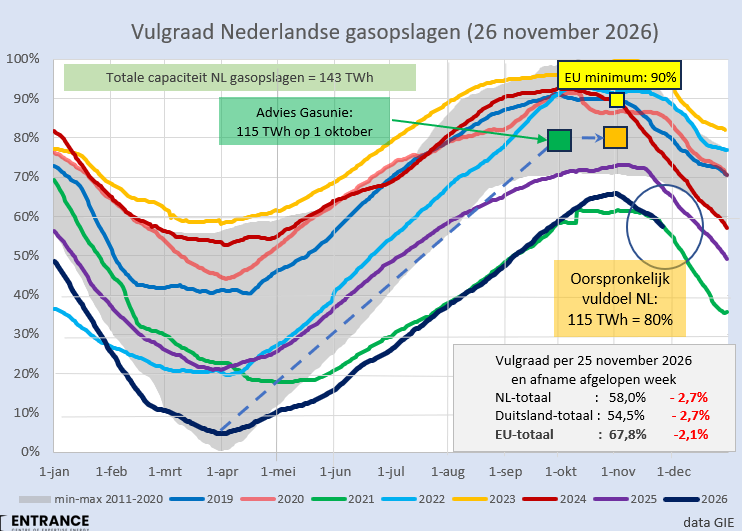
Nog 58% vulgraad en nog minder in DE. Het zorgt onverminderd voor een flinke opwaartse druk op de gas- en stroomprijzen in NW-Europa. Mooier wordt het niet.
Zou 'Den Haag' al een beetje spijt hebben dat niet naar de adviezen van o.a. Gasunie en de Mijnraad is geluisterd?
#grafiekvandedag
Здесь не упоминается важная деталь - погибшие мобики из «ЛДНР». Очевидно, в эту статистику они не включены. Поэтому на начальном этапе у России такие небольшие потери. Основная тяжесть мясных штурмов в это время легла на мобилизованных из Донбасса, их клали тысячами в штурмах. Видимо, западные разведки их считали. А у Росстата их нет
If Giorgia Meloni wants to keep the war out of the Mediterranean, she should be equally clear with Moscow. Russia has no territory on the Mediterranean. Its warships should stay out. Wherever they call, they remain military targets.
The US has retired 240 F-15s and is replacing them with F-35s and F-15EXs. These jets sit in Arizona while Ukraine waits years for new fighters.
Ukraine could use 50–60 to shoot down Russian drones and missiles, retired US Lt. Gen. David Deptula in Forbes. 1/
Perché in Russia le persone vanno in guerra spinte dalla povertà? Vi faccio un piccolo esempio.
Sulla mappa di Mediazona, che riporta nomi, cognomi, fotografie, città di provenienza e luoghi di morte di 290.000 militari russi caduti in guerra, ho cercato Dubna, la mia città d’origine, nella regione di Mosca.
Della mia città sono morti in guerra almeno 28 uomini. Tra l’altro, i due più anziani avevano rispettivamente 57 e 60 anni.
Nella vicina città di Kimry, che si trova a circa 30 chilometri da Dubna, mezz’ora di macchina, i morti accertati sono invece 86.
E qui arriva la parte interessante.
Kimry ha circa 38.000 abitanti, e la popolazione è in diminuzione. Dubna ne ha 74.000, e la popolazione è in crescita.
Com’è possibile che una città con la metà degli abitanti abbia tre volte più caduti in guerra?
La spiegazione, secondo me, è molto semplice: a Kimry la gente è decisamente più povera.
Nonostante la vicinanza geografica, la differenza nella qualità della vita tra le due città è impressionante.
Dubna si trova nella regione di Mosca ed è una naukograd, cioè una città della scienza. Tra l’altro, vi si producono i missili Kh-101 utilizzati dall’esercito russo, e non solo. Ospita inoltre una zona economica speciale, l’Istituto congiunto per la ricerca nucleare e diverse altre realtà scientifiche e industriali.
Insomma, per gli standard russi è una piccola città piuttosto prospera.
Kimry, invece, appartiene alla regione di Tver. La città versa da anni in condizioni piuttosto deplorevoli ed è tristemente nota per i suoi problemi di tossicodipendenza. Non ci sono grandi imprese o centri industriali particolarmente importanti.
Ecco, stiamo parlando di due città separate da appena 30 chilometri, ma con condizioni economiche e prospettive di vita completamente diverse.
E, a quanto pare, anche con un prezzo umano della guerra molto diverso.
Naturalmente, questi numeri da soli non dimostrano un rapporto di causa ed effetto. Ma illustrano molto bene un meccanismo di cui parlo spesso: quando lo Stato offre per andare in guerra somme che una persona difficilmente riuscirebbe a guadagnare in molti anni di lavoro, la scelta di arruolarsi non è indipendente dalle condizioni economiche in cui vive.
La povertà diventa così una delle risorse attraverso cui il Cremlino alimenta la propria macchina bellica.
Weer eentje. Zie talloze vergeefse waarschuwingen die al gedaan zijn.
NB: Dit betreft een all-electric bedrijf met een proces waarmee kan worden/en wordt (!) ingespeeld op het variërende aanbod uit wind en zon.
In dit geval speelt de ACM een bijzondere rol omdat ze de volumekorting voor dit soort bedrijven zomaar schrapte, terwijl buurlanden die handhaafden. Volgens ACM omdat EU-regelgeving die korting niet toestond. Geen afstemming met de buren dus. Pijnlijk.
Hierdoor heeft de Belgische vestiging van Nyrstar veel lagere stroomkosten dan de Nederlandse, terwijl NL nota bene hofleverancier is wat betreft stroom voor BE.
Bron: @telegraaf
NEW: Britain bought fake C4 explosive for Ukraine.
The MoD knowingly spent millions of taxpayers' money on fake C4 explosives, potentially putting Ukrainian soldiers at risk, and seemingly attempting to cover it up.
A 🧵
https://t.co/qfo1FkKLDQ