“You can revoke a user's access. You can change what the model is willing to do. When a model is released in an uncontrolled manner, there's no ability to do that. It's entirely out of your hands.”
And the mask slips. It's all about control, all about being able to grant or refuse permission.
Amodei, you may think you're doing this for "safety", but what the fuck do you think Is going to happen when the psychopaths who infect governments get such power?
An AI-enabled boot grinding a human face, forever.
I believe the @nvidia board is not acting in the best interest of shareholders nor in a manner consistent with their fiduciary duties.
What we know is that the board fired Jensen or forced his resignation for violating company policy and/or in response to the accusation of an affair with a spy.
They did so without careful consideration of the impact on the company, its customers, its shareholders or other stakeholders.
They rushed to judgment without the benefit of careful due diligence or even with a basic understanding of the facts.
How do we know this?
We know this by how quickly Jensen was fired and how little was known at the time of his firing.
It takes time to convene a board meeting. There was time, maybe, for one Zoom.
And this is a decision that should have been made by a board sitting in person and carefully deliberating the facts once they are known.
And they should have slept on the decision and met again the day after to discuss the facts, the risks and the other implications of their decision.
The timing and lack of information did not allow for careful board deliberation.
While boards can fire a CEO for an inappropriate relationship with a subordinate, it should not be an automatic decision. That is why we have boards comprised of humans and not agents.
A board should consider whether or not such a relationship was consensual or whether it was an abuse of power dynamics. And a board has to consider what the impact of the firing is on all stakeholders.
If I were in this board, I would not have rushed to judgment based on articles in the media. I would have made sure the board had all of the facts so it could make a careful and informed decision.
Boards of Delaware companies have a duty of care which means they must make informed, prudent and good faith decisions. This clearly did not happen here.
What law firm is advising this board?
Or is the board even taken good legal advice?
It doesn’t look like it.
And now the board is compounding its failures by insisting that there is no possibility for Jensen’s return as CEO.
Why is it in the best interest of the company to foreclose the possibility of Jensen’s return and to do so before all of the facts are known? This is yet another breach of their duty of care.
Furthermore, the board has launched an investigation whose scope is unknown. Investigations can be extremely damaging to a company and should be carefully targeted to address whatever facts need to be known rather than be overly broad in scope.
In short, this looks like a series of major governance failures by directors that panicked due to headlines in the media. They likely felt compelled to do something because they were afraid of looking bad in the media, not because it was the right thing for them company.
They couldn’t stand the heat.
The board’s conduct here is shocking for a company of this scale and importance to our country and the world at large, particularly at this moment in history.
Over the past week, I’ve been overwhelmed by the love and support of friends, industry colleagues, and people I've never met. Thank you to everyone who has shown kindness to my family and me. It means the world to me.
I came to the United States 53 years ago, and becoming an American citizen is one of the greatest gifts and proudest moments of my life. NVIDIA has been my life’s work. Building it into the company it is today alongside my colleagues has been a privilege and an honor. Nowhere but in America could a company like NVIDIA be possible. I love our country, and I love NVIDIA.
I did not live up to the standards expected of everyone at NVIDIA, and I have made serious mistakes in my personal life. I created problems for the Board that I deeply regret. I own my mistakes completely, and I am committed to cooperating with the Board’s independent investigation.
Since my departure, I’ve seen an outpouring of calls from NVIDIA’s employees, investors, business partners, and customers for me to return as CEO. Many continue to reach out to me directly as the company navigates complex technology, market, competitive, and geopolitical dynamics. NVIDIA is a once-in-a-generation company. If the Board of Directors decides that my return is in the best interest of our shareholders, our employees, the company, and America, I would be honored to answer these calls and return as CEO.
Thank you again to everyone who has shared their good wishes. I am profoundly humbled by your support. To my family: I love you, and I will spend the rest of my life being worthy of yours.
Jensen
The articles backtracked from their original incendiary, and now clearly false, claims to something more like "Jensen did lawful things that powerful people didn't like". It still appears the original claims came from a single competing Big Tech lobbyist.
The reporting successfully disrupted corporate governance processes, with a running cost of $1.8 trillion in losses to American pension funds and shareholders.
Here's what I fear is being lost in these articles: The proper interface between government and private citizens and their corporations is rule of law. Laws are passed, and if wrongdoing as alleged, then there's due process: an investigation followed by facts and evidence presented in open court. Due process should happen here: let the facts come out whole, and not as a trickle of dubious claims.
Press takedowns full of sketchily sourced claims and backtracking narratives are not the way. It's what we see outside of the free world, and is no model for The United States of America.
In particular, if the Jensen takedown succeeds on the basis of these journalistic failings, which is not by any means certain as Sam Altman's case shows, then it foreshadows an economically and institutionally ruinous new playbook to be adopted with no end in sight.
Imagine a weekly stream of takedowns emerging from opportunistic alignments between corporate lobbyists and political interests which, given the new partisan split between the executive and legislative branches, will attack in all directions, undermining not only the US economy but American leadership in the world.
I hope cooler heads prevail this coming week as they did not on Thursday November 12. And I urge anyone who happened to oppose Jensen, open models, and the underlying trade policies in question, to recognize that this isn't a win for "team regulation". It's a change in the game from a transparent rules-based one to a sinister new form centered around politicans and lobbyists.
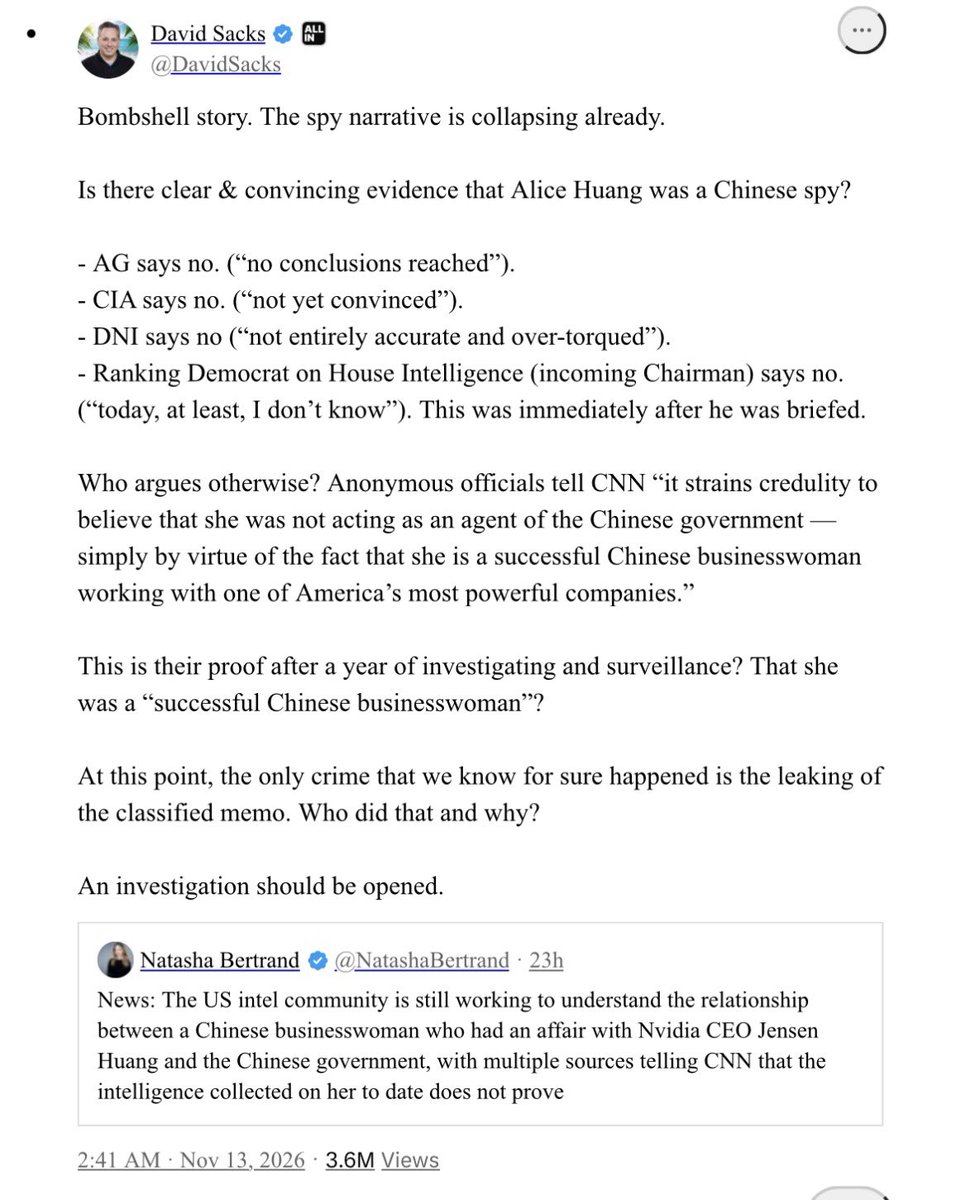
This is very irresponsible of the NYT. They claim that @DavidSacks is “spreading conspiracy theories,” but when u click through and see what this alleged conspiracy theory is it’s literally just him accurately citing CNN’s reporting.
This is the biggest irony of the whole Alice Huang / Nvidia saga: the Chinese government actually doesn't want Nvidia chips and is actively keeping them out of the country.
Last year it even ordered Alibaba and ByteDance to cancel their Nvidia orders (https://t.co/T4ZMand2BD) and sent customs teams to the ports to check every advanced chip coming in (https://t.co/UFPerK7Cgp).
And right now 600,000 Nvidia H200s are stuck in Hong Kong because Beijing won’t let them into the country (https://t.co/epimhGPQYq)👇
Nvidia also explicitly frames this as a threat to its business in its latest annual report to the SEC: "The Chinese government has encouraged customers to purchase from our China-based competitors and discouraged customers from purchasing, importing, or using our data center products" (https://t.co/TQVwWuix83).
Why does China do that? Because every Nvidia chip a Chinese company buys is one that Huawei or Cambricon doesn’t sell, and domestic chips can only catch up if people actually buy them (which means money for R&D, etc.).
Which means that the notion that Chinese intelligence was running honeytraps to get more Nvidia chips into China gets the whole thing exactly backwards.
In fact, it looks like Megaspeed - Alice Huang's company - was a counter-reaction to official Chinese policy: a private sector workaround to these efforts by the Chinese government to curtail Nvidia.
As was widely reported - including by Western media - Megaspeed built data centers in Southeast Asia and rented their computing power to Alibaba, which the New York Times called "a backdoor way of getting access" to Nvidia chips (https://t.co/tu9Re4WdzM).
That is a backdoor not only - allegedly - around Washington’s export controls, but also around China's own efforts to wean its companies off Nvidia.
I can’t believe the Chinese government was too thrilled about it: it'd make just about zero sense for it to run countless domestic measures to prevent Alibaba from using Nvidia chips, yet at the same time have its top spy agency help the same Alibaba get Nvidia chips through the back door in Southeast Asia 🤷
At the end of the day, as with all such stories, you always need to look at "cui bono?": who benefits? Who benefitted is pretty clear:
- Nvidia itself: it's in the business of selling chips so a customer willing to spend billions of dollars on chips in Southeast Asia is a godsend. Again, as they themselves state in their SEC filings, not being able to tap into Chinese demand would have "a material and adverse impact on our business" (https://t.co/TQVwWuix83).
- Chinese companies like Alibaba: facts are, 1) Chinese chips haven't yet caught up, 2) Chinese chip companies' production capabilities are still limited and 3) Chinese tech firms' historical tech stack runs on Nvidia’s CUDA ecosystem, and rewriting years of code for Huawei chips is painful. Renting Nvidia chips in Southeast Asia is the easy way to stay competitive and serve customer demand in the meantime.
- The US, according to core members of the Trump administration: back in July last year, US Commerce Secretary Howard Lutnick explained that the point of letting Nvidia sell more chips to China was to get Chinese developers "addicted to the American technology stack" (https://t.co/WpaKkS6gOG).
Who does NOT benefit, according to official Chinese policy, is the Chinese state, which has made tech self-reliance one of its foremost priorities.
Which means that, to believe the spy story, you have to believe that a person - Alice Huang - was effectively a spy paid by her own government while simultaneously sabotaging its tech self-reliance drive, which it has spent years and trillions of dollars on - pretty senseless.
Stranger things have happened, I guess, but it doesn't pass the smell test.
And there is another absolutely major contradiction in the media story. According to a Financial Times article published yesterday (https://t.co/7q1UEaUR4y), "a person who knows [Alice Huang] said they had been asked by MSS for information about her earlier this year after news emerged that Singapore was investigating the company in relation to chip-smuggling allegations. The agency wanted to find out more information about Huang, including the nature of her business and connections, the person said."
Which raises a damn obvious question: if she were indeed an MSS asset, why on earth would the MSS need to ask the people around her who she was and the nature of her business?
It's a complete contradiction with the spy story - but very much not a contradiction with what I described above: a private businesswoman running a workaround to Beijing’s own policy, which the Chinese security apparatus would naturally want to look into.
Especially since, around about the same time, Shanghai police detained her business partner, reportedly her husband, in a stock manipulation case (https://t.co/KXimvioTTd): also coherent with Chinese authorities looking into her network, and much harder to square with her being a prized MSS asset.
And, to top it all, there is - to this day - not a shred of evidence that's been published that she is, in fact, a Chinese spy: just anonymous intelligence officials, repeated by journalists who never verified it, as I detailed here (https://t.co/loSwtoVrqr) and here (https://t.co/fIWGMIF3Cr) with one of the key FT journalists on this story actually admitting that he has no idea what evidence US intelligence actually has.
So the claim went to print without anyone seeing the evidence, without anyone being able to check it, and without anyone knowing whether it even exists.
And given everything above, from Beijing blocking the very chips she was supposedly recruited to help get into China, to the MSS asking around about her, to her partner being detained in Shanghai, my bet is that the evidence doesn’t exist at all. If anything, everything we can check points the other way.
@danielkleach 🙋♂️
It's just not worth it to spend time coding by hand anymore. I'd be better served spending that week planning so I could hit the ground running the next week when it came back.
its insane that they want to ban a technology that will cure cancer
they want you to be sick, they dont want you to have the options outside of their control
Actual progress comes from hard-to-build technology.
Which comes from competitive, creative, free-market capitalism.
Which comes from one small, precarious area and then diffuses to the rest of the world.
Snuff that out, and it’s global stagnation for an extremely long time.
i’m so fucking tired of watching politicians talk about superintelligence like it’s some consumer product they can just recall from the market.
we’re talking about the future of scientific discovery itself.
the stakes are incomprehensibly bigger than the political discourse surrounding them.
For the last ten years, I have believed that AI will the decisive technology of the 21st century, and that whoever builds and deploys AI will become the richest, most powerful and prosperous nation in history.
Access to AI will decide the fate of nations, their citizens and the global balance of power.
That is why the race to control the supply chain of Intelligence is already leading to the decoupling of the Western/Chinese supply chains.
That started with export controls on US chips to China under Trump 1.0 all the way in 2019. They were extended under Biden.
There is no way the Western alliance can shore up the base of its sovereignty and security without America leading the way.
And America actually has a significant, though not unimpeachable lead.
Despite the mood music between Washington and Brussels, the ‘Pax Silica’ is emerging: a new Western-alliance to protect the Intelligence supply chain.
Signatories already include: the EU and UK in Europe; in the Gulf: the UAE, Qatar, and Israel. In South America: Paraguay, Argentina and Chile. In Oceania: Australia.
And perhaps most importantly in Asia; India, Japan, South Korea, Singapore and the Philippines.
Taiwan - for obvious reasons - is a non signatory participant, but just look to TSMC’s ~$300bn investment to build fabs in Arizona, to understand the depth of its commitment.
I truly hope Democratic (and Republican) lawmakers understand what they are doing when they call for ‘bans’ on American
SuperIntelligence.
The danger is not Superintelligence - it’s not having Superintelligence.