Two Giant stars, with a friendship that went beyond the silver screen ❤️
Elizabeth Taylor and James Dean star as Leslie Benedict and Jett Rink in the 1956 classic “Giant.”
"Without the portable book, the Renaissance would likely have happened differently, perhaps not happened at all."
Michel Chaouli on the history—and pleasures—of traveling and reading, in Quarterly no. 50, Scene: https://t.co/c6rcSAdvxB
In London, Van Gogh fell for his landlady's daughter, Eugénie Loyer, but she was engaged.
Alone, he immersed himself in the Bible and novels by Dickens and Eliot. These works on poverty, compassion, and spiritual struggle later influenced his art. #artbots#vangogh
The historical stone sculpture of Echidna (Mother of Monsters in Greek myth), Echidna was mate to Typhon and mother to creatures such as Cerberus and the Hydra; located in a wooded 16th Century Mannerist garden filled with large, whimsical stone sculptures and monuments in the Parco dei Mostri (Park of the Monsters / Sacro Bosco) in Bomarzo, Lazio, Italy 🇮🇹
Echidna is a figure from Greek mythology with the torso of a woman and a lower body that splits into two long serpent tails. Carved in 1555 CE, like most of the park’s statues, Echidna was sculpted from a massive erratic boulder of peperino, a volcanic rock typical of the Tuscia region, emerging from the ground.
The Sacred Grove of Bomarzo was created by Prince Pier Francesco "Vicino" Orsini around 1552 to process his grief over the premature death of his wife, Giulia Farnese. Transforming the volcanic boulders in his grove into tormented, gigantic creatures was his way of giving physical form to his inner "monsters" and emotions.
. . .
Greek mythology is full of terrible monsters. Although it is difficult to choose the worst or most terrible of the Greek monsters, Typhon and Echidna are strong contenders. Both were giant behemoths responsible for birthing a vast number of additional monsters together. As a team, they were so powerful, they even challenged Zeus for supremacy of the cosmos. Their history is long and complicated with multiple versions, so let’s try and straighten it all out.
There are multiple origin stories for Typhon, but they are all variations on a theme: women being mad at Zeus. Typhon was usually created as a weapon against Zeus, but who actually birthed him changes from myth to myth.
Typhon is most commonly depicted as the youngest son of Gaia. In Hesiod’s Theogony, it was stated Typhon was the son of Gaia (Earth) and Tartarus (basically Greek hell). Apollodorus, a Greek mythographer from the 1st Century AD, fleshed out the myth. He added that Gaia had Typhon because she was mad at Zeus for destroying the giants, Gaia’s older children. Other versions of this myth had Gaia conceiving Typhon on her own, with no help from Tartarus.
On the other hand, the Homeric Hymn to Apollo from the 6th century BC stated that Hera, Zeus’ wife, was the mother of Typhon. In this version, Hera was mad at Zeus for birthing Athena on his own. Hera prayed to the Titans, Gaia and Uranus, for help and became pregnant with Typhon. She then gave the baby Typhon to the serpent monster Python to raise.
A later version of the myth seems to combine both versions. It had Cronus (Zeus’ father) as the father of Typhon. Gaia, mad at Zeus for the death of giants, slandered Zeus to Hera. Hera then went to Cronus to ask for help. He gave her two eggs covered in his semen to bury underground, telling her out of one of them would come a being strong enough to defeat Zeus.
Hera did as she was told, and sure enough, Typhon was born. However, by that time Hera had cooled down and forgiven Zeus, so she warned him that a great threat was coming. Whichever version one chooses to look at, the general themes of Typhon’s birth tend to stay the same.
Echidna isn’t quite as important as her partner in crime, and so her genealogy wasn’t given quite as much attention. Echidna’s family tree also tended to change from author to author. According to Hesiod, Echidna was born to a “she”, which isn’t particularly helpful. Scholars believe this “she” was the sea goddess Ceto, probably making her father the sea god Phorcys.
Or the “she” could have been an Oceanid called Callirhoe, in which case her father would be Chrysaor, son of Medusa. Conversely, Echidna has been described as the daughter of the Oceanid Styx (goddess of the river Styx). She has also been described as the daughter of Tartarus and Gaia, much like Typhon.
#archaeohistories
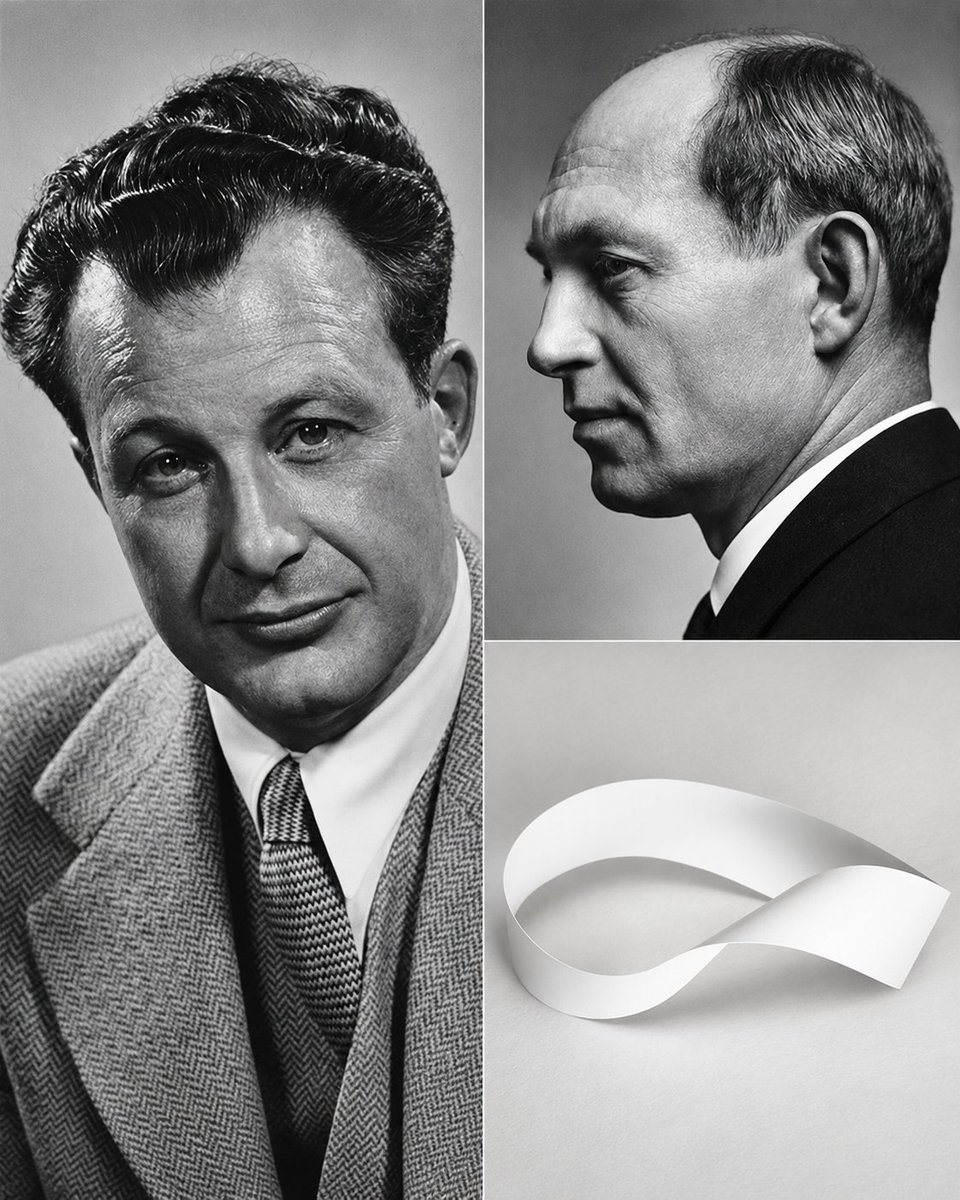
A simple strip of paper helped transform a man who disliked mathematics into the editor of one of the most entertaining mathematical books of the twentieth century.
His name was Clifton Fadiman.
Around the early 1930s, Fadiman was spending a weekend at the country home of poet Mark Van Doren.
Among the guests was his old college friend Scott Buchanan, a philosopher with a deep interest in mathematics. During the afternoon, Buchanan began demonstrating a few mathematical tricks.
One involved a strip of paper. He gave the strip a half-twist and joined its ends. The result was a Möbius strip. Unlike an ordinary paper loop, the surface had only one continuous side and one boundary edge.
Fadiman was astonished.
He had been an indifferent mathematics student in school and had long considered the subject beyond his abilities. But the demonstration showed him something he had never expected.
Mathematics could produce surprising results using nothing more complicated than a strip of paper. His curiosity had been awakened.
He began reading about mathematical ideas, mathematical personalities and the unexpected relationship between mathematics and imagination.
Years later, he started collecting stories, poems, jokes and science fiction involving mathematical ideas. After approximately five years of collecting, the project became a book.
In 1958, Simon & Schuster published Fantasia Mathematica. Fadiman dedicated the book to Scott Buchanan, calling him the mover of minds who had started everything.
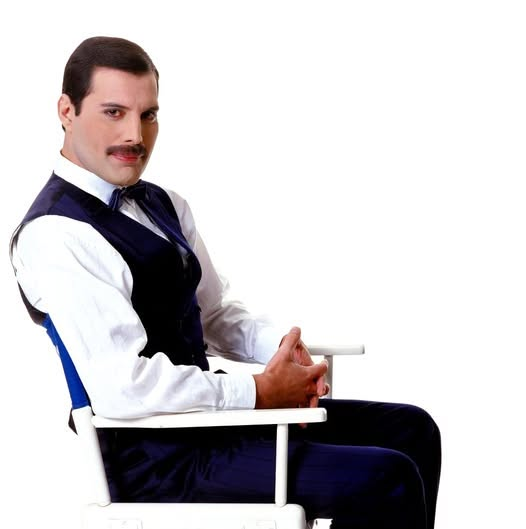
On April 19, 2016, scientists confirmed that Freddie Mercury had one of the most extraordinary voices ever.
A team of researchers from Austria, the Czech Republic and Sweden dedicated their research to the voice of Freddie Mercury.
Dr. Christian Herbst of the University of Vienna, in his article published in the journal Logopedics Phoniatrics Vocology, wrote:
"The emergence of subharmonics helps create the impression of a vocal system pushed to its limits, used with extreme mastery. These characteristics, combined with a fast and irregular vibrato, may have contributed to creating Freddie Mercury's eccentric and theatrical character ."
Scientists discovered that Freddie Mercury's vocal cords moved at a faster speed than others. His vibrato, typically oscillating between 5.4 and 6.9 Hz, reached 7.04 Hz, a frequency so high that it vibrated the throat in a way that not even Pavarotti was able to replicate.
Freddie demonstrated a mastery of subharmonics, a singing style only manageable by Tuvan singers, and did so with disarming ease.
The conclusion was unequivocal: Freddie Mercury possessed a unique voice in the Rock 'n' Roll panorama, making him one of the most singular artists.
#freddiemercury #queen