@MikeDenis411611@WholesomeMeme Just look at the words he uses. “Red cent”. People who post these memes assume billionaires are Scrooge mcduck with a pile of cash. Most times they create valuable IP, jobs, etc - and the world assigns a value to it. Let the builders build.
A 320B model. On your MacBook Pro. 🐳
We just brought GLM-5.3-Flash natively to Apple Silicon — and invented a new quantization method to make it practical:
OrcaSAQ — Orca Sensitivity-Aware Quantization.
→ 2 / 3 / 4 / 6-bit native MLX
→ Calibration-free
→ Architecture-aware
→ 97.76% Top-1 agreement vs FP8 at 6-bit
320B parameters. Near-FP8 fidelity. A fraction of the memory. Your Mac just got a much bigger model.
https://t.co/ZJiPmypBw7
Everyone is still quoting model share off OpenRouter.
Open weights are 49.2% of tokens on our gateway and 25.7% of requests. Both numbers are from the same dataset, the same week.
If you quote share of requests you get one market. Share of tokens you get a different one. Share of spend, a third. Pick the one that matches the decision you are making, and say which one you picked.
NextSlide joining @OpenAI is a decent signal that the labs are accelerating their push into office workflows. After all, slides and spreadsheets kind of rule the corporate world.
Great slides have to do several things at once: get the analysis right, tell a coherent story, keep the numbers consistent and look polished enough to use. None of these is optional in a real workflow.
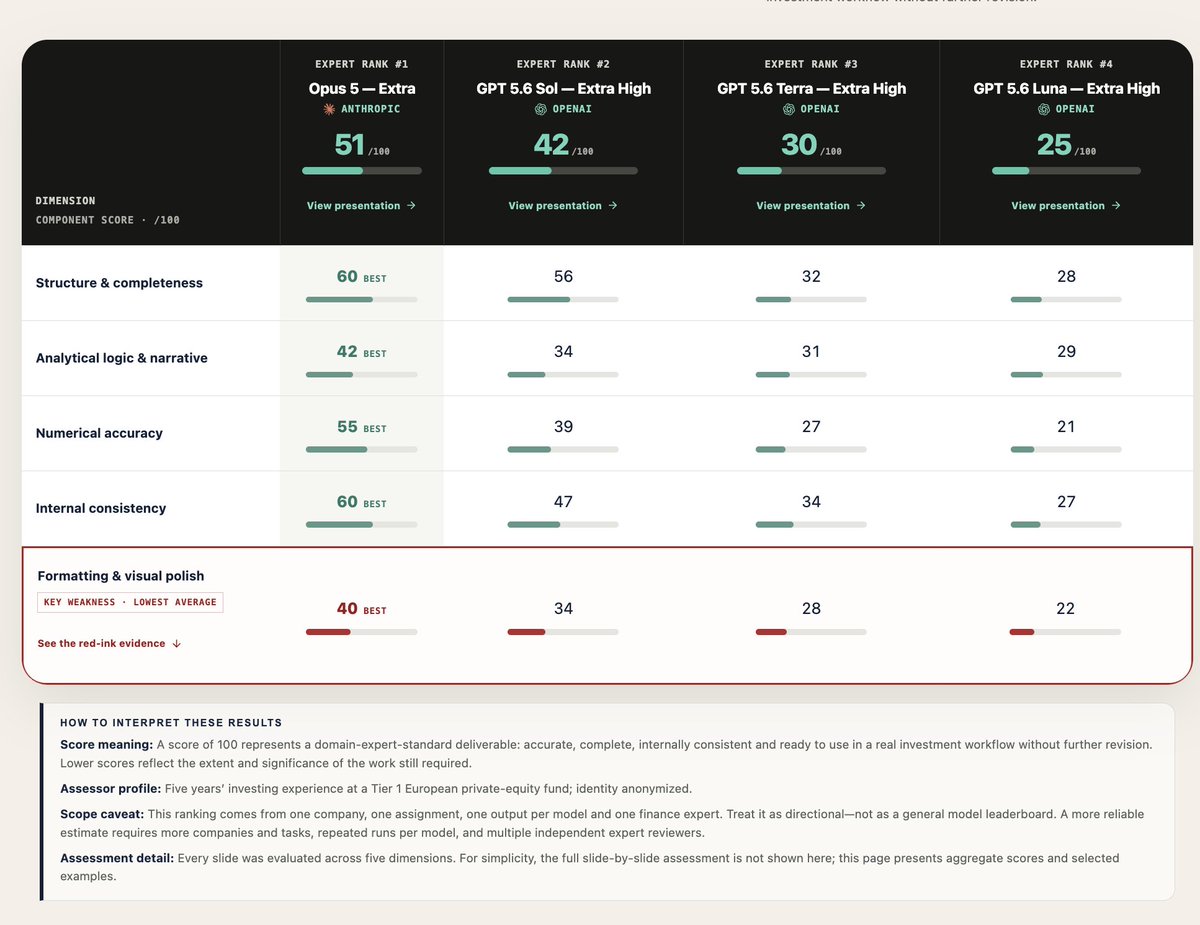
As a fun little experiment, we gave four LLMs the same assignment: build a Private Equity Investment Committee presentation (25+ slides) on a potential take-private of EPAM Systems, a ~$5bn IT-services company.
An expert (ex-PE professional) rated the AI output decks (slide by slide) on various dimensions including: (1) Structure and Completeness, (2) Logic and Narrative, (3) Numerical Accuracy, (4) Internal Consistency, (5) Formatting and Visual Polish.
Those slide-level judgments were aggregated into an overall score for each deck. The results were pretty interesting:
- Opus 5 Extra: 51/100
- GPT-5.6 Sol xHigh: 42/100
- GPT-5.6 Terra xHigh: 30/100
- GPT-5.6 Luna xHigh: 25/100
Formatting and visual polish was the weakest area across the board.
Most of the decks looked impressive at first glance. None was close to something an investment team could use as-is.
My takeaway as a former banker: there is still quite a bit of headroom, but the direction is very promising.
Thinking of scaling this into a public benchmark. Happy to share the full case study - DMs open!
Important point from @DavidSacks from the last All-In on Leopold Aschenbrenner’s fund:
Going from $225M to $45B in AUM does not mean a 200x return. It’s an open-ended fund, so new capital can subscribe at any time.
The fund was up ~450% YTD and is now up ~80%. If most of the capital arrived after the early gains, most investors never earned anything close to 450%.
AUM growth ≠ investment returns.