@jxnlco Definitely using airtable to manage image generation prompts to be sent to my LightningAI studio where I run stable diffusion models and then send image to S3 bucket and back to Airtable. Works perfectly.
Ten months ago, we launched the Vesuvius Challenge to solve the ancient problem of the Herculaneum Papyri, a library of scrolls that were flash-fried by the eruption of Mount Vesuvius in 79 AD.
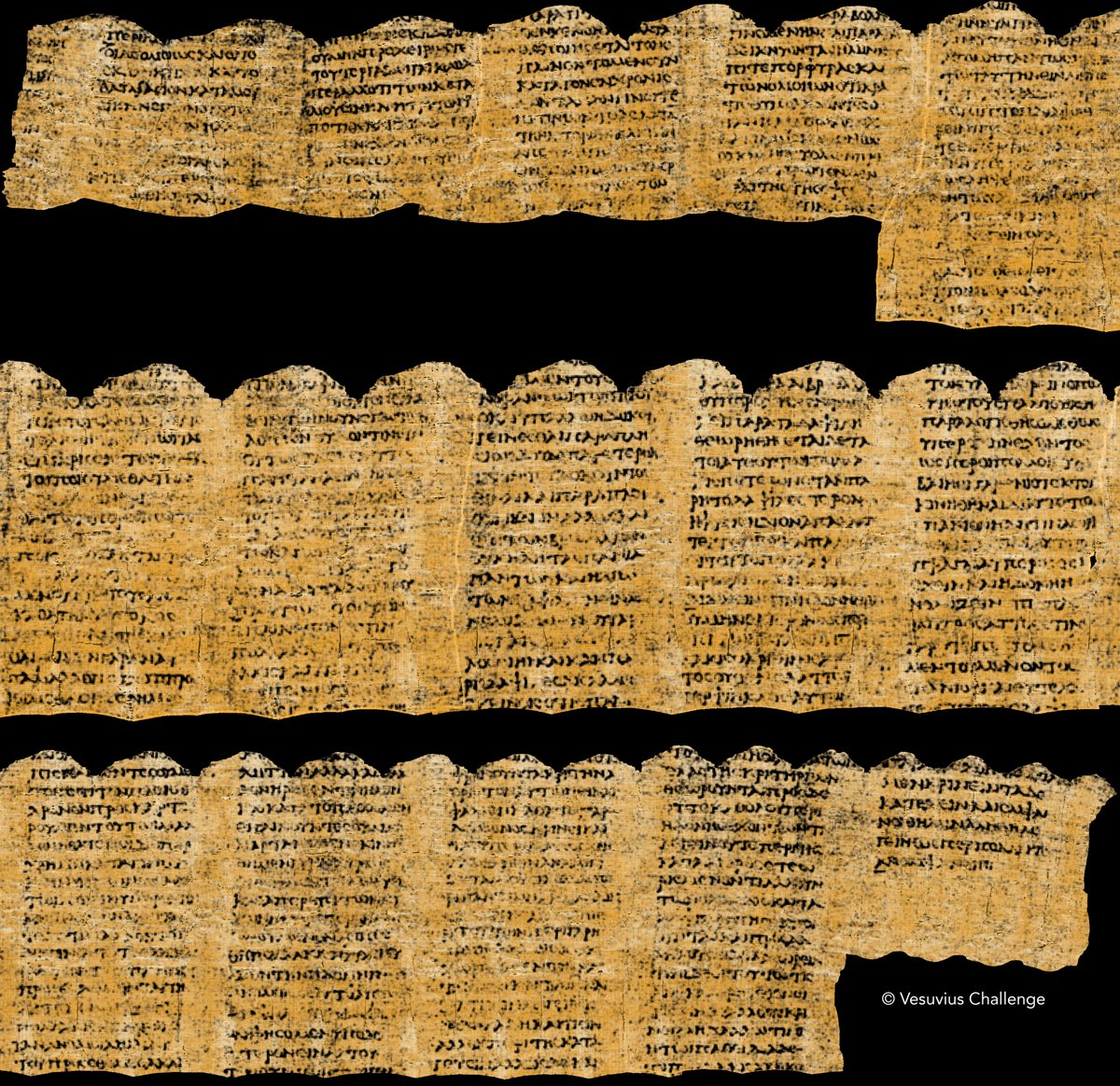
Today we are overjoyed to announce that our crazy project has succeeded. After 2000 years, we can finally read the scrolls:
This image was produced by @Youssef_M_Nader, @LukeFarritor, and @JuliSchillij, who have now won the Vesuvius Challenge Grand Prize of $700,000. Congratulations!!
These fifteen columns come from the very end of the first scroll we have been able to read and contain new text from the ancient world that has never been seen before. The author – probably Epicurean philosopher Philodemus – writes here about music, food, and how to enjoy life's pleasures. In the closing section, he throws shade at unnamed ideological adversaries – perhaps the stoics? – who "have nothing to say about pleasure, either in general or in particular."
This year, the Vesuvius Challenge continues. The text that we revealed so far represents just 5% of one scroll.
In 2024, our goal is to from reading a few passages of text to entire scrolls, and we're announcing a new $100,000 grand prize for the first team that is able to read at least 90% of all four scrolls that we have scanned.
The scrolls stored in Naples that remain to be read represent more than 16 megabytes of ancient text. But the villa where the scrolls were found was only partially excavated, and scholars tell us that there may be thousands more scrolls underground. Our hope is that the success of the Vesuvius Challenge catalyzes the excavation of the villa, that the main library is discovered, and that whatever we find there rewrites history and inspires all of us.
It's been a great joy to work on this strange and amazing project. Thanks to Brent Seales for laying the foundation for this work over so many years, thanks to the friends and Twitter users whose donations powered our effort, and thanks to the many contestants whose contributions have made the Vesuvius Challenge successful!
Read more in our announcement: https://t.co/rUlrdGXBMs
🦍Introducing the all-new gorilla-cli, now available as a pip package!✍️ With a vast collection of ~1500 🆕APIs, including 👀 Kubernetes, AWS, GCP, Azure, GitHub, Conda, Curl, Sed, and more🤩 simply state your goal, and let Gorilla CLI generate the commands for execution. Commands are executed only with your explicit approval!
Get started with a simple pip install gorilla-cli
Just gave GPT-4 access to use Chrome however it wants (click, scroll, fill forms) thru @langchain Auto-GPT agent. The results were mind-blowing!
Here's what it did: 👇
🎧Bought me an AirPod
🎉Helped me find an event venue and filled out the contact form
🍽️Booked restaurants
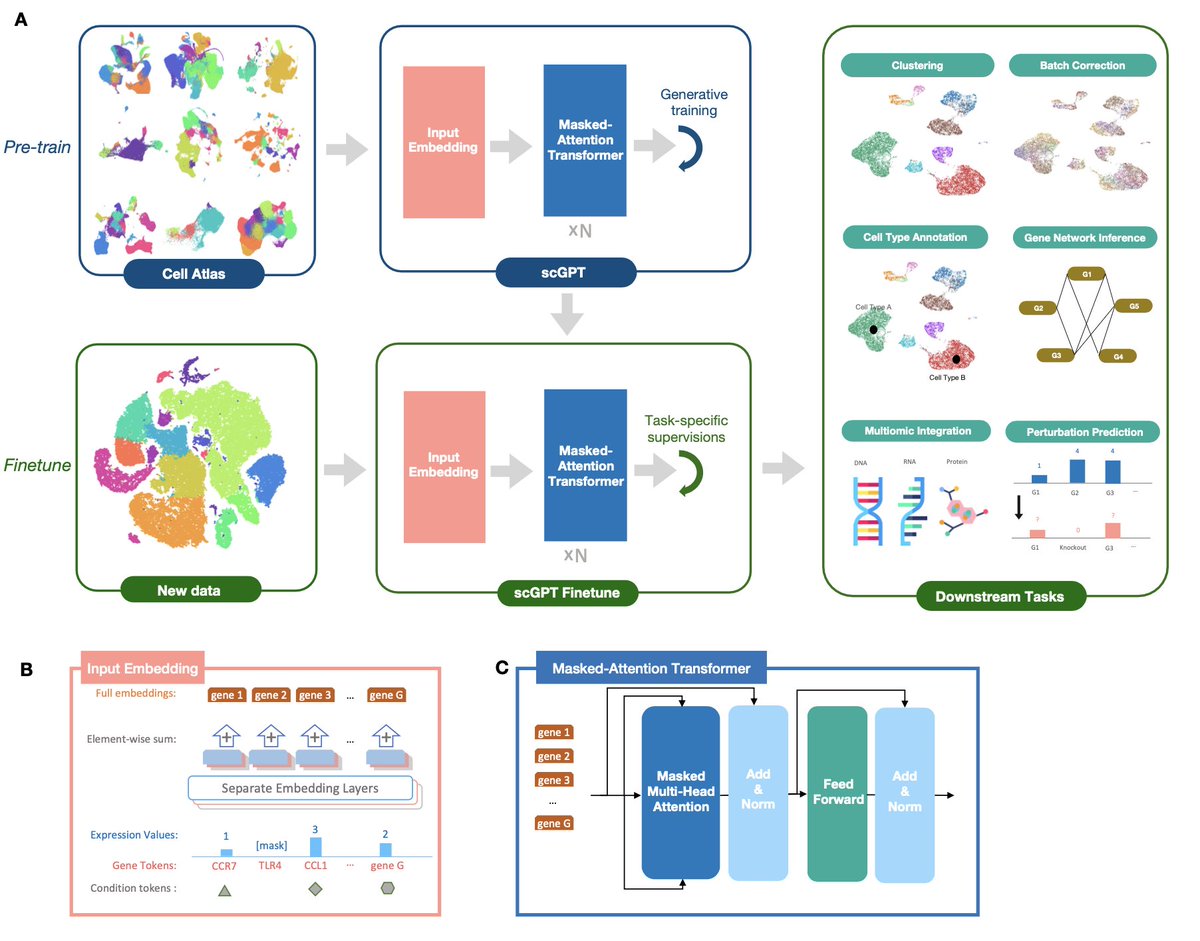
New preprint on scGPT: first foundation large language model for single cell biology, pretrained on 10 million cells.
Just as text is made of words, cells are characterized by genes
Some thoughts on how cool this is & why it challenges the status quo of single cell analysis🧵🧵
People are building weird & interesting stuff on top of AI.
For better or worse, there are now multiple tools that give GPT a goal & allow it to learn and try to accomplish that goal on its own. You can try a limited, easy-to-use web version of that here: https://t.co/xgPwz95SHd
Enough with LLMs - exciting things are happening in the world of atoms.
This is Stanford ALOHA, a low-cost and agile robot platform. The whole system is open-source (!!): hardware design, CAD models for 3D printing, simulator, and training code. Time to graft a physical arm onto GPTs 🦾
Led by my friend @tonyzzhao at Stanford, and advised by @chelseabfinn@svlevine@Vikashplus.
Project page: https://t.co/8iXpiHVEjS
If you don't want to 3D print your own components, you can buy the setup at https://t.co/ur0BCgyCZN
Copilot and Ghostwriter are 2 examples of successful LLM integration in your IDE for better productivity.
But I haven’t seen anything yet that takes advantage of notebooks. The step-by-step/cells format seems like the perfect environment for LLMs to recommend the right thing at the right time. Some ideas:
-Auto-create cells with visualizations or tests based on the last executed cell
-Prompt users for the right next steps (« you just trained your model, nice. Now let’s test it with the below code »)
Etc.
@jeremyphoward you’re the notebook master, have you heard about any breakthroughs there?
@AutumnalBaby 🔊 Give it a listen and see what you think! Here's video of an earlier flight, with sound captured by one of my two microphones: https://t.co/wqOuX8Ip4l