I was wrong. Gold still crashing!
Thats real life.
RD Lesson: Profuts are made when you buy…. Not when you sell.
I still believe gold will be $35 k in about 5-years.
But that is real life: All markets go up and down.
Another RD lesson: The richest investors invest for the future. Not today.
Take care. Trust you learned from my mistakes.
People who do not make mistakes learn nothing.
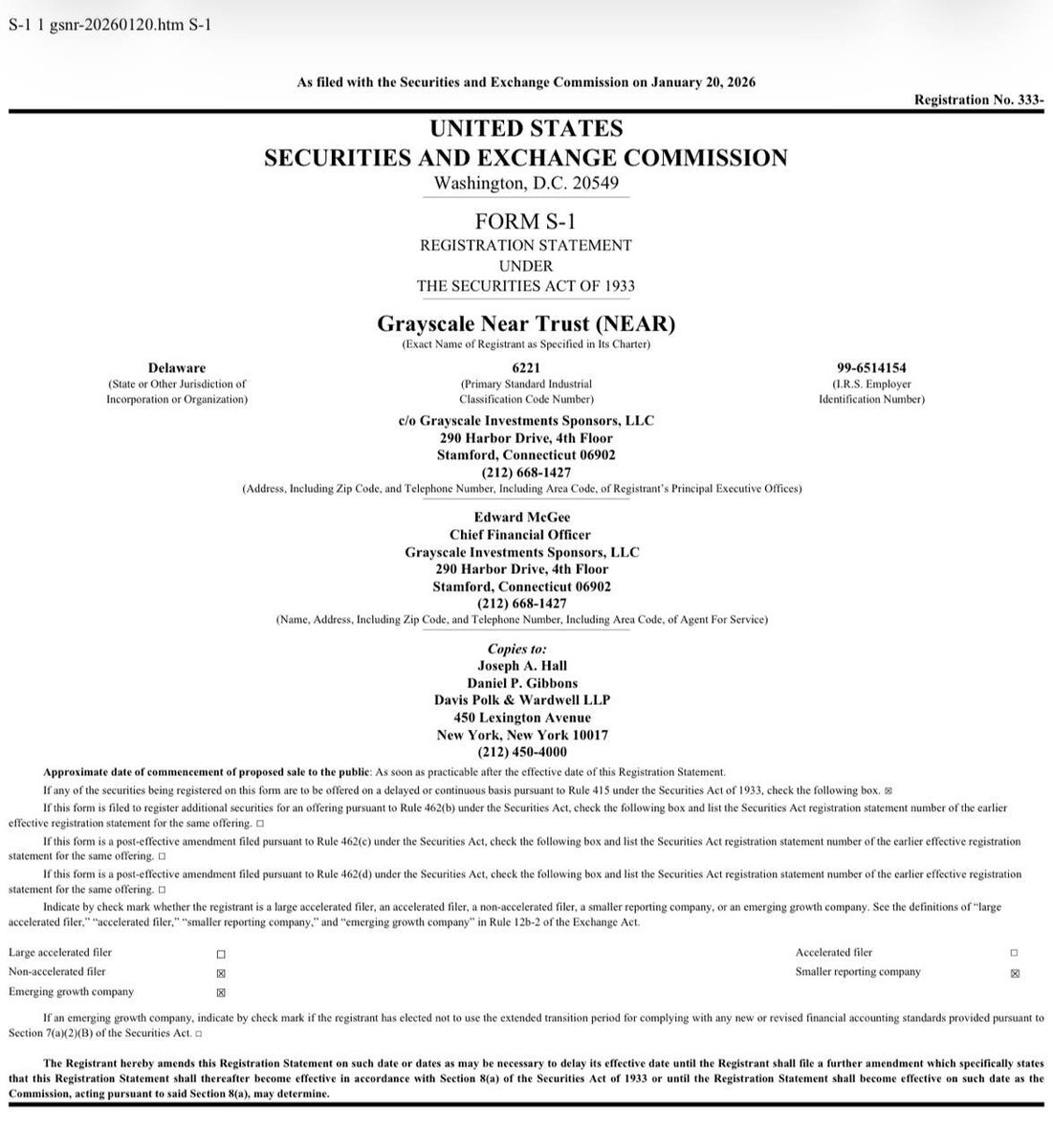
an article on $NEAR and why I think this might be one of the most underpriced setups in the market
agents are already primary consumers of the internet — they read it, parse it, and act on it faster and more often than humans now. the next domino is finance. when agents start holding value, paying for compute, subscribing to APIs, settling between each other, and routing capital across services autonomously, they will not be doing it on Visa, Stripe, or any rail designed for a human pressing confirm
they need programmable money, sub-second settlement, one identity across every chain, privacy for their strategies, and a runtime that can be cryptographically verified. that infrastructure doesn't exist on Ethereum. it doesn't exist on Solana. NEAR has quietly shipped every piece of it — chain signatures, intents, confidential execution, IronClaw, NEAR AI Cloud — and is run by one of the eight people who co-authored the paper that made modern AI possible
$NEAR is extremely undervalued.
The entire supply is circulating, and all their mechanics are build in favor of the community actively using the token.
Nobody is interested into AI <> #Crypto protocols.
And that's where the real alpha is.
The current valuation of $NEAR is $1.7B.
Arguably, that could be a lot, however I'd want to make sure to understand the thesis behind this one.
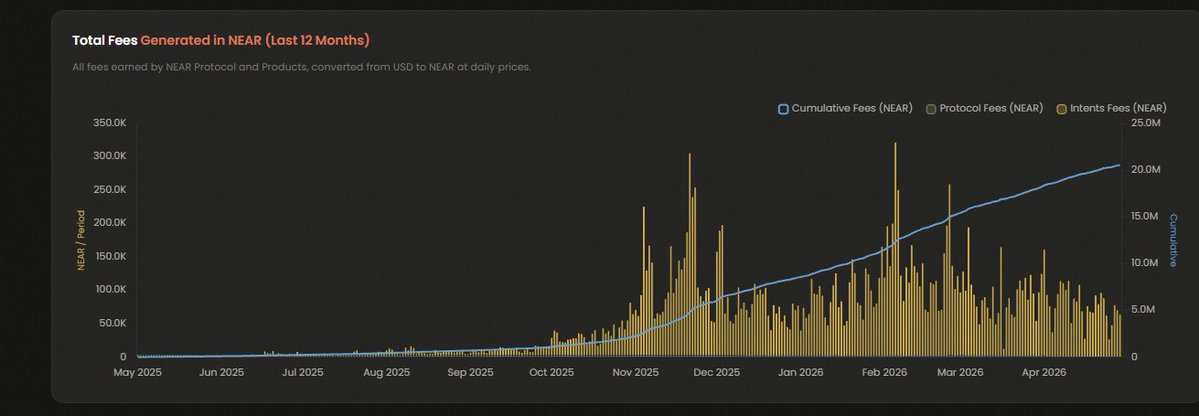
The revenue for 2026, in the first four months: 12 million $NEAR tokens.
That's: $15.6 million in 4 months (equals $40-60 million over the entire year 2026).
Before 2026, a total revenue of $10 million.
If that's solely for 2025, then it's projected to provide a CAGR of 300-500%, even during the hardest bear market conditions possible.
Let's model this further.
2025: $10 million
2026: $50 million (400%)
2027: $150 million (200%)
2028: $300 million (100%)
2029: $450 million (50%)
2030: $585 million (30%)
The projection would be that it achieves $500-600 million revenue in 2030.
To be putting this in context, the current Price-to-Sales Ratio of $NEAR is 34x.
Solana's: 40x
Ethereum: 200x
Average valuations for Web 2 companies would be between 15-30x P/S. For instance, OpenAI and Anthropic are currently trading at significantly higher numbers than that with significantly less revenue.
If this expansion continues for $NEAR, it makes sense that it will be trading at a higher valuation in the coming years, and is actually dirt cheap at this point.
The markets are undervaluing many crypto projects, and even if the current P/S ratio sustains for the coming years, $NEAR could provide an investment thesis and return of 10-15X in the coming four years.
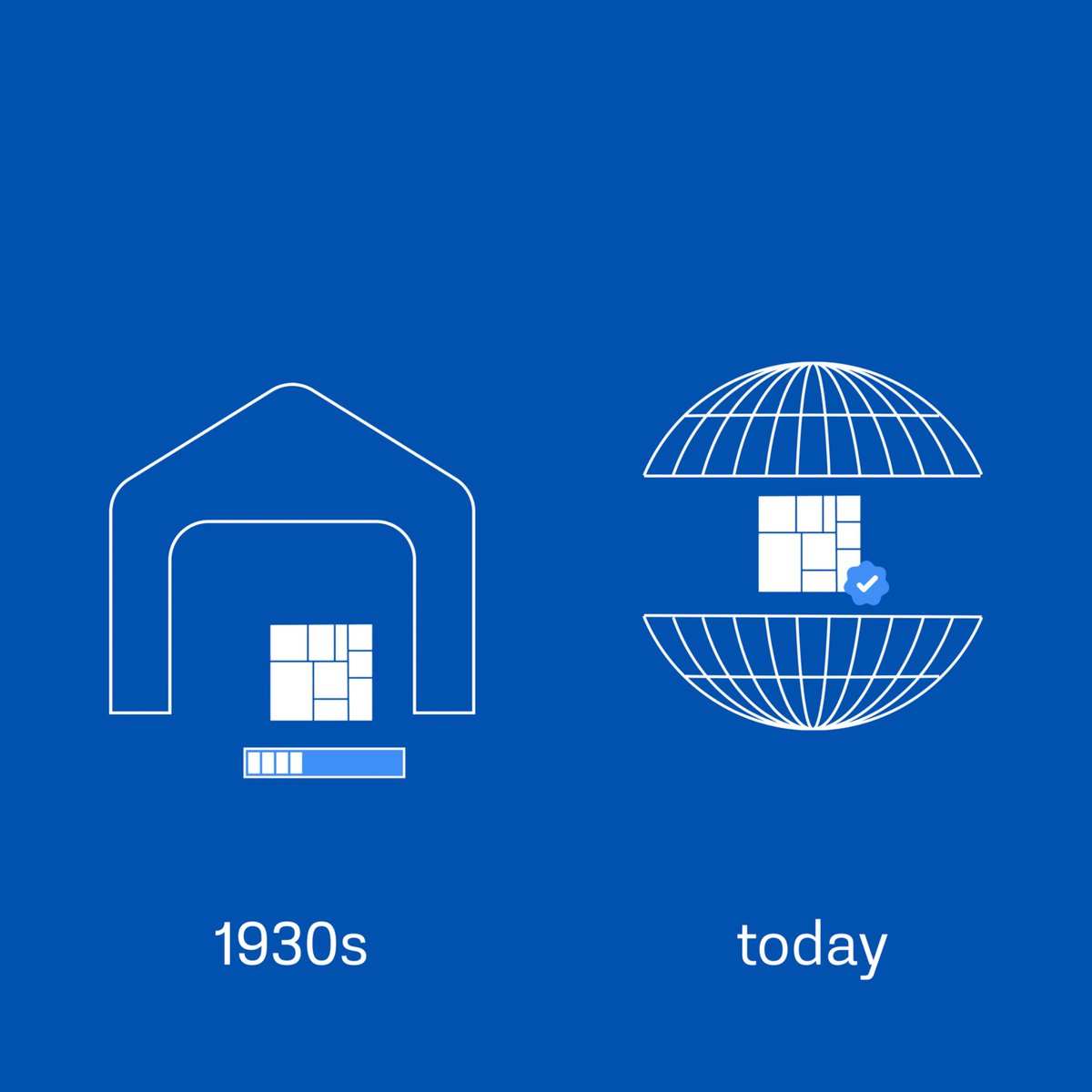
The core idea behind Reserve is almost 100 years old.
It failed back then for one reason: you needed a physical warehouse.
A digital warehouse is built different.
🗣️ Lawrence H. White at Monetarium 2:
“Going back to the late 19th century, people were worried about instability in the purchasing power of gold under a gold standard.
Even though the long term trend was good, there were short periods of volatility.
An economist named Alfred Marshall said, if the relative price of gold is changing as a result of supply discoveries or demand shocks – and in his day the biggest demand shock was Germany decides to leave the silver standard and join the gold standard – we can diminish the impact of that on the purchasing power of gold by redefining our monetary unit.
The pound would not be defined just in terms of gold, but so much gold plus so much silver. (…)
So you've got two metals defining your unit of account.
That’s a kind of gateway into having a whole bundle of commodities define the unit of account.”
“A commodity reserve currency is an idea that became popular in the Great Depression, but was kind of rediscovered when the problem was not collapsing demand, but rather the need for a way to get the money supply to grow.
That's what the original idea of the commodity reserve currency was.
But the reverse problem of excessive inflation – and so linking the dollar or whatever the unit of account is called to a basket of commodities – would be a way of preventing excessive inflation.
Our friend Hayek from 30 years before denationalization of money saw some merits in this kind of proposal.
It had the benefits of a gold standard in taking the regulation of the quantity of money out of the hands of a committee of central bankers.
It is, in a sense, putting it into the market because anybody could bring commodities to the warehouse and get money. Anybody could bring money to the warehouse and get commodities.
But the proposals in the 30s and 40s were for physical warehouses filled with physical commodities.”
“We don’t need to do that today. We could accomplish pretty much the same thing with a portfolio of tokenized commodities.”
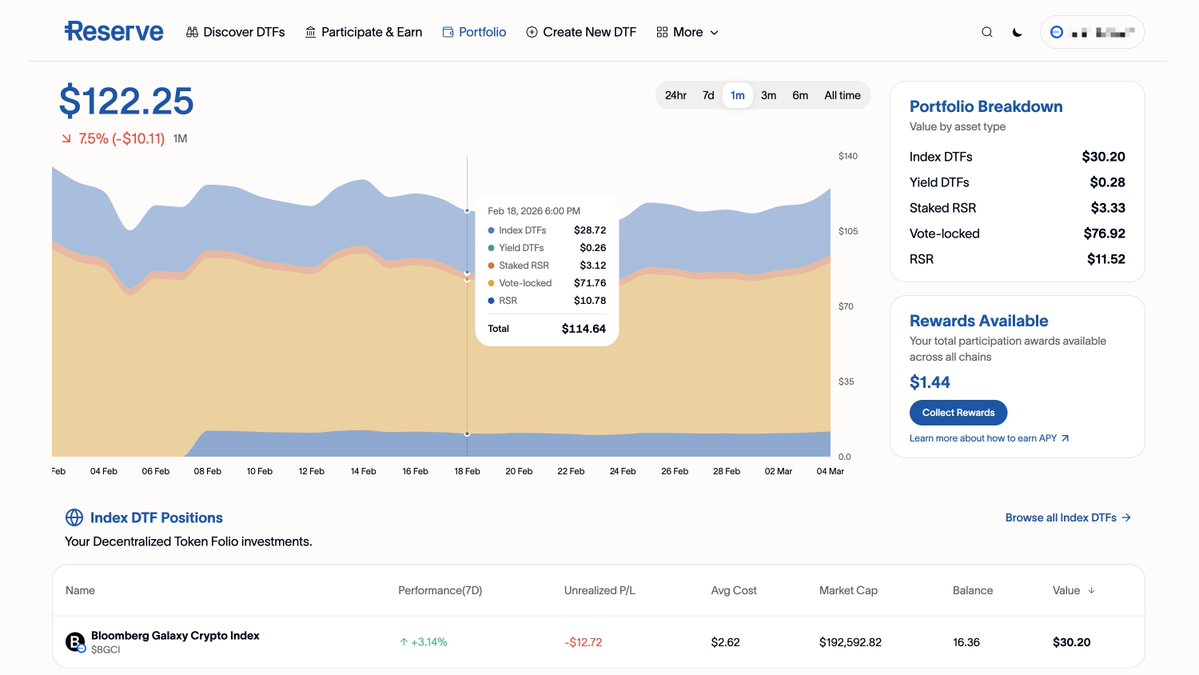
The long-awaited Portfolio view is here! 💼
A dedicated page on the Reserve app with a comprehensive overview of your DTF + RSR positions, rewards, active governance, and transaction history
Check it out and let us know what you think! → https://t.co/buxp6rSC2e
NEW FROM NEARCON
NEAR Protocol Co-founder @ilblackdragon just unveiled https://t.co/YBUSFVdRnc on stage: a super-app on crypto rails, powered by NEAR Intents. Now live.
Swap across 35+ chains. Go confidential. Trade P2P. All from a single account.
Your onchain world, unified.