Food for thought!
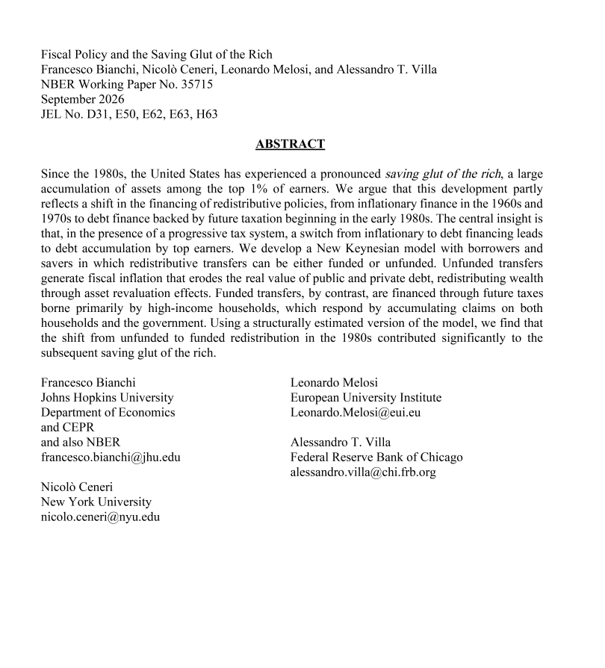
"Fiscal Policy and the Saving Glut of the Rich" by Francesco Bianchi, Nicolò Ceneri, Leonardo Melosi, and Alessandro T. Villa.
"Since the 1980s, the United States has experienced a pronounced saving glut of the rich, a large accumulation of assets among the top 1% of earners. We argue that this development partly reflects a shift in the financing of redistributive policies, from inflationary finance in the 1960s and 1970s to debt finance backed by future taxation beginning in the early 1980s. The central insight is that, in the presence of a progressive tax system, a switch from inflationary to debt financing leads to debt accumulation by top earners. We develop a New Keynesian model with borrowers and savers in which redistributive transfers can be either funded or unfunded. Unfunded transfers generate fiscal inflation that erodes the real value of public and private debt, redistributing wealth through asset revaluation effects. Funded transfers, by contrast, are financed through future taxes borne primarily by high-income households, which respond by accumulating claims on both households and the government. Using a structurally estimated version of the model, we find that the shift from unfunded to funded redistribution in the 1980s contributed significantly to the subsequent saving glut of the rich."
https://t.co/0rr5Ap18tt
Predocs! Philipp Schnabl @schnabl_econ and I are once again hiring a full-time RA. Come work with us on banking and macro finance. We'll review applications on a rolling basis.
@econ_ra#EconTwitter
🚨🚨🚨 Job Alert 🚨🚨🚨
@MartelliniPaolo and I are hiring a pre-doctoral research fellow in macroeconomics based at @NYUSternEcon.
Motivated individuals with strong quantitative & computational skills are welcome to apply ASAP.
Link: https://t.co/Q2TwjufgTr
Please circulate!
Algunas aclaraciones sobre dolarización y default a propósito de la nota de @mkanen en Infobae.
Con @andyneumeyer escribimos un modelo para entender la dolarización en economías emergentes. La dolarización es cara porque requiere comprar los pesos en circulación.
Apply to this Research Assistant position by June 30, 2024, to work with me on a cool project exploring heterogeneous consumption decisions and their impact on asset prices. More information in comments below.
We’re looking for a bright research assistant to work with us on these topics. We’re doing both empirical and structural work so apply if you want to learn about various research methodologies, including computational ones.
My past pre-docs all placed into top PhD programs.
Deadline for applying to work as a pre-doc at @CFMUK is on Thursday Feb 29.
Join a small team that works with @ilzetzki, @ben_moll, @JADHazell, @mdoepke, and I on macro, international, and finance topics. Link: https://t.co/g62ejQfdt0
🚨 Busqueda de RA 🚨
Amigo economista busca RA full-time para varios proyectos (uno conmigo).
- Master en Economia
- Experiencia en microeconometria, español e ingles
- 6 meses remoto (potencial +6 en UK)
- 1k pounds/mes aprox
CV en ingles aca:
[email protected]
The Centre for Macroeconomics at LSE is hiring predocs!
Come and work in the best city in the world with me, @liliana_vvarela, @ilzetzki@R2Rsquared and @ben_moll.
We work on macro, international economics, finance and more!
Link:
https://t.co/3fPMd5jHuG
🚨We are hiring two postdocs for AY 24-25 at the Pricing Lab at @HarvardHBS. The position is open to those with and without AP offers.
You can work with industry data alongside @albertocavallo (macro side of the lab) and myself. Link for microeconomics: https://t.co/cQZEbm7MFA
Thinking about a "pre-doc" next year? How about living in NYC?
Come to @NYUSternEcon and work with me @giulia_bran@MJ_Dickstein and @ptscott.
We are a lively group of IO economists and can promise you lots of one on one time. @econ_ra#predoc
https://t.co/RL201GvBMh
Estamos buscando una/un economista para nuestro equipo de investigación de @AgendaCAF en Buenos Aires. Aplicaciones tanto de recientes como de más experimentados PhDs in Economics son bienvenidas. Por favor, envíe su aplicación antes del 7 de enero:
https://t.co/aJRQaC3uWD
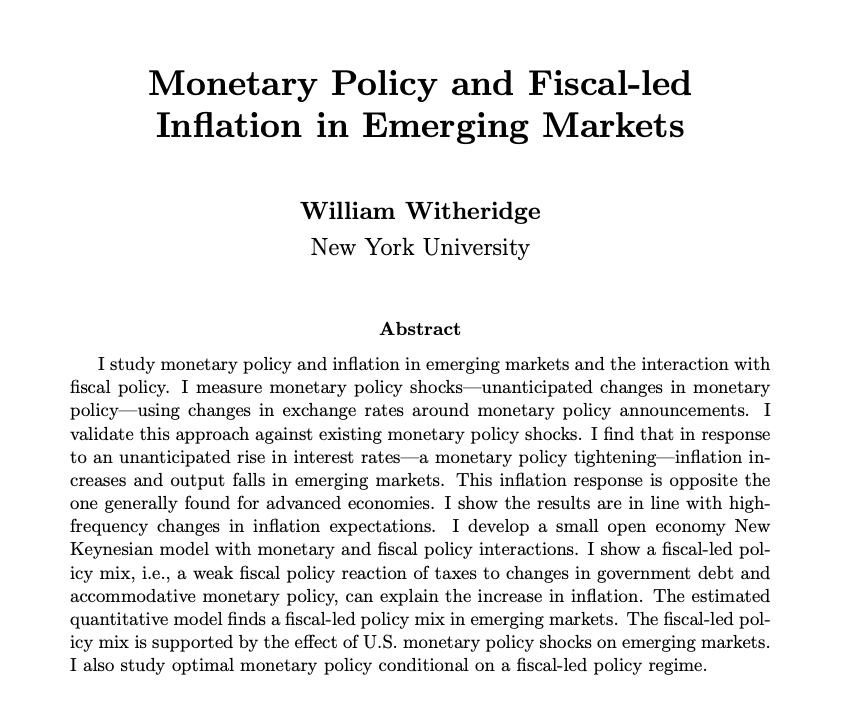
How does monetary policy affect inflation in emerging economies?
In my JMP, I find an increase in interest rates:
→ inflation increases in emerging markets, opposite to advanced economies
Why? The interaction with fiscal policy
#EconTwitter#Econjobmarket
Hi, #EconTwitter!
I am very excited to announce that I am on the Job Market this year.
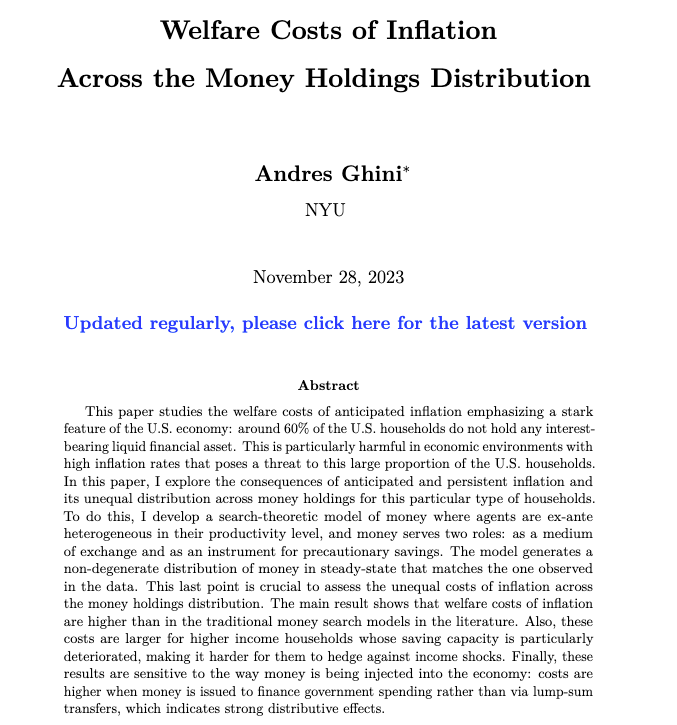
In my JMP, I study the welfare costs of anticipated inflation, not only at the aggregate level, but also across the money holdings distribution.
🧵1/
Do workers gain from economic shocks to firms? Does collective bargaining affect the extent to which they do?
Excited to share my job market paper, "Collective Bargaining Networks, Rent-sharing, and the Propagation of Shocks."
https://t.co/pXcgtmxPSL
Argentina just elected right-wing libertarian Javier Milei as its new president, who promised to lift the country out of its economic hardship.
With astronomical inflation and poverty rates, how did Argentina get to such a bad place economically? @ColumbiaSIPA prof and IGP Affiliated Faculty Member @fercirelli explains:
@ILASColumbia
I am on the academic job market this year!
In my JMP, I study how large capital inflow episodes affect aggregate output, aggregate productivity, and resource allocation across firms.
Thread on the paper coming soon, but the draft can be found here: https://t.co/3WGDigSGGX
Hello! Today I'm writing in my role as the faculty director of the PhD program in Economics at @NYUSternEcon, introducing our fantastic students on the econ job market, in alphabetical order: