Hi, #EconTwitter!
I am very excited to announce that I am on the Job Market this year.
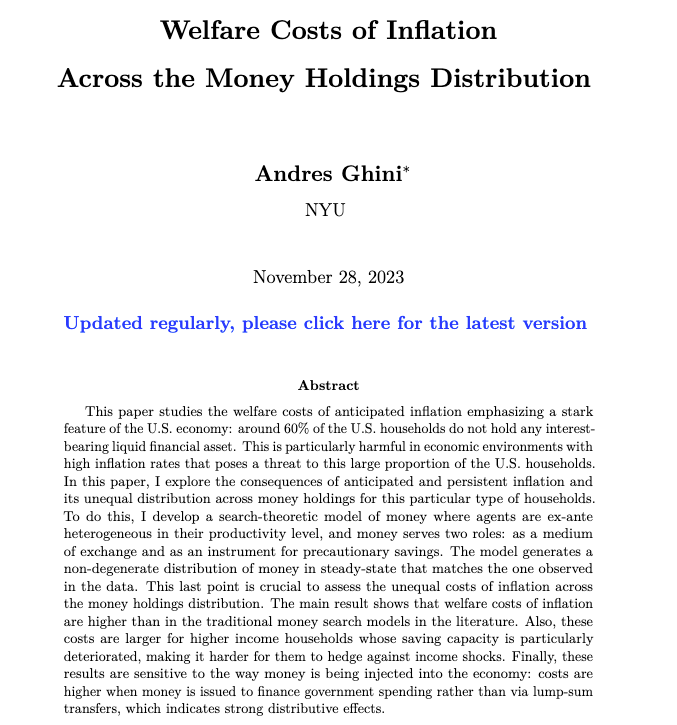
In my JMP, I study the welfare costs of anticipated inflation, not only at the aggregate level, but also across the money holdings distribution.
🧵1/
Andres Ghini (@andresghini92) is a macroeconomist specialized in monetary economics and fiscal-monetary policy. He studies how the welfare costs of inflation vary across households. Learn more at https://t.co/p5nenLtbk6.
More interesting insights in the paper:
➡️ Differences in the consumption-saving distortion across money distribution
➡️ Inflation-Output relationship
➡️ Implications for policy
Thanks for reading! #EconTwitter
Website: https://t.co/qIHmb4gl7P
Hi, #EconTwitter!
I am very excited to announce that I am on the Job Market this year.
In my JMP, I study the welfare costs of anticipated inflation, not only at the aggregate level, but also across the money holdings distribution.
🧵1/
🔴 What is driving these results?
➡️ Inflation acts as a tax on money holdings, constantly reducing its real value. The implied
reduction on savings impede these households to hedge against income shocks, making them
more vulnerable to higher consumption fluctuations.
🧵12/
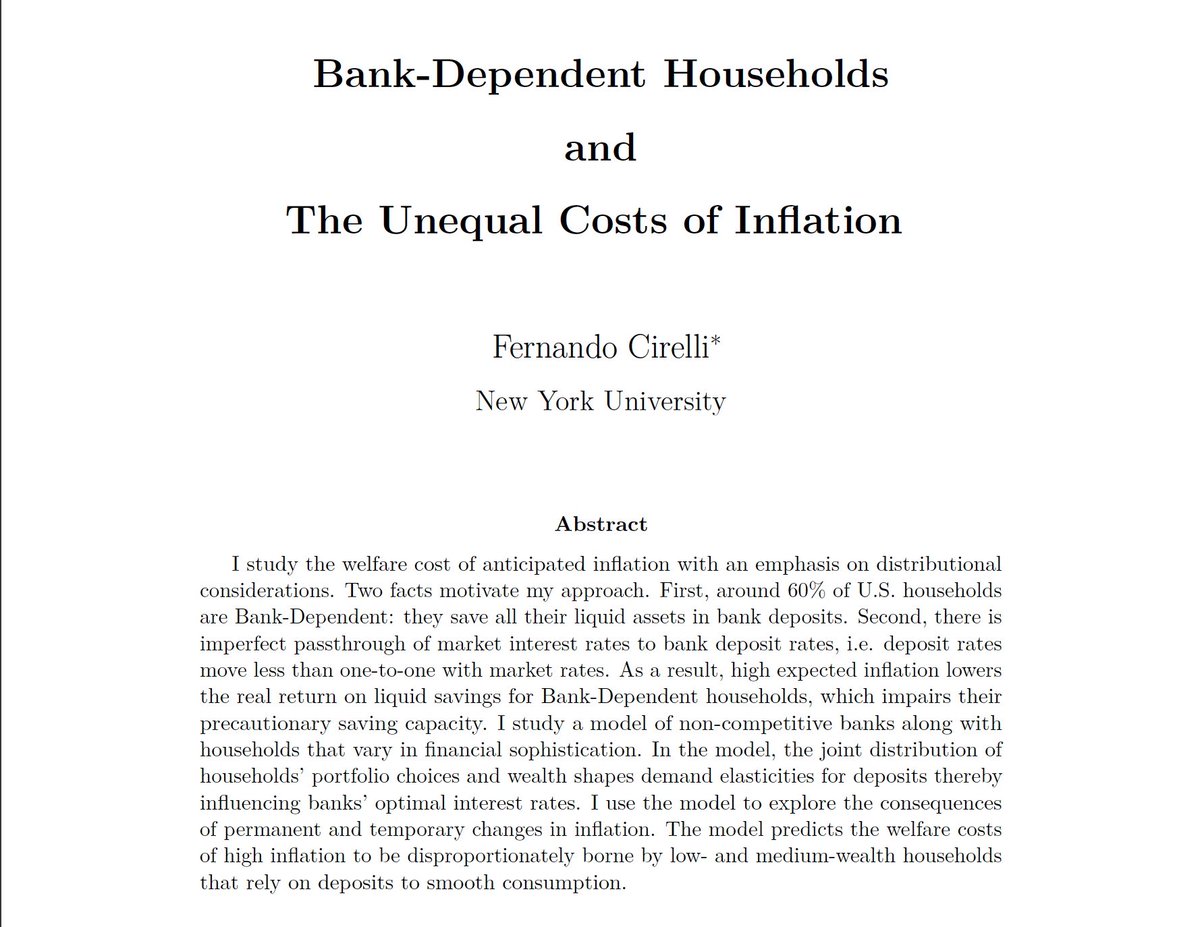
What makes inflation costly? Who bears these costs?
In my JMP, I explore an understudied mechanism:
Inflation impairs households’ ability to save for precautionary reasons
How? Let’s take a look at households’ liquid assets portfolios
#EconTwitter#Econjobmarket