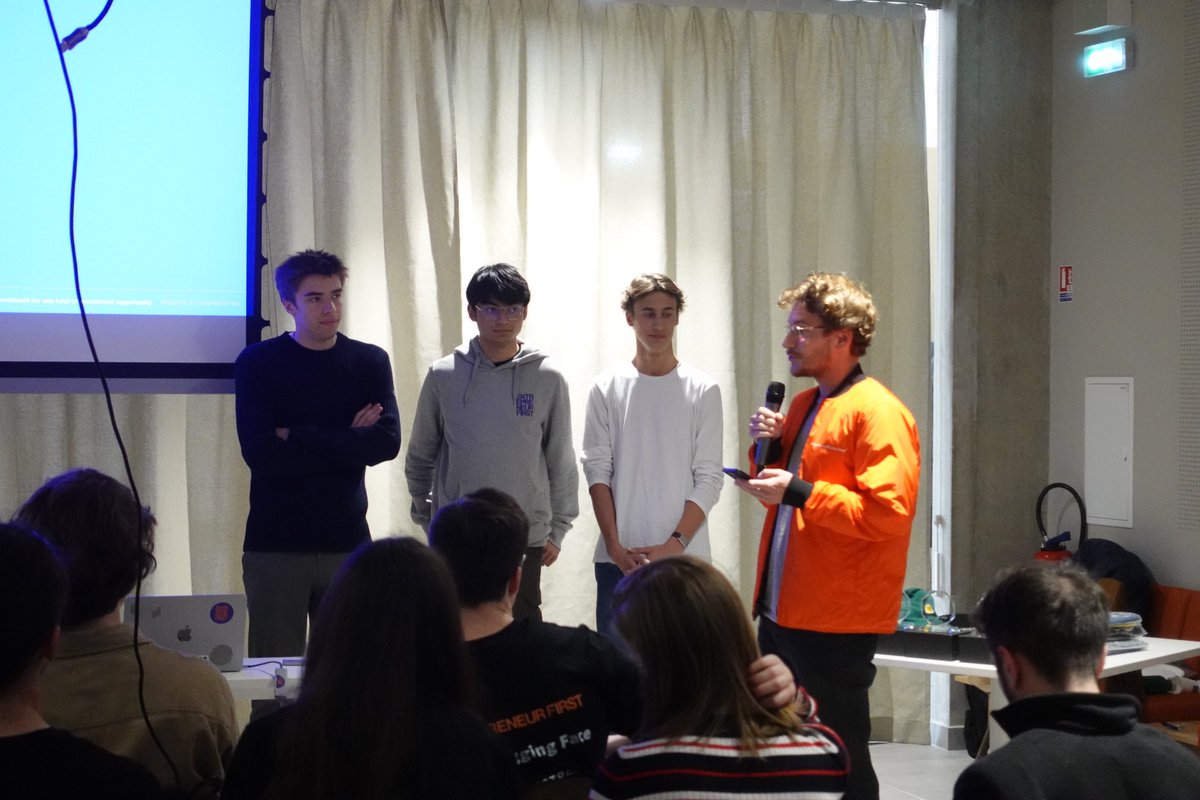
Thrilled with our third-place finish at the LLM Hack Hackathon! Over the last 48h, we created a POC using @zama that we will be open-sourcing soon. Big thanks to my team @hugolb05 @bonsainoodle, the sponsors @join_ef, @MistralAI, @huggingface, for enabling this! #LLMHackParis
An internal version of Astra, @OpenAI’s next major model family, solved 10 major open problems in mathematics, quantum complexity, and theoretical computer science.
We believe it will be a major step for scientific reasoning. https://t.co/iP6cyheZ7i
i think we finally have enough clues to reverse-engineer ilya sutskever’s secret SSI research.
my highest-probability guess: SSI has found a brain-inspired way to make an AI continually learn.
today’s frontier models learn mostly during training. afterward, their core knowledge is largely frozen. they consume enormous datasets and still fail strangely when a problem falls outside their training.
SSI may have an early system that can:
• learn a new skill from very few experiences
• recognize when an approach is failing before reaching the final answer
• update itself without erasing old skills
• transfer one lesson into completely different problems
• keep learning after deployment
think of it like a gifted teenager instead of a finished encyclopedia. it may not begin knowing every profession, but it could rapidly learn any profession.
the evidence lines up almost too cleanly:
ilya called poor generalization the fundamental limitation of current AI. models “generalize dramatically worse than people.”
he described SSI’s target as a “superintelligent 15-year-old” capable of learning any job.
when asked how to create human-like learning, he said there is a machine-learning principle he has opinions about but cannot discuss publicly.
WSJ now reports that SSI’s secret research focuses on “overlooked aspects of how the human brain functions.”
Nvidia received rare access to the research, made a substantial investment, gave SSI 10x more compute, and agreed to let SSI help shape future computing platforms.
my technical guess:
experience → internal judgment → self-correction → durable learning → transfer → repeat
the internal judgment may be the brain-inspired component.
humans do not wait until the end of a 10,000-step task to know they are failing. emotions, intuition and judgment provide constant feedback. ilya has argued that AI needs an equivalent internal “value function.”
this could also explain SSI’s central promise: capability and safety trained together.
the same mechanism that teaches the AI what works may also teach it what it should care about.
my confidence is roughly 70% on human-like generalization plus continual learning, and 40% that an internal value system is the central mechanism.
the simplest description:
an AI whose intelligence compounds from experience, with its values learning inside the same loop.
Sequoia's thesis: the next $1T company sells work🏗️, not software
Sell a copilot and you compete with every model release. Sell the outcome, books closed, contracts reviewed, claims handled, and every AI improvement widens your margin instead of threatening your product.
The insight most people miss: for every $1 spent on software, roughly $6 goes to services.
SaaS chased the software dollar. AI chases the services dollar at software margins.
Not AI for accountants. The AI accounting firm. Not AI for lawyers. The AI law firm
The winners will look like services firms rebuilt on software infrastructure, and most founders are still building copilots.
Which dollar are you chasing?
"How you do one thing is how you do everything."
The expensive version: the standard has to survive delegation. You can write it down, but you can't install it, you can only hire people who already have it.
Hermine (my sister) is hiring across engineering and GTM at ClarityCare.
The first experimental evidence of recursive self-improvement (RSI).
Autoresearching the autoresearch agent for eight days.
The result beats the harness we hand-tuned for two years, on held-out benchmarks: 🧵(1/7)
What if we could cancel out urban noise pollution?
Place a set of speakers that act like noise-cancelling airpods for all pedestrians simultaneously
You can actually do this - and it paves the way for an "acoustics foundation model"
Simulation code + proposal 👇