Our (@spozdn & @MicheleCeriotti) recent work on testing the impacts of using approximate, rather than exact, rotational invariance in a machine-learning interatomic potential of water has been published by @MLSTjournal! We find that, for bulk water, approximate invariance is ok..
Couldn't have asked for better timing #NobelPrize
Our new work on 'Molecular Simulations with a Pretrained Neural Network and Universal Pairwise Force Fields' is now out on @ChemRxiv!
#MachineLearning#compchem
(Big) life update 😊:
With @vict0rsch & @m_galtier, we are co-founding @Entalpic_ai, an AI startup for chemistry and materials discovery. Our mission is to develop science and its applications for a fair and ecological transition.
In stealth but hiring
https://t.co/idCEredN8B
I am happy to announce that the Temperature Dependent Effective Potentials (TDEP) code is officially released and published in JOSS! 🎉
TDEP is a code for advanced phonon simulations in materials with a focus on anharmonic properties. More details below:
https://t.co/HBbrp5i3HN
✨ Out in JCP today: https://t.co/mPDbhx2zaV! Everything you ever needed to know about using AD to compute forces, stress, and heat flux. Everything is implemented in the glp library at https://t.co/JqtIl7HngX.
Data and code specific to the paper at https://t.co/W13VCIc7UM!
❓Struggling to capture non-local effects using message passing? We present Matrix Function Networks, a new architecture that captures non-local effects in a structured and topology aware manner.
https://t.co/9VYEHTNN05 🧵👇(1/10)
Excited to share our latest work at the intersection of machine learning and computational chemistry; Path Integral Stochastic Optimal Control for Sampling Transition Paths between molecular conformations. With @YuanqiD*, @priyankjaini, Ferry Hooft, @BerndEnsing and @wellingmax
🔊💾
Interested in learning @JuliaLanguage for #MachineLearning?
Our PhD student @adr_hill created a beautiful course and all material is available online.
Lectures and homework are interactive using @PlutoJL, giving you instant feedback while working on it.
#JuliaLang
Check out this new work w/ @marceldotsci and @flokno_phys which tells you all you need to know about implementing stress and heat flux for machine learning potentials with AD.
Featuring implementations in JAX that allow calculating thermal conductivities in <1d 🚀🔥
🚀 New work: "Stress and heat flux via automatic differentiation" w/ @frankthorben and @flokno_phys. We give an overview of using AD for stress and heat flux, and provide an implementation in JAX. See https://t.co/A1omuOgLUV; code at https://t.co/JqtIl7HngX. 🧵⤵️
New Preprint: @marceldotsci and me joined expertises to enable thermal transport simulations with semi-local machine-learning potentials that use message passing, where one has to be careful with the definition of the heat flux. Check out!
https://t.co/VOdGUat0Ou
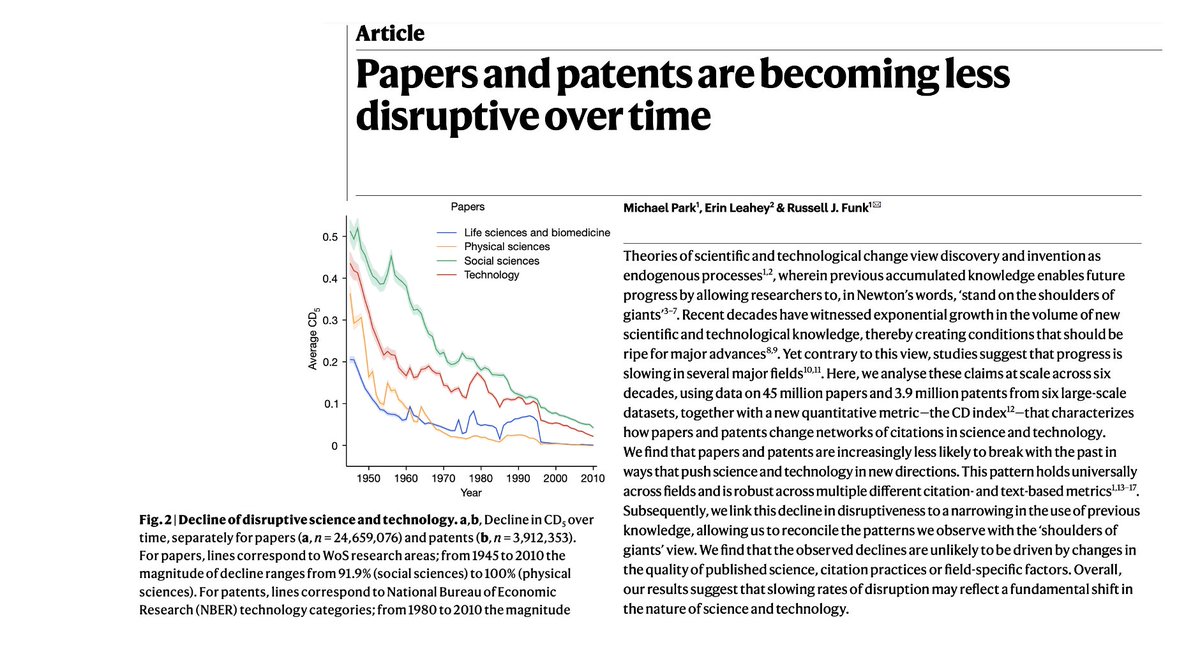
New Nature paper provides evidence that science has become less innovative since the 1950s. The authors suggest reversing the trend by:
1. reading widely,
2. focusing less on quantity of papers, & more on research quality,
3. taking year-long sabbaticals.
https://t.co/oYV5JCXRl8
I believe @AI_for_Science is a true test of #AI capabilities. While generating realistic text or images can be fun to play with, more controlled tests of #AI is easier with scientific domains where we have more concrete metrics and objectives to measure
OK, this website still seems to be working…so…time to share our latest preprint!
Very pleased to be able to share this one: is attention all you need to solve the Schrödinger equation? https://t.co/Ya4aiFT3l7