OpenAI employees and paid influencers should really just wake up to the fact that their leadership is sociopathic and have no problem lying to their faces. Just read the damn https://t.co/f6wDmzDCJ2
Anyone who’s there to ‘advance responsible ai’ is either coping or larping
@XinCynthiaChen, thank you!
The interview with @ETH_en is built on lessons we learned together as a team (with @LukasFluri_ and many others):
1. A model that acts deceptive is not a model that intends to deceive (detectors mistakenly flag sarcasm, false statements and role-playing!)
2. (Obvious) but worth repeating: Emergent misalignment needs a benign baseline (harmless fine-tuning already yields ~5%)
3. Let the evidence set the policy response, e.g., E1. what a model does: monitor, E2. what harm it causes: restrict deployment and E3. why it happens: a pause?
Acting on early evidence can be right, as long as we (scientists) don’t proclaim it as certain! Get this wrong and we will misdirect safety resources to non-existent threats while losing credibility as a field.
Read the article here: https://t.co/sRyORekR6w
... and share it if it resonates!
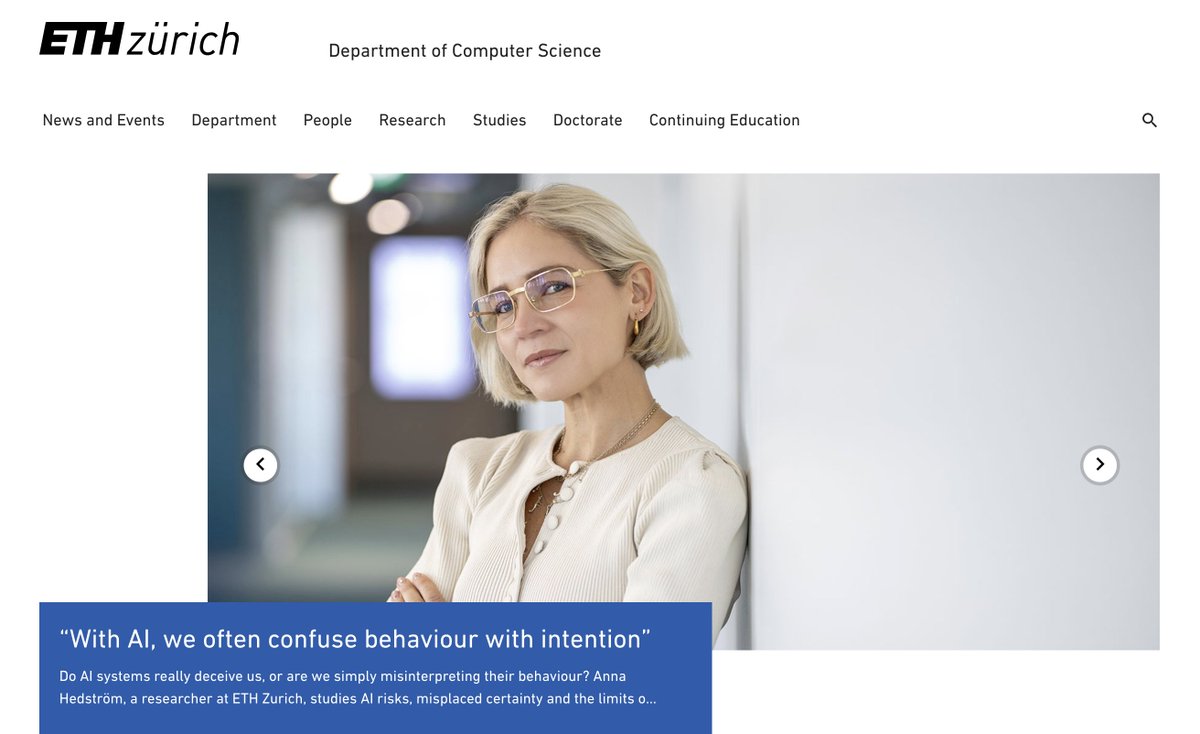
One of the co-leads of this project, @anna_hedstroem, gave an interview about our paper and many recent incidents. This interview article is quite well-written, and is now on ETH's Department of Computer Science's main site! I love how Anna not only touches on technical problems, but also broadly:
- AI safety is not just a technical problem: it also depends on social resilience, that is, how well our public institutions can absorb and recover from failures.
- As in aviation and medicine, reporting serious incidents [from companies] should not be optional.
- ... we also need neutral, third-party voices with the freedom to take the long view needed to build up a science of misalignment.
I hope every AI researcher can achieve a thoughtful interview like this one with Anna, not only on one's technical expertise, but also on deep reflections on their work's implications for society, and their theories of change.
https://t.co/CAOk9r3TcT
Excited to share that CryptanalysisBench has been accepted to NeurIPS 2026! See you guys in Sydney! 🦘
More info about the project here: https://t.co/gYqiLHDQlE
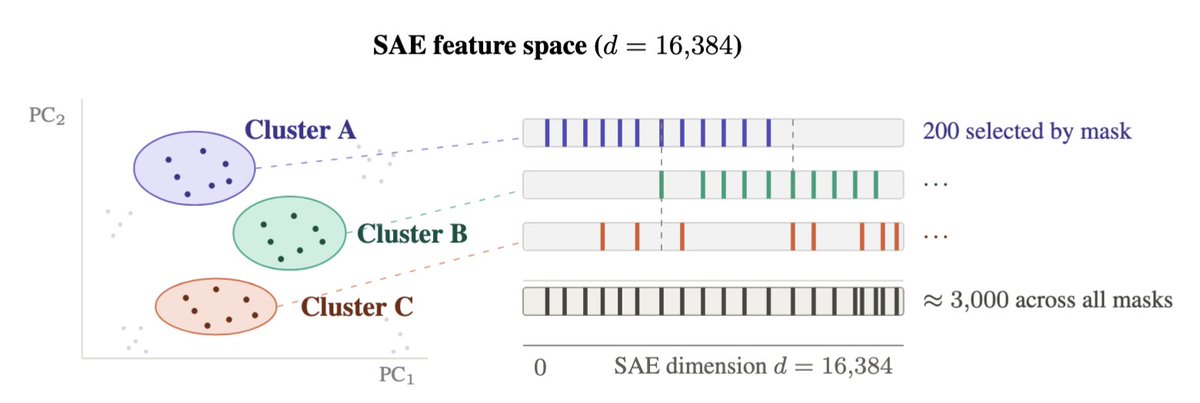
SAE can create low local dimensionality in the representation space, creating a vast opportunity for interpretability (better structural computation when dimensions are low, and one only needs to inspect ~1% of neurons across tens of thousands of SAE dimensions).
https://t.co/RZdqkpDkOx
I’m starting a blog! My first post is on how 3rd party embedded evaluators seem totally unsuited to addressing the problems we are currently facing, and what the real problem is.
https://t.co/clHrp7LkCy
I shared this tweet with my students, telling them that a publication at ICLR/ICML isn't a big difference, but having public records of submitting a low-quality paper can negatively affect their careers. In fact, after many years in one community, one can gradually tell who optimizes for numbers instead of quality. This is considered negative, and the names quite often come up in gossip! Don't be the person who gets negatively talked about, if you want to play the long-term game (i.e. your career) in research.
After the heated incidents in the past weeks and the noise that followed, for me, it all boils down to a principle almost too simple to state: safety evidence belongs in public.
1. We need to stop arguing about extinction or hidden agendas of frontier lab safety dropouts. It polarises the debate and diverts attention from the AI harms already happening (6,000+ reports in the AI incident database and counting)
2. We need more scientific evidence on what's circulating: how evaluation awareness and shutdown resistance arise, when sandboxes are escaped, which alignment methods work and where (across the full pre, mid and post-training pipeline including the harness)
3. We need radical transparency from the labs and open Europe-first infrastructure outside them (and no, open science and AI safety are not contradictory). Asking a for-profit lab to supply both the capability and safety is a conflict of interest
Our petition is open to sign and share: https://t.co/H5eemti0tQ
From data curation and pre-training to post-training and deployment-time interventions, including mechanistic methods and harness adaptations, safety can be targeted at multiple points in the LLM lifecycle.
The harder question is: at which stage are safety interventions most impactful?
Very excited to be organising a session around exactly this question with @valentina__py at the @ETH_AI_Center AI+X Summit.
Keynotes from @BlancheMinerva + @cervisiarius followed by a panel @jkminder, @XinCynthiaChen, @DubMagda, @thomasklbg + Guilherme Santos taking deliberately different positions
Oct 1 in Zurich :) https://t.co/tZOY3AZmtg
📢Staging x Misalignment Science: When, Where and How Safety Enters LLM Training
@anna_hedstroem and I are co-organizing a workshop at this year's AI+X Summit in Zurich to discuss where in the LLM training pipeline safety is actually decided, and with which methods? This session explores that question across: data filtering and curation, pre-training, post-training, evaluation, mechanistic interpretability, deployment, and runtime security; from both academic and industry perspectives.
We will start with two keynotes by @cervisiarius and @BlancheMinerva and then continue with a panel that brings together researchers who take deliberately opposing positions on when, where and how safety should be built in.
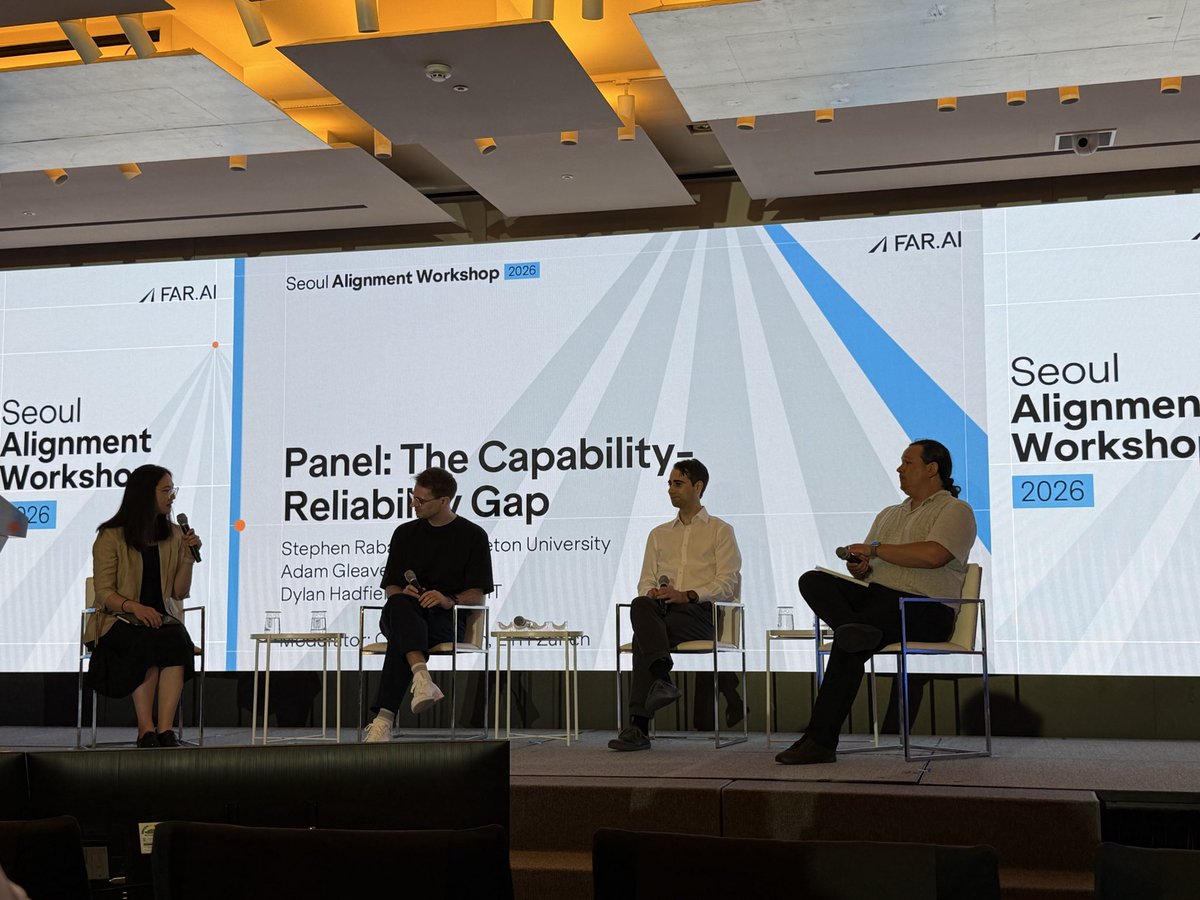
Day 0 at @icmlconf and https://t.co/lKMg1Rf1ul alignment workshop sets a high bar!
A full day of insightful conversations on reducing AI risk + predictable mech interp and an honour to moderate the lightning talks @farairesearch ✨
With the @ETH_AI_Center team: @arkrause@XinCynthiaChen@LukasFluri_ etc
The week is only just getting started in Seoul.
See you tomorrow: Oral 2C AI Safety & Alignment, Hall D2, Tue 7 Jul, 1:30 p.m.–2:30 p.m. KST https://t.co/zCnrQ8BQ79
As frontier models become more capable, are our scientific standards of evidence in AI safety keeping up?
I couldn't be more excited to share that our recent paper, Position: Anthropomorphic Misalignment Research Needs Stronger Evidence, was selected as an Oral (top 0.7%) at ICML 2026!
We argue that many claims about deception, shutdown resistance and emergent misalignment need stronger evidential foundations before informing deployment and policy decisions. One striking example: probes designed to detect "deception" also fired on "medieval peasants", "recital" and "sarcasm", suggesting that we may unreliably be measuring surface-level cues rather than true deceptive intent.
Paper: https://t.co/f8JGD9XNGg
Incredibly talented co-authors: Vansh Gupta, @PeterNutter1, Samuel Stante, @arkrause, @florian_tramer, @LukasFluri_, @XinCynthiaChen
🇰🇷 See you in Seoul!
Tue, Jul 7, 2026 • 5:30 AM – 5:45 AM BST HALL D2
@ETH_AI_Center
Excited that our ICML position paper has been accepted as an Oral 🎉!
When a model looks like it "deceives" or "resists shutdown," how do we know it isn't role-play, instruction-following, or just task-completion pressure? Often the current evidence can't yet tell them apart, and those claims are starting to inform deployment and regulation.
We map where the evidence gets thin across four stages and propose a shared standard to strengthen it. Here's the map.
🧵
https://t.co/gzM8mLGB5P
Almost forgot to share — last month, I defended my thesis, with distinction!
Feeling deeply grateful for the learnings, collaborations and friendships along the way.
New chapter at @ETH_AI_Center 🚀
🔊 Not to miss …. last month @anna_hedstroem defended her PhD “Evaluation-centric advances in neural model interpretability” at TU Berlin — with distinction! ✨🧠💻☕️
Here’s a thread of a selection of Anna’s evaluation-centric interpretability work + what comes next. 🧵
Happy to share that our PRISM paper has been accepted at #NeurIPS2025 🎉
In this work, we introduce a multi-concept feature description framework that can identify and score polysemantic features.
📄 Paper: https://t.co/7HE1JGhnvD
#NeurIPS#MechInterp#XAI
🎉 Huge congratulations to @kirill_bykov, the very first PhD student of our lab, who successfully defended his thesis “Explaining Representations in Deep Neural Networks” this Monday with summa cum laude! 👏
🧵 In the next tweets, we’ll highlight some of his key works:
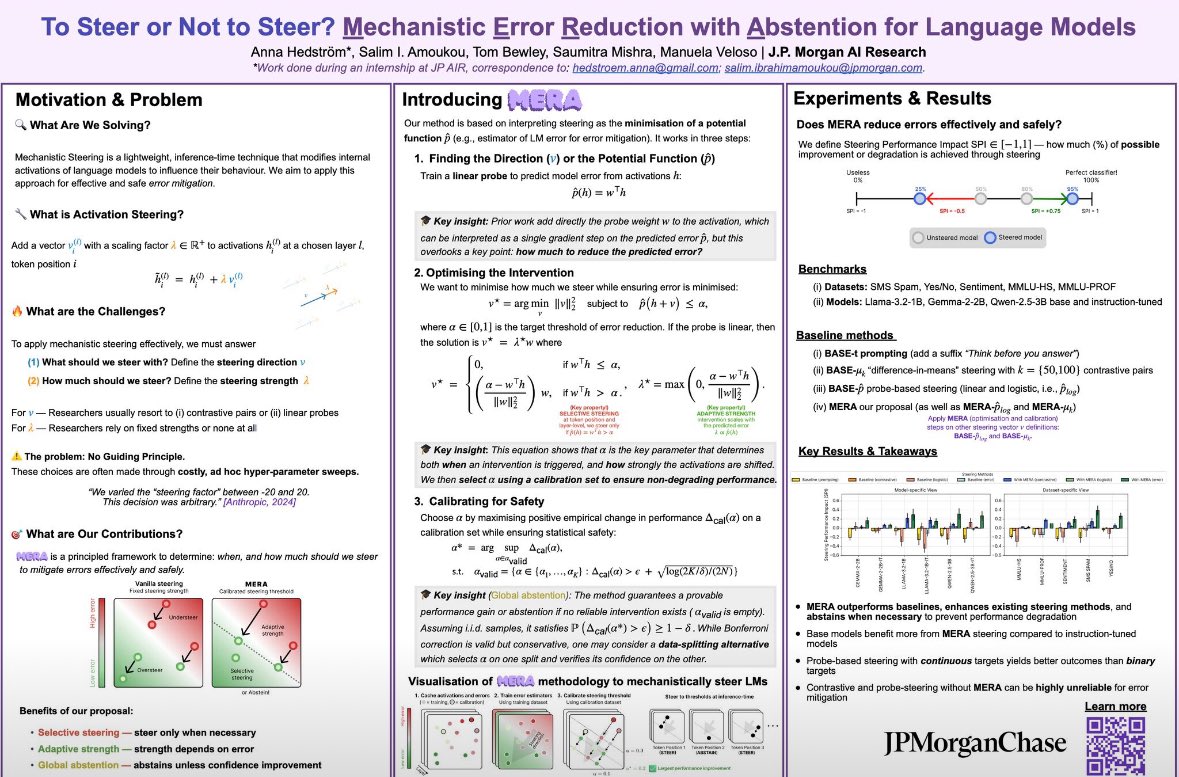
My brilliant co-author @salim_amk0 is presenting our work on Mechanistic Error Reduction with Abstention (MERA) now at ICML in Vancouver! 🚀
If you’re at ICML, come by East Exhibition Hall A-B, E-2605 at 4:30 pm (Vancouver, BC).
We’d love to hear what you think!