What if the way we communicate is shaped by a hidden harmonic rhythm?
In our #ACL2025NLP paper, we explore the hypothesis that the components of the information contour of a document vary periodically, with periods that correspond to the boundaries of structural units.
Are transformer LLMs Turing complete or not?
Spoiler: they are! @franz_nowak@AnejSvete@butoialexandra@RyanCotterell proved it for CoT LLMs in their paper.
We talk with Franz about the expressivity of Transformer encoders, decoders with CoT, and RNNs.
📺https://t.co/Cn6HIgn0Lp
Check out our #NAACL2024 paper showing how RNN Language Models can simulate Probabilistic Finite State Automata! https://t.co/iAUomQqpvj
With @AnejSvete, Anisha Mohamed Sahabdeen, and @ryandcotterell
✨How do LMs learn grammatical phenomena? Do they rely on co-occurrence patterns during training, or can they make grammatical judgments based on indirect evidence as well?
Through Filtered Corpus Training (FiCT) we are able to answer these questions at scale!
🧵
I am excited to share our #ACL2024 main paper, "What Languages are Easy to Language-Model? A Perspective from Learning Probabilistic Regular Languages".
📖 Link: https://t.co/wsI5asBQpQ
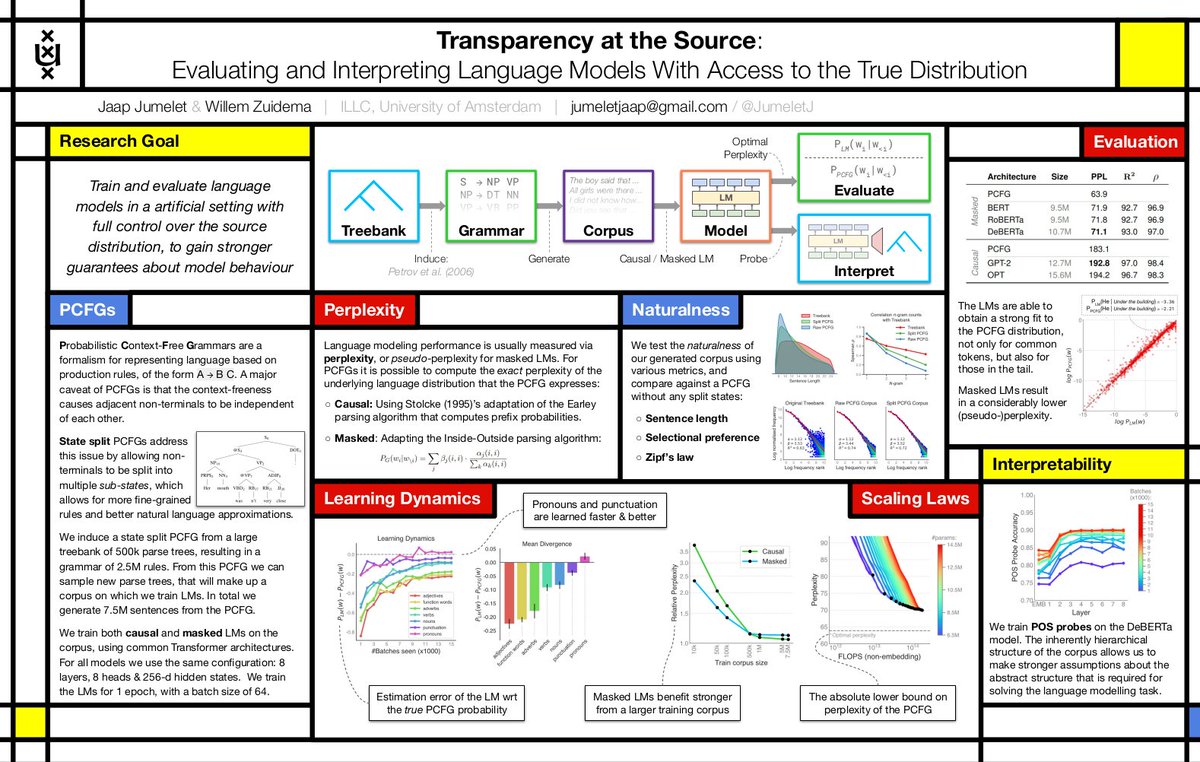
How can we faithfully test interpretability methods in an environment that's reflective of natural language?
We approach this via large-scale PCFGs from which we sample corpora that provide full control over the source distribution!
I'll present this Findings work @BlackboxNLP!
@_florianmai Yes, the main idea of having an adaptive number of steps between outputs is the same, if no hard upper limit is set. However, note that ACT interpolates outputs and hidden states by "halting probabilities" in a way that is at odds with simulating PTMs using our construction.
🤖 Ever wondered what RNN-based language models are truly capable of? Check out our #EMNLP2023 paper which places formal bounds on their capabilities! With @AnejSvete, @leoduw, and @RyanCotterell (1/7)
https://t.co/CwBl9Klyhh
📊 We show that a lower bound of the capabilities of RNN language models is that they can simulate multi-tape real-time Turing machines. With this, we delimit the capabilities of RNN language models in terms of theoretical models of computation. (7/7)
🔬 Since, in practice, this is not how most language models operate, we treat this as an upper bound on their expressivity. We also investigate the more realistic case of RNN language models having to output a word at each time step. (6/7)