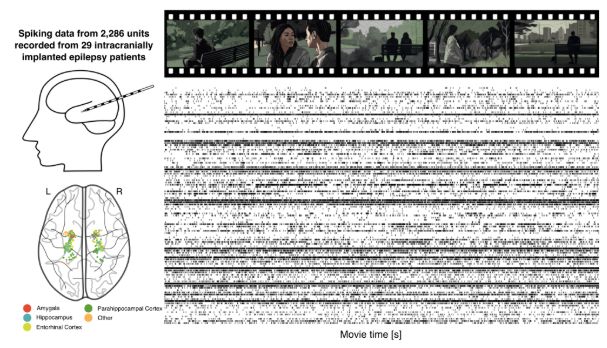
🎉 Extremely excited to share our human single neuron + movie dataset is out in #ScientificData!
📄 Human neuron activity during an 83-minute movie from 2,286 neurons and 29 patients
🔗https://t.co/IX744Qod65
1st public dataset from @humansingleneuron.bsky.socia!🧵
🎉 Extremely excited to share our human single neuron + movie dataset is out in #ScientificData!
📄 Human neuron activity during an 83-minute movie from 2,286 neurons and 29 patients
🔗https://t.co/IX744Qod65
1st public dataset from @humansingleneuron.bsky.socia!🧵
A huge thank you to all the patients who agreed to watch this 2009 gem of millennial culture, with big thanks to @alanadarcher.bsky.social @humansingleneuron.bsky.social, @jakhmack , and @lealtaixe for their support! 🙌
⭐🚨 Tweeprint! 🚨⭐
Very excited to present my & @AlanaDarcher’s PhD research!
What happens in your brain when you watch a movie?
How is the information underlying the movie’s content distributed across neurons?
https://t.co/HiAoNhvwcj
Both spike & movie frames are highly correlated with themselves, which can allow networks to cheat a bit.
Randomly selecting train/val/test samples gets ~100 prediction. As we introduce “buffers” between sets (aka ignore samples), we find that the performance plateaus at ~30.