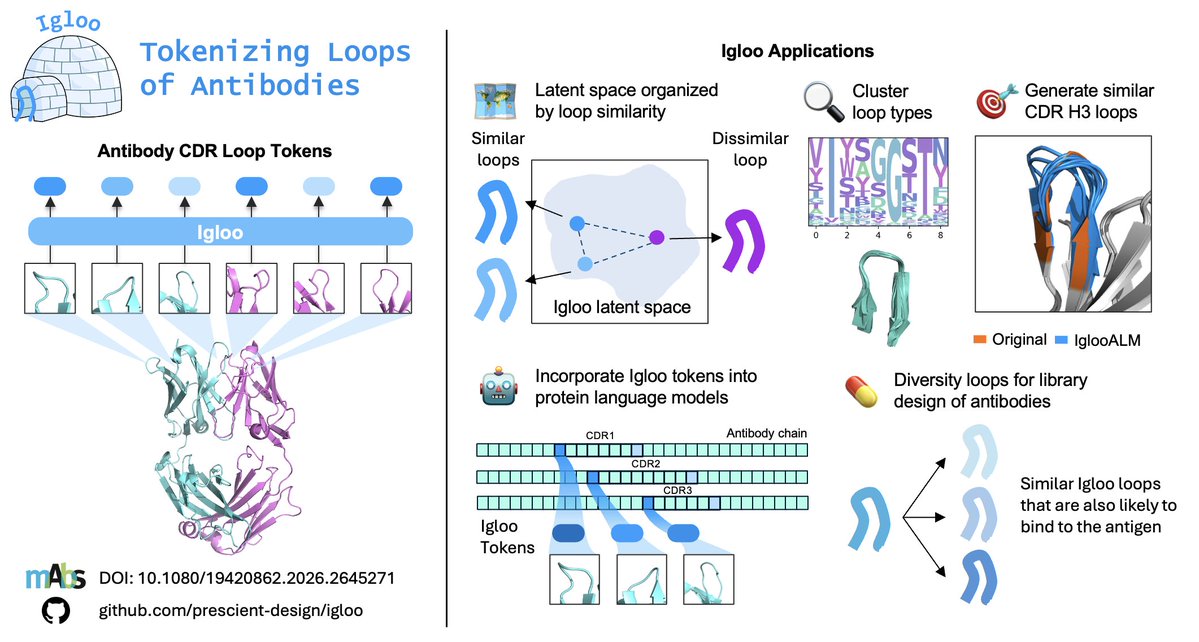
Tokenizing loops of antibodies has now been published in mAbs!
Antibody loops are critical for binding, but hard to design. Our tokenizer, Igloo, learns multimodal tokens that capture sequence, structure, and similarity to other loops.
Igloo can be used to:
🔍 retrieve similar loops for library design
🎯 generate similar CDR H3 loops
🤖 plug into protein language models
🧪 boost predictions of variant effects on binding affinity
💊 Diversity loops for library design of antibodies
Link to paper and github below.
Big thanks to:
@frdreyer Rob Alberstein, and Simon Kelow
@genentech
Where are all the de novo designed therapeutics? In a guest post by @frdreyer, we break down what the actual bottlenecks, challenges, and opportunities are in building and deploying purely in silico drug discovery engines, with a focus on antibody structure.
Link below 👇
@prof_ajay_jain@sokrypton@wpwalters@ProteinBoston Their diffdock-L update is almost a year old at this point. Really would be more interesting to see this kind of benchmark with AF3, Boltz-1, Chai-1 instead since this is where the field has already moved to.
@prof_ajay_jain@sokrypton@wpwalters@ProteinBoston Being delayed doesn't really absolve one from due diligence that what you are putting out is an accurate assessment of the current state of the art. You also ignored our paper from September that already showed similar performance gaps with classical docking.
If Elizabeth Gardner (https://t.co/BMOgonORz4) had not passed away so prematurely, she might have been among the nominees for yesterday’s Nobel Prize in Physics. Let’s remember her pioneering contributions to the study of neural networks.
My co-authors and I are pleased to share our latest work on paired antibody language models, where we trained the largest open-source antibody-specific models to date on over two billion sequences from the Observed Antibody Space.
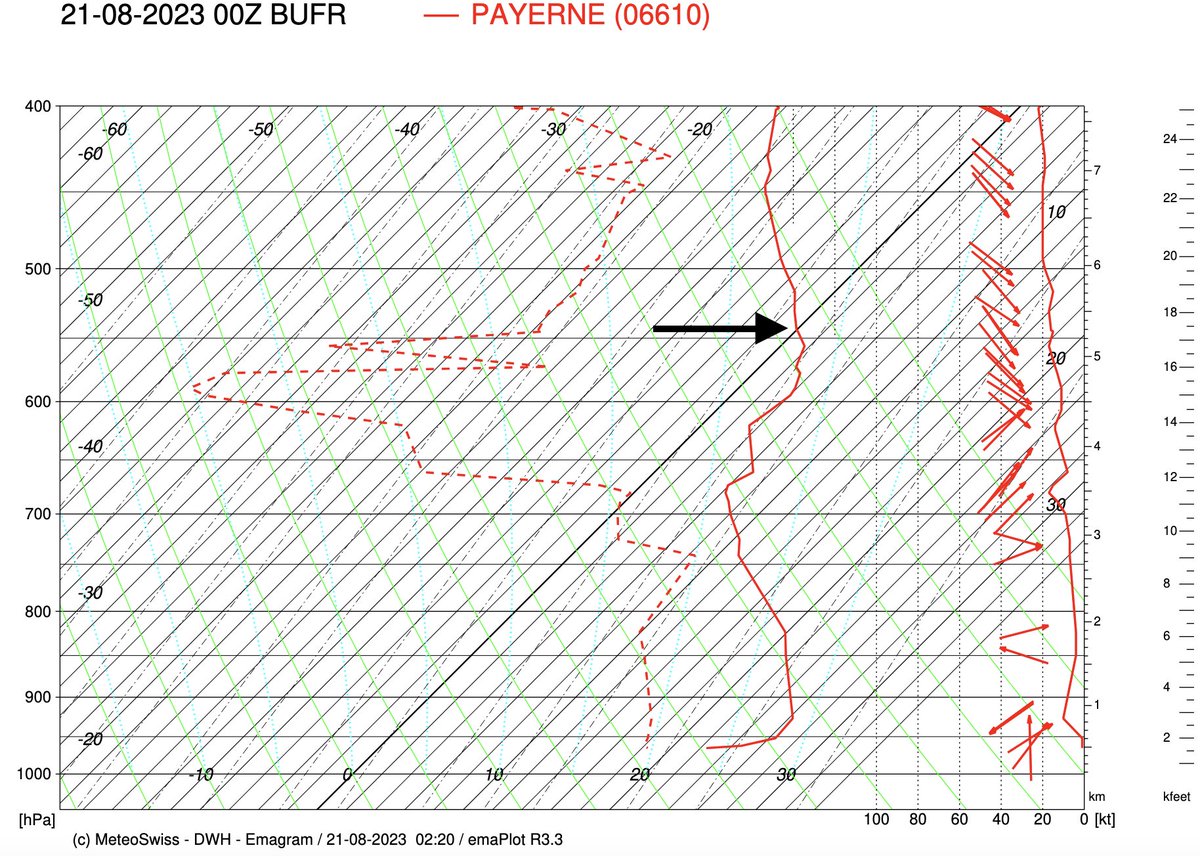
Rekord! Noch nie wurde mittels Ballonsondierung eine so hohe Nullgradgrenze ermittelt wie heute früh. Gestartet wurde der Wetterballon in Payerne, die Nullgradgrenze war auf 5298m (schwarzer Pfeil), bisheriger Rekord wurde somit deutlich übertroffen (5184m, 25.07.22). (me)
A startlingly beautiful image that has just been published @CERN was inspired by an algorithm proposed by Prof Gavin Salam & Dr @frdreyer from the Rudolf Peierls Centre for Theoretical Physics at @UniofOxford along with collaborator Gregory Soyez from @UnivParisSaclay in 2018.
Is #AI generated text biased towards protected groups? In a new @OxfordAI paper, we look at occupational biases for gender intersectionality with religion, sexuality, political affiliation...Why does #GPT-2 think women are maids not computer programmers?
https://t.co/LOLJFRCo7B
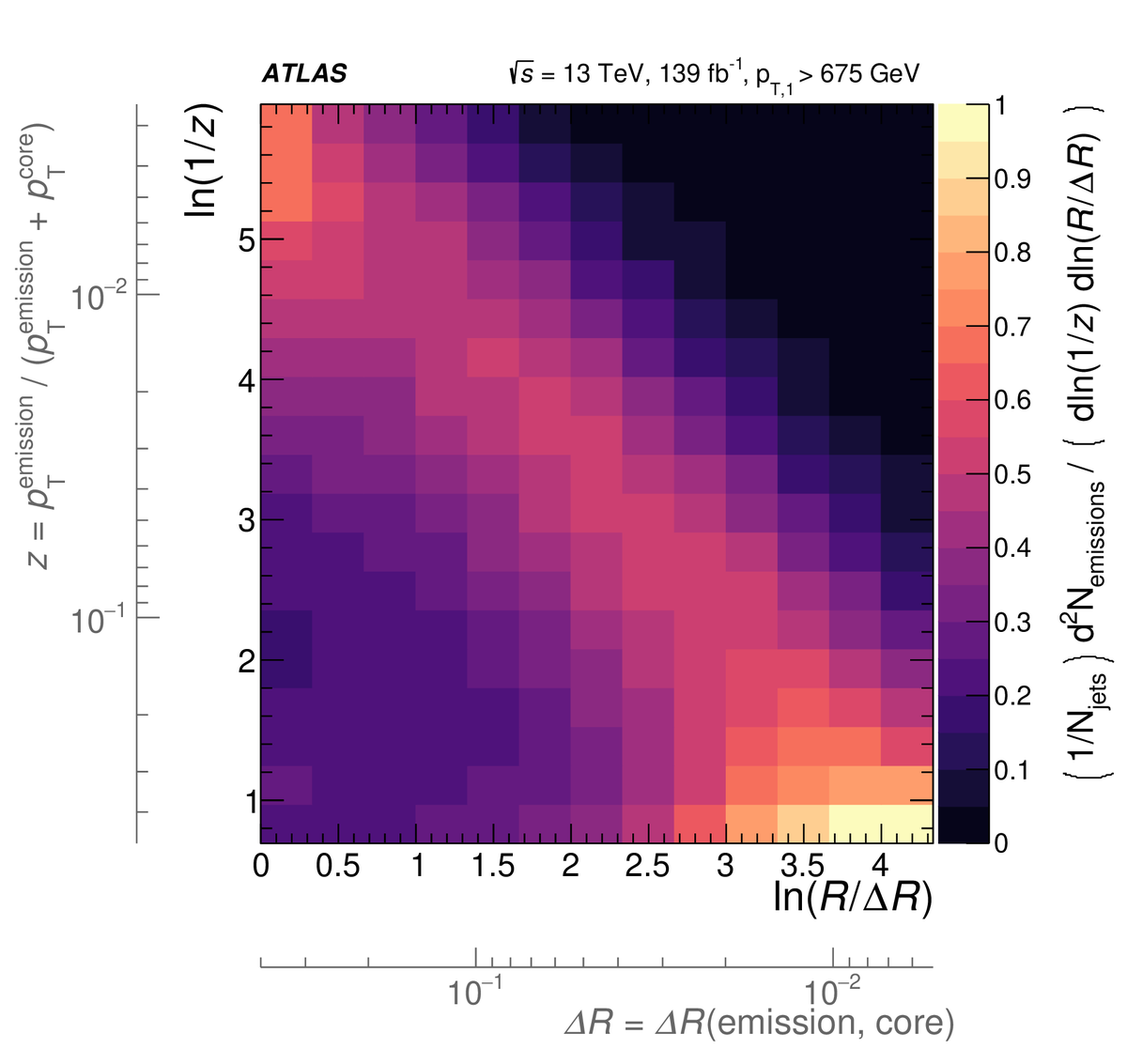
New physics briefing! ATLAS performs novel tests of the strong force 🏋️♀️, applying recent advancements in the study of particle jets.
➡️Learn more about ATLAS' latest measurements of the jet substructure and the "Lund jet plane": https://t.co/n1rsQGBjMk
We can now read the Imperial College report on COVID-19 that led to the extreme measures we've seen in the US this week. Read it; it's terrifying. I'll offer a summary in this thread; please correct me if I've gotten it wrong.
https://t.co/AwE2cHIbeJ
To get a better feeling about dynamics of spreading disease and social distancing, go to this page, scroll to Immunity section and play with transmission rate slider:
https://t.co/SSogcfL2ki
A first application of image-to-image translation in particle #physics: using #machinelearning with cycle-consistent adversarial networks to transform images of jets.