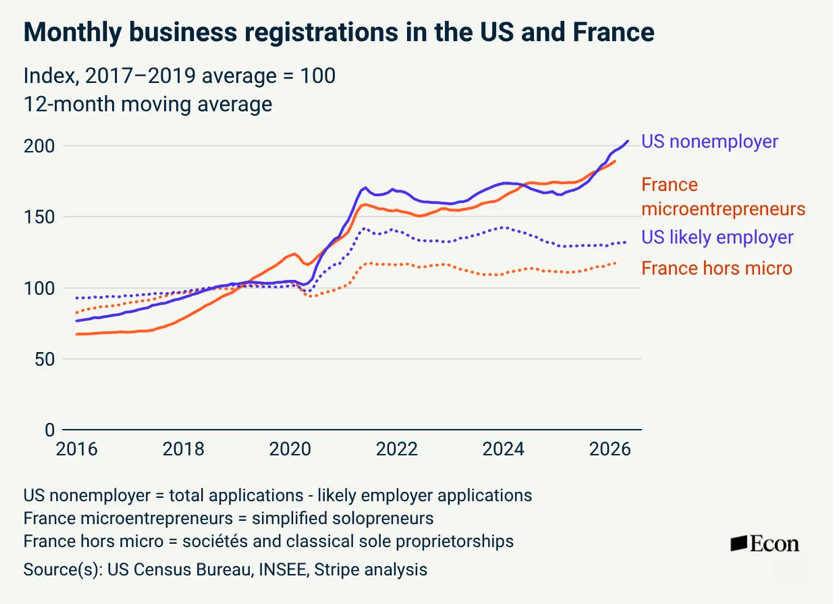
But what are these new businesses? The emerging consensus is that these are AI-driven 'solopreneurs' - one-person companies that are using AI to fill the gaps in their own skill sets. And as this great blog from @stripe shows, it's happening in France too https://t.co/wnQGwun5Gd
I’d always assumed that for chant development you need a critical mass (and density) of season ticket holders there every week. Most top tier US sports don’t afford this (too many games, too expensive, crowd from far away etc.). Obviously England don’t have that feature but (a) England chants also bad and (b) some chant transference from clubs (tunes, structures etc.)
✨ Announcing fast grants for British progress ✨
Have an idea for how to drive growth and progress in Britain? We’re making small grants for research, policy and other projects, with funding decisions in just two weeks. No academic affiliation required.
Need some prompting to start cooking? We’ve got a list of questions we’d love people to tackle - on topics like devolution, AI diffusion, financial regulation and more…
Apply here: https://t.co/VT8SXWF39A
More on why we’re doing this: https://t.co/AXasxE5mMY
Delighted to share that Frontier has raised an additional $915 million to accelerate the world’s best carbon removal companies.
https://t.co/23KDQRf5xC
New blog post: The third wave of American philanthropy
Hundreds of billions of dollars in new philanthropic capital will soon become liquid. The OpenAI Foundation holds 26% of OpenAI, worth about $220B at today’s valuation. Anthropic’s seven co-founders have pledged to give away 80% of their wealth and have instituted the most aggressive donor matching program for employees in tech history.
How much does this all add up to? And how meaningful is that in the context of philanthropy today?
I was doing some simple napkin math to wrap my head around the scale of what’s coming, and radicalized myself in the process. I had dramatically underappreciated the scale of the philanthropic capital that’s about to become available and the corresponding gap in talent and organizations that will be needed to make the most of it.
This piece aims to directionally sketch the scale of what’s coming, the gap in operational capacity needed to absorb it, and what we can do to fill it.
(Link to full post in reply)
New today on Stripe Economics: four of my favorite Sessions-related chart from this year.
Solopreneurs are multiplying. The SaaSpocalypse wasn't about current activity. And the Solow paradox suggests AI productivity gains may be ahead of us, not behind. /1
https://t.co/y71yZDuK6s
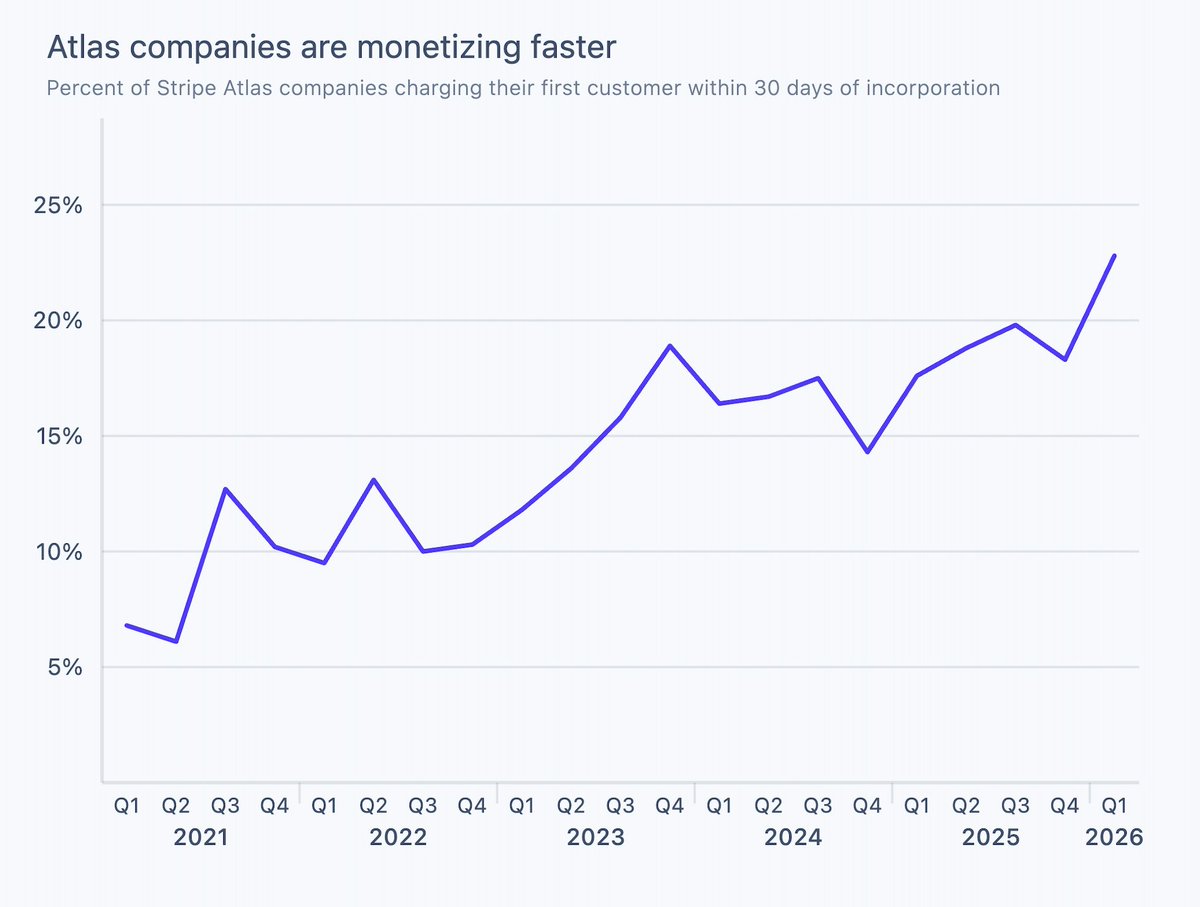
Atlas startups are monetizing faster.
Companies charging their first customer within 30 days of incorporation rose to an all-time high of 23%, 3x the rate in 2021.
I wrote an incredibly navel-gazing essay for the Institute of Economic Affairs about what I think, where my views come from, and how they have developed over time.
I actually wrote it a year ago, but it has come out today and I am so old that I have barely changed in that 12 months.
Learn:
- How I became a wild-eyed obsessive as a teen
- What ideology I consider myself to have
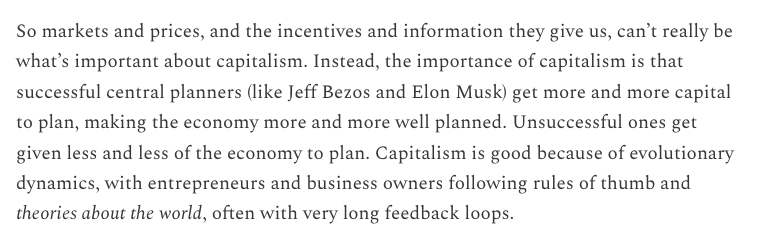
- Why I don't think that the difference between 'state' and 'market' matters all that much
- The reason I am obsessed with the infrastructure delivery mechanisms of the 1600s, 1700s, and 1800s
https://t.co/4e4tdauA7a
We’re seeing a structural increase in economic dynamism.
Economic data:
• US non-employer new business applications are up 24% YoY in the first quarter of 2026.
• The number of solopreneurs earning over $100,000 per year has increased a third since 2022.
• New business registrations are up 40% in Finland, 75% in France, 40% in the Netherlands.
Stripe data:
• @Atlas incorporations in the first quarter of 2026 were almost double the same period in 2025.
• As of the first three months of the year, our Atlas ‘2026 class’ is tracking (in aggregate) to 5x the revenue of the ‘25 class.
• Five years ago, 11.6% of companies on Stripe earned most of their revenue outside their home country. That number has since doubled to 22.9%.
• The top 100 AI startups on Stripe sell into a median of 55 markets within their first year. The median earns most of its revenue outside its home country.
"With AI we expect fewer people per firm, more output per firm, more firms, and more coordination happening through market-like mechanisms." – @emilygsands