We did it!
Absolutely thrilled to share the results of the ASPEN trial published today in @NEJM
Brensocatib(10mg and 25mg vs placebo) reduced exacerbations over 52 weeks and slowed lung function decline
A new treatment for bronchiectasis patients
https://t.co/u94U83zFk6
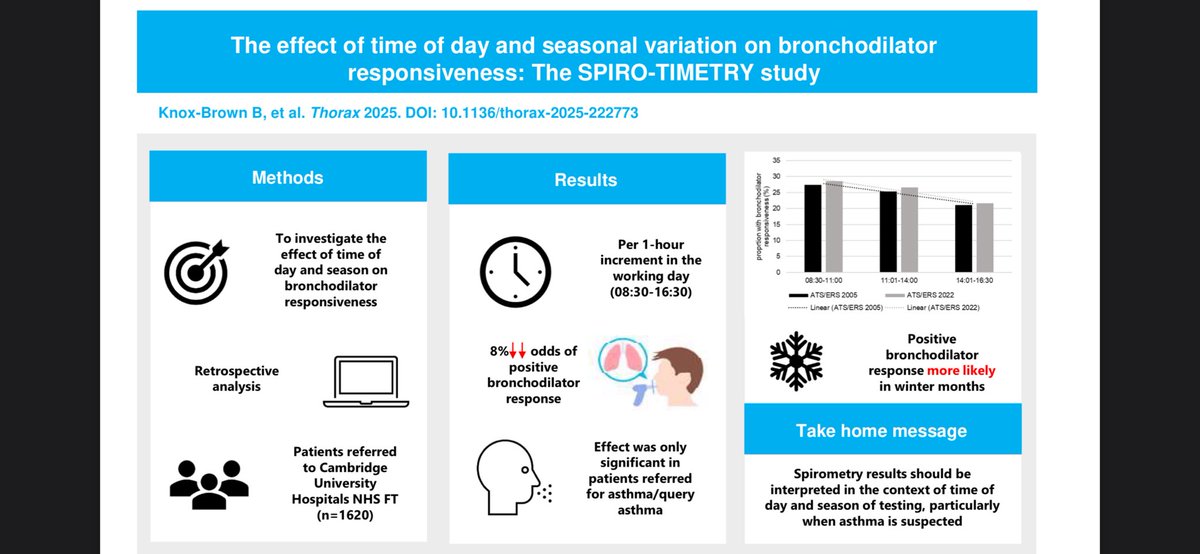
🫁 ⏰ When do you perform bronchodilator reversibility testing to help support a diagnosis of asthma?
We had a 👀 at the what effect time of day and season has on responsiveness @HLRI_Cambridge@CUH_NHS
Results published in @ThoraxBMJ today! https://t.co/G4xNsNzJAj
@AmieBurbridge@DrBenLovell Superb as usual. I rarely come on twitter now but needed to comment to show my appreciation for these excellent podcasts. I am learning so much; please keep doing what you’re doing!
New Episode out today!
We are back @DrBenLovell with a great Internal Medicine case that will get us all thinking.
Ben reminisces on his medical school years and I forget all the causes of clubbing 😄
Happy listening #MedEd#MedTwitter https://t.co/ciBjvHTncW
@KingsResp Argh histopathology! Will be honest and say the histo slides mean nothing to me 😬 Nevertheless I am going to opt for B Aspergilloma based on the history and description of the radiology which sounds like a mycetoma to me? 🤔
Some might remember my proposed education initiative to improve feedback and the general education experience for doctors in acute medicine last year.
Well, I have now been running the ‘feedback clinic’ for a year, and I wanted to share my learning/experiences
A thread about consultants about giving feedback. 🧵
Consultants: Have you ever looked at feedback from rotating doctors - either end of rotation surveys or GMC survey data - that highlight a lack feedback in your department?
And thought ‘but I give feedback all the time?!’ 🤨
For surgical history nerds:
Here is the main figure from Seldinger's 1953 paper showing what later became known as the Seldinger technique.
There seem to be 2 extra things that Seldinger did that most people probably don't do these days, as we'll see next:
(1/ )
A day late, but no less exciting, here is this week’s #ThoracicThursday#SCE style quiz question. We’re focusing on pharmacology! Not sure of the answer? Why not ask your friendly Respiratory pharmacist? Answers Sunday or Monday dependant on train wifi signals! #RespEd
The stethoscope is the image of medicine, a commonly used tool, and its importance in the field is immeasurable.
But what is its past, present, and future?
A short thread
Physicians! You need to know the figures from this study when you talk about lumbar puncture with your headache patient.
A negative CT means a low post-test probability. How many LPs do we need to do to identify one SAH? What will the patient accept? @acutemedicine