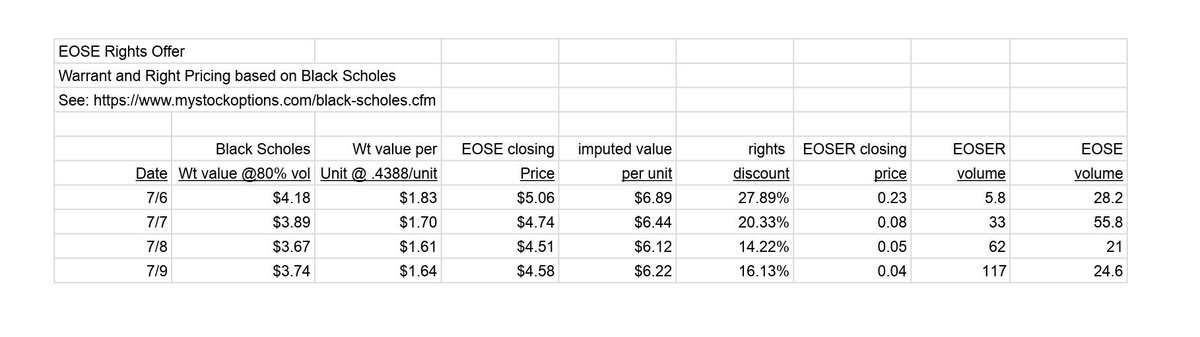
@todd_gleason@jfcBruin My spreadsheet is getting way too complicated. The one I share just compared the theoretical value via Black Scholes vs. the imputed value. A new version I’m working on brings in the price of EOSER and compares that market price based value to the theoretical value.
Interesting thesis to which I partially subscribe.
This makes it sound like a solution for existing shorts. But I think the trade has been for new shorts, buying ~14 rights to fully hedge their position and getting the kick of part of a warrant to boot. But, yes, some established shorts may see this as a way out.
Cutting against this theory are long bozos like me who have acquired six figure positions in the rights, and ain't giving them up. Also the volume on the underlying stock on this continued downtick has been an opportunity for shorts to cover. Any news on short lending levels to prove/disprove that?
If this theory is valid, we very shortly should see a flip to an upside bias-- we don't need to wait to see rights exercise for that to happen.
Nice work. Keep theorizing. Wen virtual roadshow? Wen orders? Wen rights offering amendment to juice it up?
@SpearfishingCap Agree on your rights offering timing. A key additional date will be how long it stays open: one week? two weeks? Only important because the shorts won't know until the conclusion how many warrants and shares were subscribed for and thus how many they will need to provide their stock lender. And like own situation at Fidelity, I believe a great many shorts must true up in "as issued" vs. a "cash mark to market" on the value of the warrants. I know of one desk who tries to stay perfectly hedged against the converts. Until the RO closes they won't know how big a hedge they need. Then there will be bozos like me buying warrants on a when issued basis even in excess of my allocation on a basic and over subscription.
I don’t think this is correct. Subscription rights will be distributed as a dividend. And just as cash dividends are owed to the stock lender, so will these subscription rights. My friend Claude agrees: “The Lender's Entitlement
Under standard securities lending agreements (such as those governed by the MSLA — Master Securities Lending Agreement — or the GMSLA internationally), the borrower (short seller) is generally obligated to "manufacture" or compensate the lender for any distributions or entitlements that arise during the loan period. This is because the economic benefit of ownership is meant to be preserved for the lender. Specifically:
•The borrower must pay the lender a cash equivalent of any rights distribution, or
•Return equivalent securities or entitlements, depending on what the agreement specifies.
This manufactured payment is meant to make the lender economically whole, as if they had never lent the shares.
Practical Complications with Rights
Rights offerings are more complex than cash dividends because:
•Rights have a subscription feature (the lender may want to exercise them, not just receive cash).
•Rights are often transferable and tradeable, adding a valuation question.
•The borrower may need to either purchase equivalent rights in the open market and deliver them, or pay cash equal to their value.
•If the rights are non-transferable, the borrower typically compensates the lender with the cash value of the rights.
Summary
Yes, the lender is economically entitled to the benefit of the rights — but not via direct receipt from the issuer. Instead, the borrower is contractually obligated under the securities lending agreement to compensate the lender for the value of those rights. The exact mechanics (delivery of rights vs. cash payment) depend on the terms of the lending agreement and whether the rights are transferable.”
Chris: I looked at a low res image of 45.6059, -119.5630 which is where ChatGPT tells me Sunstone is located. This is to the east of Bombing Range road and probably 15km south of I84. Slightly to the north of Pine City, and a good bit west. Does that sound right? In any event, not enough visible in the low res image to by a higher res image. sounds like you are still in the camp that feels this must still be an EOS prospect, as am I. It needs to be 6+ hours of duration that they always talked about.
$EOSE soil remains undisturbed at Camp Pendleton. if I wait for a cloudless day, when someone else must have requested the satellite path, the price ain’t so bad. Here’s a 50cm image from May 19th which set me back $27. This is eating into my transport to Sicily but I guess I have time to earn that back? Or I could start swimming now?
Claude and I have done a bit more noodling on the warrant coverage for this rights offering. It is clear as mud in the 8K:
"Rights Offering Participants are expected to be entitled to receive warrants (each a “RO Warrant”) to purchase a number of Eos Common Shares (such shares, collectively, the “RO WarrantShares”) equal to (a)(i) their respective subscription amounts, multiplied by (ii) 33% and divided by (b) a valuation per warrant to be mutually agreed to by CCM Frontier and the Company (whichwill be the same valuation used for determining the shares underlying the CCM Frontier Warrant described below), provided, however that in no event will such valuation result in pro forma dilution to the holders of Eos Common Shares, assuming each holder of Eos Common Shares fully subscribes to itspro rata share of the Rights Offering (such value, the “Applicable Value”)."
So we know each holder of 100 shares will get the rights to buy 5 shares. This is based on $150 million sought being 5% of the primary market cap of $3 billion (which seems to change every moment as Frontier USA makes more announcements.) But how many warrants would be included?
At 80% of the Weighted Average price, assumed as $8= 80% of $10, the subscription price for 5 shares would be $40. Apply the 33% haircut to the subscription amount and you get $13.20. But we must then divide that by an "applicable value" agreed by Cerberus and EOS. I think the warrants would be valued with the Black Scholes model which gives a very rich price of $6.50/warrant given the 10 year tenor and high volatility. so 13.20 divided by $6.50 is about 2 warrants to every EOS holder of 100 shares.
I'm eager to receive rights to buy 5 shares and 10 year warrants to buy another 2 shares, for every 100 shares of EOSE I currently own. Sorry for all the verbiage which may go out the window when we see an S1 prospectus which I bet drops June 4, after the numbers from the shareholder vote on June 3 can be dropped in.
@bert_gilfoyle $eose I've been through a couple of rights offerings and think this one will be similar. have copied Bert on this since this differs on some of his numbers and amplifies others.
The company is raising $150 million from this rights offering, or about 5% of our current market cap, based on primary not fully diluted shares outstanding, of about $3 billion. That means that each shareholder of 100 shares will receive 1 "unit" consisting of a right to buy five shares and about 1.6 10 year warrants to buy other shares. See the 8K for details sparse though they are: https://t.co/RxwRh9O6wj Language there is a bit odd on the number of warrants so that number may be off. My reading has both the share price and warrant exercise price at 80% of the pre-rights offering stock weighted average stock price.
I would expect this will be done via an S1 prospectus which will only drop once the shareholder vote is done. In past rights offerings, the "unit"- consisting of rights to purchase shares and the warrants- has been granted a "when issued" trading symbol, as have the warrants themselves. I suspect there will be a massive runup on the warrants as short sellers have to make their stock lender whole for this new distribution. Same requirement for a short seller, who owes dividends received to the stock lender. These rights will likely be distributed to us as a dividend.
Finally, rights offerings like this typically have a basic and an over subscription. That is you can subscribe to your basic pro-rata. But you may also indicate the amount you'd be willing to do in an "over subscription" so the company can make sure the whole $150million is subscribed. In other rights offerings, you've been able to "strip" the unit and sell either the when issued shares, or the when issued warrants. But we wouldn't want to do the latter and make the shorts lives easier.
Devil is in the details. And the upcoming S1. I've definitely voted "yes" on this particular share increase. This should be fun. Good luck to all.
@bert_gilfoyle $eose I've been through a couple of rights offerings and think this one will be similar. have copied Bert on this since this differs on some of his numbers and amplifies others.
The company is raising $150 million from this rights offering, or about 5% of our current market cap, based on primary not fully diluted shares outstanding, of about $3 billion. That means that each shareholder of 100 shares will receive 1 "unit" consisting of a right to buy five shares and about 1.6 10 year warrants to buy other shares. See the 8K for details sparse though they are: https://t.co/RxwRh9O6wj Language there is a bit odd on the number of warrants so that number may be off. My reading has both the share price and warrant exercise price at 80% of the pre-rights offering stock weighted average stock price.
I would expect this will be done via an S1 prospectus which will only drop once the shareholder vote is done. In past rights offerings, the "unit"- consisting of rights to purchase shares and the warrants- has been granted a "when issued" trading symbol, as have the warrants themselves. I suspect there will be a massive runup on the warrants as short sellers have to make their stock lender whole for this new distribution. Same requirement for a short seller, who owes dividends received to the stock lender. These rights will likely be distributed to us as a dividend.
Finally, rights offerings like this typically have a basic and an over subscription. That is you can subscribe to your basic pro-rata. But you may also indicate the amount you'd be willing to do in an "over subscription" so the company can make sure the whole $150million is subscribed. In other rights offerings, you've been able to "strip" the unit and sell either the when issued shares, or the when issued warrants. But we wouldn't want to do the latter and make the shorts lives easier.
Devil is in the details. And the upcoming S1. I've definitely voted "yes" on this particular share increase. This should be fun. Good luck to all.
@bert_gilfoyle $eose I've been through a couple of rights offerings and think this one will be similar. have copied Bert on this since this differs on some of his numbers and amplifies others.
The company is raising $150 million from this rights offering, or about 5% of our current market cap, based on primary not fully diluted shares outstanding, of about $3 billion. That means that each shareholder of 100 shares will receive 1 "unit" consisting of a right to buy five shares and about 1.6 10 year warrants to buy other shares. See the 8K for details sparse though they are: https://t.co/RxwRh9O6wj Language there is a bit odd on the number of warrants so that number may be off. My reading has both the share price and warrant exercise price at 80% of the pre-rights offering stock weighted average stock price.
I would expect this will be done via an S1 prospectus which will only drop once the shareholder vote is done. In past rights offerings, the "unit"- consisting of rights to purchase shares and the warrants- has been granted a "when issued" trading symbol, as have the warrants themselves. I suspect there will be a massive runup on the warrants as short sellers have to make their stock lender whole for this new distribution. Same requirement for a short seller, who owes dividends received to the stock lender. These rights will likely be distributed to us as a dividend.
Finally, rights offerings like this typically have a basic and an over subscription. That is you can subscribe to your basic pro-rata. But you may also indicate the amount you'd be willing to do in an "over subscription" so the company can make sure the whole $150million is subscribed. In other rights offerings, you've been able to "strip" the unit and sell either the when issued shares, or the when issued warrants. But we wouldn't want to do the latter and make the shorts lives easier.
Devil is in the details. And the upcoming S1. I've definitely voted "yes" on this particular share increase. This should be fun. Good luck to all.
$eose a great term in today’s NYTimes: Bragawatt. https://t.co/b1EaeVBCJw
“One way for a company to stand out — or to intimidate the competition — is to boast, often without evidence, about how much power it has access to.”
$eose a great term in today’s NYTimes: Bragawatt. https://t.co/b1EaeVBCJw
“One way for a company to stand out — or to intimidate the competition — is to boast, often without evidence, about how much power it has access to.”
@DesignClimate@nav7634 $eose And just in case there’s any question of which zinc they are talking about, here’s the pic referenced in the quote above as figure B6:
$eose Sunstone is one of the biggies I’m watching. Would expect an announcement in the 2Q. Amazon didn’t plunk down $83mm to buy it out of bankruptcy, just to sit on it.
here’s from the 2023 application where they are very clear that zinc is one of the choices for this 7,200Mwh battery:
“Zinc batteries are powered by a zinc hybrid cathode and allow for a full 3- to 12-hour discharge
period. Compared to Li-ion batteries, zinc battery systems do not require HVAC or fire suppression
systems, because they are able to operate across a higher range of temperatures and have a lower
fire risk. Zinc batteries are estimated to have a lifespan of at least 20 years with a milder
degradation rate than is typical for Li-ion batteries. Similar to Li-ion, zinc batteries can also smooth
fluctuations in energy generation to better match daily power consumption patterns.
Zinc-based energy storage systems are also provided in outdoor rated, modular, metal container-
based units (see Figure B-6 for an illustration of a zinc battery storage system). The smallest
indivisible unit of the system is a battery module, typically with 12 modules per string, and 12
strings per container (144 battery modules/container). A modular container can discharge 116
kilowatts of power, and 700-kilowatt-hour in energy. For this Facility, a quantity of 14,946 zinc
battery containers would be installed to meet the nameplate capacity. In the layout shown on
Figure C-2 in Exhibit C, the battery energy storage system is depicted with 14,946 containers total,
which is considered”
See https://t.co/VrvkyFaOdx
@eose@JigarShahDC Good Bloomberg article on natural gas and batteries for data centers: https://t.co/5ZPKJwiqmY They miss what Jigar has said, and what was in this weeks EOS whitepaper: that the 10% to 50% power cycles five times per minute will tear up a Lithium battery, and would demolish a stand alone gas turbine.